
Buick Skylark Coupe 2D buyer's guide
Buick Skylark Coupe 2D -- the model's own buyer's guide: variants, values and what to check.
Years listed: 1963-1970 · Series: GS
Overview and history
The Buick Skylark coupe is not one car. It is two quite different cars wearing the same name in the same decade, and telling them apart is the first skill a buyer needs. The first Skylark coupe, built for 1961 to 1963, is a compact: a top-trim version of Buick's Special, on General Motors' Y-body platform shared with the Oldsmobile F-85 and Pontiac Tempest, powered in most cases by a small all-aluminium V8. The second, built from 1964 to 1972, is the car nearly every buyer means by the name: a mid-size coupe on GM's A-body platform, sharing its basic shell and chassis with the Chevrolet Chevelle, Pontiac LeMans and Oldsmobile Cutlass, but with Buick engines, Buick trim and a Buick ride. Almost everything in the listings pool behind this guide — cars from 1963 through 1972 — belongs to one of those two families, and the 1964-on A-body cars dominate it.
The name began as a flagship: Skylark started in 1953 as a limited-production convertible for Buick's fiftieth anniversary, returned briefly in 1954, then disappeared until Buick revived it for 1961 on the new compact Special. That car was the dressed-up Special — better trim, a standard V8 where lesser Specials made do with a V6 — and for 1962–63 it settled in as the compact Buick for people who wanted a small car without a small-car cabin.
The break came for 1964. GM's new A-body intermediates replaced the compacts, and the Skylark moved up a size class in every dimension that matters: a longer 115-inch wheelbase, a proper perimeter frame, coil springs all round, room for five adults, and — crucially — room under the bonnet for Buick's big V8s. That last point created the car's second life. In 1965 Buick offered the Gran Sport option on the Skylark, installing the 401-cubic-inch nailhead V8 from the full-size cars, and the Skylark GS spent the rest of the decade as one of the most effective and most understated muscle cars in America, culminating in the GS 455 and the Stage 1 package of 1970. Through all of it, the ordinary Skylark and Skylark Custom coupes sold alongside as quiet, comfortable, well-finished cars — which is why the name covers everything from a six-cylinder post coupe bought for economy to a Stage 1 hardtop bought for war.
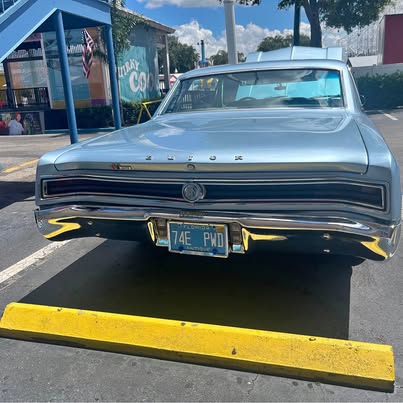
Styling divides the A-body run into three acts. The 1964–65 cars are crisp and upright. The 1966–67 cars are longer-hooded and more sculpted, the Coke-bottle shape at its most elegant. The 1968–72 cars share the rounded, semi-fastback shell GM used across all four divisions, restyled in detail each year — the 1970 cars the cleanest of that group, the 1971–72 cars carrying lower-compression engines throughout.
Why buy one now, against a Chevelle or a GTO from the same platform? Three reasons. The Buick engines are torquier, quieter and happier at low revs; the cabins are genuinely better finished, especially in Skylark Custom form; and the market prices the Buick a step behind the equivalent Chevrolet or Pontiac, so the same money buys a better-sorted car. The counterweight is that Buick-specific parts, trim especially, are thinner on the ground, and badges, engines and even whole front clips swap readily within the A-body family — so identity checks matter.
One honest caution about evidence: the cars we have photo-checked in detail for this specific coupe pool number just 2, with no rust, smoke, leak or damage mentions recorded in either set. That sample is far too small to generalise from — the survival knowledge here comes from the wider A-body and Buick record, and you should inspect any individual car as if no statistics stood behind it.

The models
Start with the body, because on a Skylark coupe the word coupe covers two shells. The two-door sedan, often called the post coupe or pillared coupe, has a fixed window frame and a thin B-pillar; it was the cheapest coupe in the range, the lightest, and the stiffest. The two-door hardtop, sold as the Sport Coupe, has no B-pillar: wind the front and rear side glass down and the side of the car is one open span, with a lower, sleeker roofline. Hardtops outsold post coupes, carry the premium today, and are the leakier, rattlier shell fifty years on — the pillarless glass seals against rubber and chrome rather than a frame, and every seal in that chain is now old. A convertible exists in the same range but sits outside this guide's coupe pool.
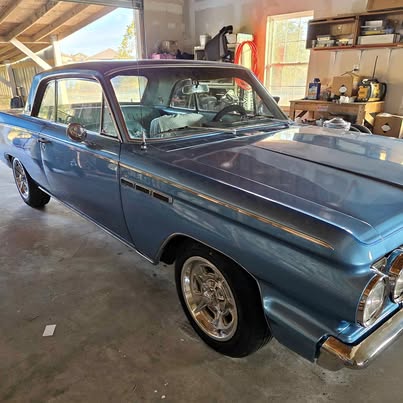
1961–63: the compact cars. The Skylark was the top Special: standard equipment was the 215-cubic-inch aluminium V8, with the 198-cubic-inch Fireball V6 — a Buick design, and one of the first production V6s in America — appearing on the cheaper Specials rather than the Skylark proper. Trim is bright, cabins are compact-car simple by Buick standards, and the cars are narrow and light by later standards. A genuine 1963 car is the blue coupe pictured above: three ventiports, horizontal lamps, and a scale that looks a class smaller than any 1964-on car parked beside it. These early cars are bought for charm, rarity and the aluminium engine, not for speed or for parts ease.
1964–65: the first A-body cars. The Skylark and Skylark Custom coupes arrived with the 225 V6 as the base engine, the new 300 V8 above it, and the Custom adding plusher trim, more brightwork and better seats. Mid-1965 brought the Gran Sport option — initially a package on the Skylark, with the 401 nailhead, a heavy-duty frame and suspension, and minimal exterior identification. A 1965 GS is identified by its engine and its paperwork, not by stripes: most wear small Gran Sport badges and nothing else.
1966–67: the GS becomes a series. For 1966 the Gran Sport stood alone as the GS 400, with its own 400-badged version of the nailhead. For 1967 Buick split the line: the GS 340, using the new small-block 340 V8, and the GS 400, now powered by Buick's all-new big-block 400. Ordinary Skylarks continued with the V6, the 300 and then the 340 as their V8 ladder. These two years are the stylist's pick of the whole run.
1968–69: the rounded body. The new shell brought a shorter 112-inch wheelbase on two-doors, a new Buick 350 replacing the 340, a Chevrolet-sourced 250 six as base engine, and the GS line renamed GS 350 and GS 400. The Stage 1 package — hotter camshaft, bigger valves and carburation, freer exhaust — appeared on the GS 400 for 1969 and turned a fast car into a genuinely quick one.
1970–72: the 455 era and the fade. For 1970 the big-block grew to 455 across the GS range, the GS 455 Stage 1 became the flagship, and the limited GSX package added stripes, a rear spoiler and heavy-duty equipment. From 1971, compression fell across every engine for low-lead fuel, outputs dropped, and the GS shrank toward an appearance-and-handling package by 1972, though a 455 could still be ordered. The Skylark name continued on other platforms after 1972, but those cars are outside this guide's pool and scope.
| Model | Years | Engine | Output | Character |
|---|---|---|---|---|
| Skylark (compact) | 1961–1963 | 215 cu in aluminium V8 | 155–190 hp | The charming original; light, narrow, trim-critical |
| Skylark coupe | 1964–1965 | 225 V6 / 300 V8 | 155 / 210–250 hp | First A-body; crisp styling, simple specification |
| Skylark GS | 1965 | 401 nailhead V8 | 325 hp | The sleeper begins; verify by engine, not badges |
| GS 340 | 1967 | 340 V8 | 260 hp | The junior GS; lighter, rarer than the 400 |
| GS 400 | 1966–1969 | 400 nailhead, then 400 big-block | 325–340 hp | The core muscle Skylark |
| Skylark / Custom | 1968–1972 | 250 six / Buick 350 V8 | 155 / 230–315 hp | The volume coupes; comfort first, pace optional |
| GS 350 | 1968–1972 | Buick 350 V8 | 280–315 hp | Small-block GS; sweet, balanced, overlooked |
| GS 455 | 1970–1972 | 455 big-block V8 | 350 hp (1970) | The heavy hitter; Stage 1 is the collector car |
| GS 455 Stage 1 | 1969–1972 | 400, then 455, Stage 1 tune | 340–360 hp | The flagship; paperwork is half the value |
(Outputs are period gross ratings as published when new; the 1971–72 cars were rated lower as compression fell and the industry moved toward net figures, so a 1972 number is not directly comparable with a 1970 one. Production figures for individual coupe variants are entangled with sedan and convertible totals in the period records, so this guide does not quote per-variant build counts it cannot stand behind.)
Reading a car's identity. Buick stamped the model and body information on a cowl tag on the firewall, and the VIN on a plate in the driver's door jamb area on later cars and at the windscreen base on the 1968-on shell. The cowl tag's style number tells you the series and body the factory built — Skylark, Skylark Custom and GS carry different series numbers — and the stampings on the engine and gearbox tell you whether the drivetrain is the one the car was born with. This matters more here than on almost any rival, because the price ladder from a six-cylinder post coupe to a Stage 1 hardtop is steep, every step can be faked with badges and a swapped engine, and the fakes are common enough that you should assume nothing until the numbers agree.
Engines and gearboxes
Five engine families power the cars in this guide, and they share almost nothing with each other — not even, in one case, the number of cylinders firing evenly. Learn which family you are looking at before you judge how it runs, because a fault on one is a feature on another: the base V6 is supposed to idle with a lope, and a Buick 350 with a Chevrolet 350's front-mounted distributor does not exist — if the distributor is at the back, the engine in the car is not a Buick small-block at all.
The 215 aluminium V8 and the Fireball V6 (1961–63)
The compact Skylark's 215-cubic-inch V8 is an all-aluminium engine — aluminium block and heads, with cast-iron cylinder liners — that GM built from 1961 to 1963 and then sold, tooling and all, to Rover in Britain, where its descendants powered Land Rovers, Range Rovers and TVRs for decades. In the Skylark it came in low- and high-compression forms, the four-barrel high-compression version the one to have. It is a sweet, free-revving engine, light enough to change the whole character of the car, and its weaknesses are the weaknesses of early aluminium: it needs proper coolant with corrosion protection, because neglected coolant corrodes the aluminium around the liners and head faces; it dislikes overheating more than an iron engine does, because distortion follows sooner; and head-gasket failure shows as coolant loss and pressurisation long before it shows as noise. A 215 that runs cool, holds its coolant and shows clean oil is a delight. One with a history of overheating is a specialist rebuild, and the specialists are fewer every year.
The 198 and later 225 Fireball V6 matters here as the base engine of the wider Special and early A-body range. Derived from the 215's architecture — effectively the V8 with two cylinders removed — it is an odd-fire engine: its crank throws space the firing intervals unevenly, giving a lumpy, rocking idle no tune-up will remove. Owners chase that lope with plugs, points and carburettor adjustments for years; the test is whether it pulls cleanly under load, not whether it idles like a V8. The 225, used in the 1964–67 cars, is torquier and better liked than the 198. Both are durable, both are slow, and both were frequently swapped for V8s — so a V6 car with a V8 in it is a conversion to judge on workmanship, not a discovery.
The small-block Buicks: 300, 340 and 350
The 300 of 1964–67 grew out of the 215 programme — early cars even used aluminium heads on an iron block before Buick standardised on iron heads — and the 340 of 1966–67 is its bored and stroked development. Both are honest, torquey small V8s fed by two- or four-barrel Rochester carburettors, and both suffer the same indignity today: they are the engines most often removed to make a clone GS, so survivors in ordinary Skylarks are worth more respect than the market gives them.
The Buick 350, built from 1968 to the end of this guide's range and beyond, is a different design from the Chevrolet 350 it is forever confused with, and the confusion costs buyers money. Identification is instant once you know it: the Buick 350 carries its distributor at the front of the engine, angled through the timing cover, where a Chevrolet's sits at the back. The Buick unit is a deep-skirt block with a high nickel content reputation among machinists, a long stroke for its size, and torque delivery that suits the car's weight. Its signature weakness lives in that timing cover: the oil pump is housed in the aluminium front cover rather than in the sump, driven from the camshaft, and as the cover's pump cavity wears, hot idle oil pressure falls. The distinguishing test is a mechanical oil-pressure gauge on a fully hot engine at idle in gear — the dashboard light and the factory gauge both flatter it. Worn cover, scored pump gears and a tired pressure relief are the usual causes, in that order of expense; a replacement cover or a properly set-up pump with a booster plate is a known job in the few-hundred-dollar parts range plus labour, while ignoring low pressure until the bearings complain turns it into an engine rebuild. The other small-block habit is timing-cover and front-seal leaks that coat the front of the engine and are routinely misread as sump leaks — clean the engine, run it, and watch where the oil actually starts.
All of these engines use Rochester carburation in this period — two-barrel 2GC-type units on the economy versions and the four-barrel Quadrajet on most four-barrel V8s from the late sixties. The Quadrajet is an excellent carburettor when its well plugs are sealed and its throttle shafts are not worn; its classic faults are a bog on opening the secondaries (an air-valve adjustment and vacuum-break problem, not a jetting problem), fuel leaking internally from the well plugs overnight (hard hot starts and a rich smell, fixed by sealing the plugs), and a worn primary throttle shaft that leaks air and makes the idle wander. Budget a proper rebuild by someone who knows the model — a few hundred dollars — rather than an exchange unit of unknown calibration.
The big Buicks: the nailhead 401 and the 400/455
The 1965–66 GS uses the 401-cubic-inch nailhead, named for its small, upright valves — the valve covers are tall, narrow and vertical-sided, with the spark plugs running down the centre of each cover under a wire channel, and the distributor at the rear. It is a torque engine in the purest sense: 445 lb-ft in period rating, delivered low, with modest horsepower by later standards and no interest at all in high revs. Its party trick is effortlessness; its weaknesses are age-related rather than design-related — hardened valve stem seals and blue smoke on start-up, a tired timing chain, and oil leaks from every gasket surface Buick sealed in cork. The 401 also drinks through a single four-barrel Carter AFB or Rochester unit, and a GS that feels flat is usually down to ignition timing, a stretched chain moving the cam timing, or a carburettor fault, in that order — check the timing chain slack at the distributor rotor before paying for anything else.
For 1967 Buick replaced the nailhead with an all-new big-block, launched at 400 cubic inches for the GS and 430 for the big cars, and enlarged to 455 for 1970. This is the engine of the GS 400, GS 455 and Stage 1: a thin-wall iron block, the distributor still at the rear (the front distributor is a small-block Buick trait), and in Stage 1 form a hotter camshaft, larger valves, stronger valve springs and a recalibrated Quadrajet and distributor. The 455's torque output in 1970 form is the headline of the whole Skylark story, and a genuine Stage 1 pulls with a violence the standard car only approaches.
The big-block's known vulnerability is oiling at sustained high load. The stock oil pump pickup and passage sizes were marginal for extended high-rpm use even when new, and the aftermarket's answer — a larger-diameter pickup, careful bearing clearances, and a properly set-up pump — is so well established that a rebuilt 455 without those details deserves questions. For road use at sane revs a healthy stock engine is fine, and the test is the same as the small-block's: real oil pressure, hot, on a gauge, at idle and at cruise. Front timing-cover oil pump wear applies here too. The other 455 check is cooling: these engines fill the engine bay, the fan shroud matters, the factory radiator was adequate when clean and is not adequate when half-blocked with fifty years of scale, and a big-block car that creeps up in traffic is telling you about the radiator, the shroud and the fan clutch before it is telling you about the head gaskets — test in that order.
Gearboxes
The compact cars used a two-speed Dual-Path Turbine Drive automatic, a three-speed manual, or a four-speed manual; the Dual-Path is smooth, slow and now a specialist item, and a compact with a manual box is the driver's pick if you can find one.
The A-body cars offer the full GM menu. The base automatic for 1964–68 was the Super Turbine 300, a two-speed automatic with a switch-pitch torque converter on many versions — a solenoid changes the converter stator angle, giving a lower stall for pulling away and a tighter one for cruising, and a switch-pitch car whose solenoid or vacuum switch has failed feels permanently lazy or permanently loose depending on which state it is stuck in. From 1969 the three-speed Turbo Hydra-Matic 350 became the standard Skylark automatic, and it is the best automatic of the run: tough, cheap to rebuild (a full specialist rebuild typically lands in the low thousands of dollars fitted), and diagnosed by the usual rules — clean red fluid, firm shifts, no flare on the 2–3 change, no delay engaging reverse on a cold morning. The GS 400 and GS 455 used the heavier Turbo Hydra-Matic 400, one of the strongest automatics ever fitted to a passenger car; a TH400 that shifts badly is usually a vacuum modulator, its hose, or a governor problem before it is a rebuild, and the vacuum test at the modulator distinguishes them in minutes.
Manual cars are the minority in this pool, as they were when new. The three-speed column-shift manual is a curiosity; the four-speeds are Muncie units — the wide-ratio M20 in most applications, the close-ratio M21 behind some GS engines — judged on second-gear synchromesh, which wears first, and on shifter linkage slop, which is external and cheap rather than internal and dear. A manual GS with a documented Muncie is a premium car. The listings behind this guide are overwhelmingly automatic, so a genuine factory manual coupe is the exception you verify hardest, via the cowl tag and the tunnel — a converted car betrays itself in the pedal box, the column and a patched tunnel.

Problem areas
A Skylark coupe fails in a predictable order: the shell rusts, the frame follows in the salt states, the trim crumbles or goes missing, and the mechanicals — which are mostly strong, mostly shared with millions of other GM cars, and mostly fixable — get blamed for all of it. Work through the car in that order and you will price it correctly. The one exception to hold in mind throughout: the 1961–63 compact shares almost no structure or trim with the A-body cars, so where the two differ, this section says so.
Rust: the map
Rust on an A-body coupe follows the water and the road salt, and the map is well known because the same shell rusts the same way in all four divisions.
Rear window channel and the trunk beneath it. The single most characteristic A-body coupe failure. The rear glass sits in a channel that traps water under the bright trim; the channel perforates; water runs down inside the panel and collects in the trunk, where it rots the trunk floor from the top down, usually worst around the body mounts and the wheel tub seams. Lift the trunk mat and the spare, prod the floor over the frame rails, and look up at the underside of the package shelf area for staining. A car with a perfect trunk floor has usually had the channel repaired already — ask for the photos of that job, because a channel filled with sealant and filler over perforation is a two-year reprieve, not a repair. Trunk floor replacement sections are available and the fitted job, with the channel properly cut out and welded, is a four-figure commitment at shop rates; treat any quote in the hundreds as a patch.
Frame, especially the rear kick-up and the convertible-style boxed sections. A-body frames rust from the inside, worst where the rails kick up over the rear axle, at the body mount points, and along the bottom of the rails where salt spray sits. Hardtop and post coupes use an open-channel perimeter frame that is less rust-prone than the boxed convertible frame but far from immune. The check that matters is a hammer-and-screwdriver survey on a lift, mount by mount: a frame that rings is sound, a frame that crunches or flakes in scales at the kick-up is a car whose body is slowly detaching from its chassis. Frame repair is fabrication, priced per car, and a perforated kick-up on a base six-cylinder coupe writes the car off economically even when a GS with the same damage might justify the work. Check the body mounts themselves while you are there — perished or missing mount cushions let the body sit down on the frame, which shows as door gaps that close at the top and a coupe that groans over driveway angles.
Cowl, windscreen surround and floors. The windscreen seal perishes, water enters at the cowl, runs down behind the dash and sits under the front carpets, rotting the floor pans at the toe boards and along the tunnel seams. The cowl's drain paths block with leaves, which is why the same car often has rust at the windscreen frame's bottom corners and the lower hinge pillars. Lift every carpet; surface scale is a clean-and-treat job, perforation at the seat mounts or belt anchorages is structural. Floor sections are reproduced, and a side fitted and finished typically runs into four figures once carpets, seat removal and paint are counted — and floors rarely rot alone.
Lower wings, doors, quarters and sills. The bottom of the front wings behind the wheel, the lower rear quarters, the door bottoms and the sills are the cosmetic-structural borderland: each is available as a repair section, each takes a day or more of skilled metalwork to fit properly, and each is routinely hidden under filler and fresh paint. The magnet test — a weak fridge magnet in a cloth, dragged over every lower panel — finds filler honestly, and door bottoms are checked with a fingertip along the lower edge and a look at the drain slots: a door that has held water rusts from the seam outward, and bubbling along the bottom edge means the seam inside is already gone. On hardtops, add the rear roof pillars and drip rails, and treat a vinyl roof covering with bubbles or a spongy feel as hiding perforation until proved otherwise — and proving otherwise means the covering comes off.
Core support and battery tray. The radiator core support rots at its lower corners and under the battery tray, where acid accelerates everything. A support rotted at the mounts lets the whole front clip sit subtly wrong, which sellers blame on panel adjustment. It is a bolt-in panel in principle and a rusted-fastener ordeal in practice; budget the panel, the hardware and a long day.
The compact cars rust differently in detail — floors, sills, front wing tops and the trunk floor are their map, and the smaller shell means repair sections are far scarcer than A-body panels — but the logic is identical: water paths first, structure before cosmetics, and a lift before money.
Chassis, suspension, steering and brakes
The A-body chassis is conventional to the point of being a gift: unequal-length wishbones and coil springs at the front, a live rear axle on coil springs located by four links, recirculating-ball steering with power assistance on most cars, and drum brakes as standard with front discs optional early and increasingly common later. Everything wears, everything is available, and almost nothing is expensive — which is why a Skylark that handles badly is a Skylark nobody has spent even modest money on, and that tells you about the rest of its maintenance.
Front suspension. Ball joints, control-arm bushes and idler arms wear together. Jack the front up under the lower arms so the joints are loaded as designed and rock the wheels both ways; play at the ball joints is a safety item, play in the idler arm and centre link makes the steering wander and the tyres feather. A full front-end refresh is a few hundred dollars in components and a day's labour, plus an alignment — cheap insurance, and a negotiation point rather than a walk-away. Sway-bar links perish and clonk; coil springs sag, worst on big-block cars, and a GS that sits nose-down with the tyres tucked is on tired springs, not a lowering kit, until proved otherwise.
Rear axle. The four-link rear end wears its control-arm bushes, which lets the axle steer itself slightly under power — the car feels loose changing lanes on the throttle. The axle itself, the GM 8.2-inch 10-bolt on most Buick applications of the period (with the stronger 8.5-inch appearing later and the 12-bolt largely a Chevrolet fitment), whines when the pinion bearings or the gear mesh are tired and clunks when the universal joints go. A whine that changes on and off the throttle is gear mesh; a steady-speed whine is bearings; either is a specialist axle job in the high hundreds to low thousands fitted, so price it in rather than hoping it is the tyres. Check the axle vent is clear — a blocked vent pressurises the housing and pushes oil past the seals, which then gets blamed on the seals.
Steering. Power steering on these cars is the Saginaw system: a pump, a box, and hoses, all shared across GM. Leaks come from the pump reservoir and hose crimps first; box wear shows as free play at the wheel centre that adjustment only partly cures, because the wear is in the straight-ahead position where the box has lived its life. A rebuilt box is a few hundred dollars exchanged. Manual-steering cars are heavy at parking speeds by design — judge them on smoothness and play, not effort.
Brakes. Judge the system, not the pedal. Drum-brake cars stop adequately when the drums are round, the shoes are arced and the self-adjusters work, and badly when any of the three is skipped — pulling to one side is usually a seized wheel cylinder or a contaminated shoe, and both are cheap parts hiding behind an expensive-sounding symptom. Disc-brake cars use a single-piston floating caliper that seizes on its slides after standing; a full hydraulic refresh — master cylinder, hoses, wheel cylinders or calipers, fluid — is the standard recommissioning job on any car that has sat, in the region of several hundred dollars in parts and the same again in labour. The dual-circuit master cylinder arrived for 1967, so a 1964–66 car has a single-circuit system in which one leak empties everything; converting to dual-circuit is the one modification almost every expert recommends on an early car that will be driven. Vacuum boosters fail by hardening diaphragms: a hard pedal with a hiss on application is the booster, not the hydraulics.
Interior, trim and glass
This is where a Skylark separates itself from a Chevelle in cost. Mechanical parts interchange across divisions; Buick trim largely does not, and the reproduction industry serves Buick coupes a distant third behind Chevrolet and Pontiac.
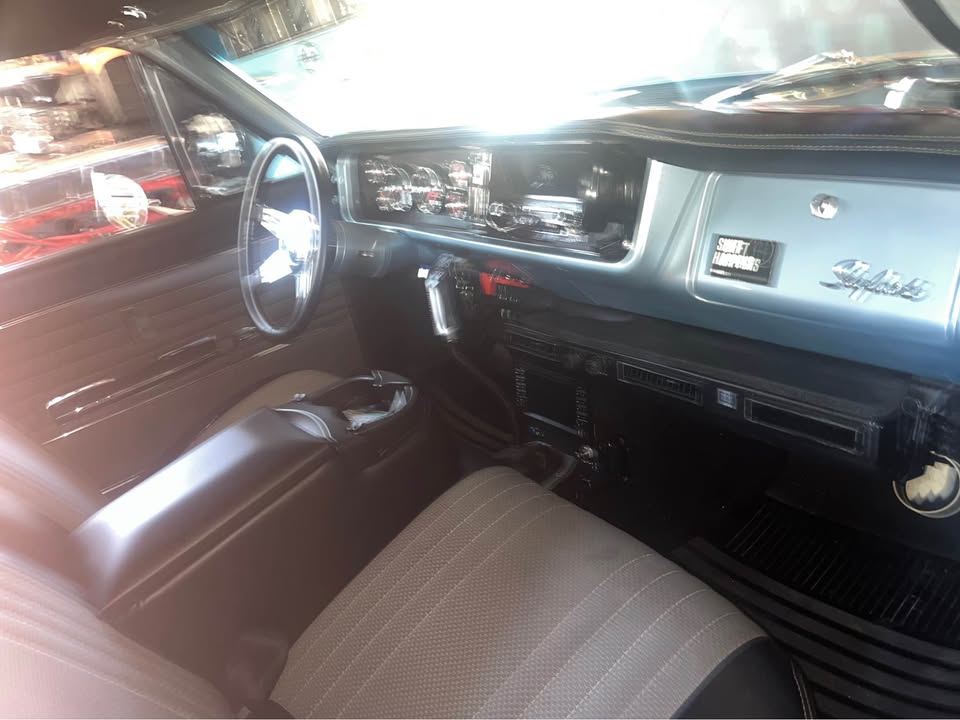
Seats and soft trim. Bench and bucket seats use foam that crumbles and vinyl that splits at the seams and at the driver's entry bolster first. Sit in the driver's seat: a seat collapsed to the springs needs foam and covers, and a quality cover set plus foam plus fitting is a four-figure job by the time both front seats and the rear bench match. Skylark Custom trim is harder to source than base trim, so a Custom with a sound original interior earns a real premium over one needing a retrim. Headlinings sag and tear at the seams; replacement is inexpensive in materials and fiddly in labour, and on a hardtop the job is the moment to inspect the roof rails and drip channels from inside.
Brightwork and model-specific trim. Grilles, lamp surrounds, side spears, ventiport trim, GS badges, wheel-arch mouldings and the one-year-only pieces for 1966, 1967 and each of the 1968–72 facelifts are the hardest parts of the whole car to replace in good order. Inventory the brightwork on a viewing the way you would inventory an engine: piece by piece, against photographs of a correct car, because a missing 1967-only grille surround can take a year to find at any price, while a missing 1970 piece is merely expensive. Stainless window trim on hardtops doubles as part of the weather seal system, and bent or sprung pieces are why many hardtops leak at the front of the side glass no matter how new the rubbers are.
Glass and seals. Hardtop side glass adjusts on multiple axes and almost never has been, fifty years on: wind noise and water entry at the quarter glass are adjustment and seal jobs, priced in hours. Glass and rubbers are available; the chrome filler strips that lock the rubbers are the perishable nuisance. Power windows wear at the regulator gear and nylon rollers — a slow window is usually rollers and dried grease before it is a motor, and the test is to help the glass by hand: if it moves freely with assistance, the motor is fine and the mechanism is the bill.
Electrics, cooling and the small systems
Period GM electrics are simple and the faults are honest: voltage regulators (external on early cars, internal in the alternator later) that overcharge and boil batteries, fusible links that corrode at the starter and kill the whole car intermittently, and earth straps whose corrosion produces every haunted symptom in the catalogue, from dim lamps to a starter that clicks only when hot. The hot-start click sells many unnecessary starters: heat soak raises resistance in a marginal circuit, and the cure is clean connections, a sound solenoid and, on big-block cars, the heat shield Buick fitted for exactly this reason. Test by bridging at the solenoid with the car hot; a starter that spins strongly on a direct feed was never the problem.
Cooling separates the engines. The small-blocks cool easily on a clean system; the 215 corrodes internally on old coolant, and the 455 produces more heat than a scaled, half-blocked radiator can shed. The diagnostic order is always the same — verify the gauge against an infrared reading at the thermostat housing, check the fan and the shroud, pressure-test the cap and system, and only then discuss head gaskets. Air conditioning, fitted to many Customs, uses the rebuildable GM A6 compressor; a system needing a compressor, condenser and conversion work is a four-figure recommissioning, so a car whose air "just needs gas" is priced as a car with no air until a gauge set proves otherwise.
How to inspect one
Allow ninety minutes, bring a torch, a weak magnet in a cloth, an infrared thermometer if you have one, and a mechanical oil-pressure gauge with the right adapter if the seller will allow it — on a Buick V8 that gauge is worth more than any other tool you own. Insist on a cold engine when you arrive, and pay for a lift inspection on any car that passes you: the frame check alone justifies it.
- Paperwork and identity first. Match the VIN to the title. Read the cowl tag on the firewall and decode the series and body style: does the tag describe a Skylark, a Skylark Custom or a GS, in a post coupe or a hardtop shell? Then check the engine against the badge — distributor at the front means a Buick small-block, tall narrow valve covers with the plugs down the centre means a nailhead, and a Stage 1 claim needs paperwork, because Stage 1 hardware inside an engine cannot be verified from outside it. A car whose numbers disagree with its badges is priced as the car the numbers describe, full stop.
- Cold start. From cold, every engine in this guide should start promptly on the choke and settle. Note blue smoke at start-up (valve stem seals, common and fixable), blue smoke that continues under load (rings, an engine conversation), and any knock in the first seconds that fades as pressure builds (bearing clearance announcing itself — walk away from a big-block that does this unless the price is an engine-out price).
- Read the idle for the engine it is. The odd-fire V6 is supposed to rock at idle; a V8 is not. A Buick 350 or 455 should idle evenly once warm. A wandering idle on a Quadrajet car points first at a worn throttle shaft and vacuum leaks, and a rich, eye-watering idle at a car that also starts hard hot points at the carburettor's internal well plugs — both from the engines section, both cheaper than the misdiagnoses they usually attract.
- The oil-pressure test. With the engine fully hot, take a real pressure reading at idle in gear and at a steady cruise. This is the test that prices a Buick V8: falling hot idle pressure is the timing-cover oil pump story from the engines section, and it is negotiable money, while low pressure everywhere with any bearing noise is a rebuild. Check the dipstick too — the level, the smell of fuel, and mayonnaise under the filler cap that suggests coolant where it should not be.
- Underneath: frame before everything. On the lift, work the frame rail by rail with a hammer and screwdriver, concentrating on the rear kick-up over the axle, the body mounts and the bottom faces of the rails. Check the body mount cushions are present and not crushed flat. Perforation at the kick-up ends the inspection for a base car and reprices a GS on the spot.
- The water path. Lift the trunk mat and the spare and prod the trunk floor over the rails; look at the rear window channel's lower corners for bubbling under the trim; lift all four carpets and prod the toe boards and floor seams; run a fingertip along every door bottom and the bottom of the front wings. This is the rust map from the problem areas, walked in order — a car dry and sound at every one of these points is the exception, and it is the car to stretch for.
- The magnet walk. Drag the cloth-wrapped magnet over the lower quarters, the sills, the door bottoms, the wing bottoms and around the wheel arches. Where it will not hold, there is filler; some filler in fifty-year-old lower panels is normal life, filler over the rear window channel, the sills or the frame-adjacent panels is the rust story being hidden rather than repaired.
- Front end and steering. With the front raised under the lower arms, rock each wheel for ball-joint and bearing play, then side to side for idler and linkage play. Price a full refresh as a known sum rather than treating play as a mystery. Check the power steering for leaks at the pump and hoses and for centre-position free play at the wheel.
- The test drive. Fifteen minutes, mixed roads, some full throttle. A TH350 or TH400 car should shift firmly with no flare and engage reverse cold without a long delay; a switch-pitch Super Turbine 300 car should not feel stuck lazy or stuck loose. A GS should pull hard and clean from low revs — flatness is timing, chain or carburation, in that order of checking. Brake firmly from speed: straight, no judder, no pull. Listen for axle whine on and off the throttle and for the lane-change looseness of worn rear bushes.
- Heat soak and hot restart. Park, let it idle five minutes, and watch the temperature against an infrared reading at the thermostat housing — this is where a 455 with a scaled radiator confesses. Switch off, wait five minutes, and restart: a hot-start click is the solenoid and heat story from the problem areas, a long crank with a fuel smell is the Quadrajet well plugs, and both are bargaining points with known prices, not acts of God.
- Interior and trim inventory. Sit in the driver's seat and feel for the spring frame through the foam. Work every window — on a hardtop, watch the quarter glass meet its seals — every switch, the heater blower on all speeds, the wipers and washers. Then inventory the brightwork piece by piece against photographs of a correct car for that exact year: missing one-year trim is the costliest sentence in this guide, because it is paid in search time, not just money.
- Stance and gaps, last. Stand back and look down each flank. The car should sit level side to side. Door gaps that pinch at the top suggest body mounts or frame trouble from step 5, not door adjustment. Ripples down a flank in raking light tell you how much of step 7's filler is sculpture.
Values
The market block beneath this guide carries the current numbers — what is listed now, and what recorded sales have achieved — and this section exists to teach you how to read them, because a Skylark coupe's price is almost never about the badge on the boot lid. It is about which of four cars, hiding under one name, you are actually looking at.
The first split is generation. The 1961–63 compact coupes trade in a small, enthusiast market where rarity and charm set the price and where a correct, complete car matters more than outright condition in any single area — a compact missing its year-specific trim can sit unsold at a price that would move a complete car quickly. The A-body cars split three ways: ordinary Skylark and Custom coupes, which trade as classic American coupes and are priced chiefly on body condition and interior completeness; the GS 340 and GS 350 cars, which carry a real but modest muscle premium and are often the best value in the whole family because the market undervalues them against their big-block brothers; and the GS 400, GS 455 and Stage 1 cars, which trade in the muscle-car market proper, where paperwork, matching numbers and originality move the price more than condition does.
The condition spread inside any one variant is wide, and it is driven by the order of the problem areas: shell, frame, trim, mechanicals. A rust-free, complete, honestly presented driver is worth a multiple of a shiny car with a perforated rear window channel and a crunchy frame kick-up, because the first car's needs are all in the fixable categories and the second car's needs start with fabrication. Project cars price accordingly: an A-body coupe project is worth what its shell, frame and trim inventory are worth, with the engine treated as a core until it is proved otherwise, and the gap between a project and a driver is almost exactly the cost of the welding, paint and interior work between the two states — there is no arbitrage in buying the cheap one and paying retail for the work.
Asking and achieved prices part company most visibly at the two ends. At the top, Stage 1 asking prices are often set by comparison with Pontiac and Chevrolet equivalents; achieved prices follow Buick-specific demand, which is thinner, so patience and documentation matter more than bidding drama. At the bottom, marketplace-grade coupes — the shape of most of the current pool behind this guide: private sellers, automatics, cars briefly described and briefly photographed — are priced by sellers against each other rather than against the wider market, producing both the occasional genuine bargain and a long tail of optimistic projects. In that pool the discount for an unverified car should be real: a coupe you cannot put on a lift, oil-pressure test or identity-check is a parts-value purchase until the day you can.
Premiums that are genuinely earned: a documented Stage 1; a factory four-speed GS with its numbers in order; a Skylark Custom with a complete, original, uncut interior; air conditioning that demonstrably works on a hot day; and any coupe, of any variant, with a photographed, welded rear-window-channel and trunk repair already done properly. Premiums that are not earned: stripes, spoilers and GS badges on a car whose cowl tag describes something else; a fresh paint job with no photographs of what is underneath it; and a rebuilt engine with no invoice naming who built it and what went inside. Negotiate on the inspection findings with known prices — the front-end refresh, the brake recommissioning, the timing-cover oil pump work, the interior retrim — because those are sums a seller can verify as easily as you can, and they move a price further than any argument about what the market is doing.
Parts and ownership
The Skylark's ownership proposition is the A-body's: a car whose wearing parts were made by the tens of millions, wrapped in Buick-specific clothing that was not. Run the car on the shared parts and budget your patience for the Buick parts, and it is one of the easiest muscle-era coupes to live with.
Easy: almost everything mechanical that wears. Suspension joints, bushes and springs, steering components, brake hydraulics and friction parts, universal joints, engine service items, gaskets and seals, water pumps, alternators and starters, TH350 and TH400 rebuild parts and expertise, and Quadrajet service parts are all catalogue items at ordinary money, shared with the wider GM fleet. A competent general classic shop can maintain the whole car; a Buick-literate shop earns its premium mainly on the engines' oil-pressure and timing-cover work.
Harder and dearer: Buick engine internals at rebuild time — the 215 aluminium engine is specialist territory outright, nailhead parts are a dedicated trade rather than a catalogue, and 455 performance internals are available but from Buick specialists rather than every speed shop; timing covers for the oil-pump-in-cover engines, where good used and quality reproduction supply comes and goes; and above all, trim. Grilles, lamp surrounds, year-specific side trim, hardtop stainless, GS-specific badges and Skylark Custom interior pieces are hunted, not ordered, and the correct strategy is to buy a complete car rather than a cheap car plus a parts search.
Running costs. Fuel consumption is period American: gentle teens in town for a V8 car, better on a run, worse in a 455 driven as a 455 invites. The honest budget line is the first year of deferred maintenance on a newly bought driver — fluids, hoses, belts, brake recommissioning, a carburettor rebuild and the small leaks — a four-figure sum at shop rates on almost any example that has changed hands, and materially more on a car recommissioned from standing, where the fuel system needs cleaning end to end and every seal has taken a set. Cars that have stood on ethanol-blended fuel need the tank and lines treated as contaminated until flushed and proved. Buy the car that has been in regular use, even at a higher price: on a Skylark, use is maintenance, and storage is a slow invoice.
Which one to buy
- The all-rounder: a 1968–70 Skylark Custom hardtop with the Buick 350. The best-finished cabin of the ordinary cars, torque enough for any modern road, the easiest parts life of any coupe in this guide, and a market that prices it as transport rather than treasure. This is the Skylark to actually drive.
- The value buy: a GS 350, or a 1967 GS 340. Real Gran Sport hardware and character at a fraction of big-block money, in a lighter, sweeter-handling car. The market overlooks them because the 455 exists; your wallet should not.
- The collector car: a documented 1970 GS 455 Stage 1. The flagship, and priced like one when the paperwork, the numbers and the shell all agree. Verify all three ruthlessly — a Stage 1 without documentation is a GS 455 with a story, and it should be bought at GS 455 money.
- The stylist's pick: a 1966 or 1967 GS 400. The most elegant shell of the run, the nailhead in 1966 or the new big-block in 1967, and a cabin a clear step above the divisional rivals. Buy the most complete one you can find; 1966–67 trim is the hardest in the guide to replace.
- The charmer: a 1961–63 compact Skylark. Light, pretty, aluminium-engined and rare. Buy it for what it is, with a specialist's inspection of the 215, never as a cheap substitute for the A-body car.
- The project to buy: a rust-free six-cylinder or 350 post coupe. The stiffest, lightest shell, bought at the bottom of the market, is the honest basis for a car you build your way — provided you go in knowing it will never be a GS, and price it accordingly forever.
And the rule that overrides all of the above: buy the shell, the frame and the trim, and let the engine be the thing you fix. Every engine and gearbox here can be rebuilt by somebody, at a price you can plan for. A perforated frame kick-up, a rotted rear window channel hidden under filler, and missing one-year brightwork are the three bills that turn a Skylark into a project that owes you money — and none can be made original again once the metal and trim are gone.
See the 4 Skylark Coupe 2D cars currently listed.
For sale now
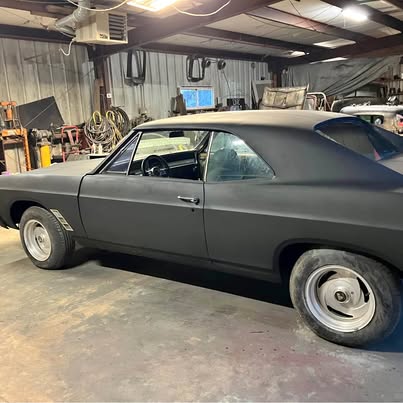 $10,000 · 43% below typical
Expand
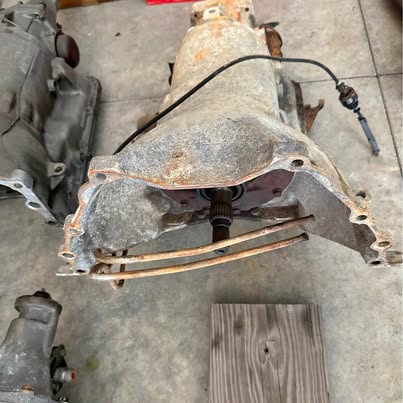 $600 · 97% below typical
Expand
$18,000 · 3% above typicalExpand
$33,000 · 88% above typicalExpand
What they sell for: Skylark Coupe 2D sale prices.