
Chevrolet Caprice Hardtop buyer's guide
Chevrolet Caprice Hardtop -- the model's own buyer's guide: variants, values and what to check.
Years listed: 1966-1967 · Series: Impala
# Chevrolet Caprice Hardtop — Buying Guide
Overview and history
The Caprice Hardtop is the car Chevrolet built when it realised the full-size buyer wanted luxury without leaving the Chevrolet showroom for a Buick or an Oldsmobile. The name appears halfway through the 1965 model year as the Custom Caprice option — essentially a lavish trim and equipment package on the Impala four-door Sport Hardtop — and for 1966 Caprice becomes a series in its own right, sitting above Impala, Bel Air and Biscayne at the very top of the full-size B-body range. The hardtops are the heart of it: a two-door Sport Hardtop with a pillarless roof and a four-door Sport Hardtop that gives you the same open, glassy cabin with rear doors for passengers. Both ride the same 119-inch-wheelbase perimeter frame as every other 1965–70 B-body, with coil springs at all four corners, a live rear axle, and a choice of small-block and big-block V8s that runs from an economical 283 to a 427 you have to work quite hard to find today.
Understand what the car is and is not. It is not a muscle car wearing a suit, even when a big-block is fitted — the suspension is tuned for a quiet, level ride, the steering is deliberately light, and the cabin is trimmed to hush road and engine noise rather than celebrate them. It is not rare in the way a limited-production car is rare; Chevrolet built Caprices in serious volume, and the hardtops were popular family-luxury cars, which is precisely why so many survive as ordinary old cars rather than pampered collectibles. And it is not a car you judge by its badge or its paint. Sixty years of use, storage, winter salt and well-meaning restoration mean the spread between the best and worst Caprice Hardtop you will look at is enormous, and almost all of that spread lives in the body shell and the frame, not in the engine bay.
That is the good news hidden inside the warning. Mechanically, this is one of the best-supported American cars ever made. The small-block Chevrolet V8, the Powerglide and Turbo Hydra-Matic gearboxes, the Saginaw steering and the 10- and 12-bolt rear axles are all understood by every competent shop in the country, and parts supply ranges from good to excellent. A Caprice Hardtop fails to be a good buy for structural and cosmetic reasons — rust in the frame and floors, tired vinyl and pot-metal trim that is expensive to restore correctly — far more often than it fails because an engine or gearbox cannot be fixed. Buy the shell and the trim first, and let the mechanical condition set the fine adjustment to what you pay.
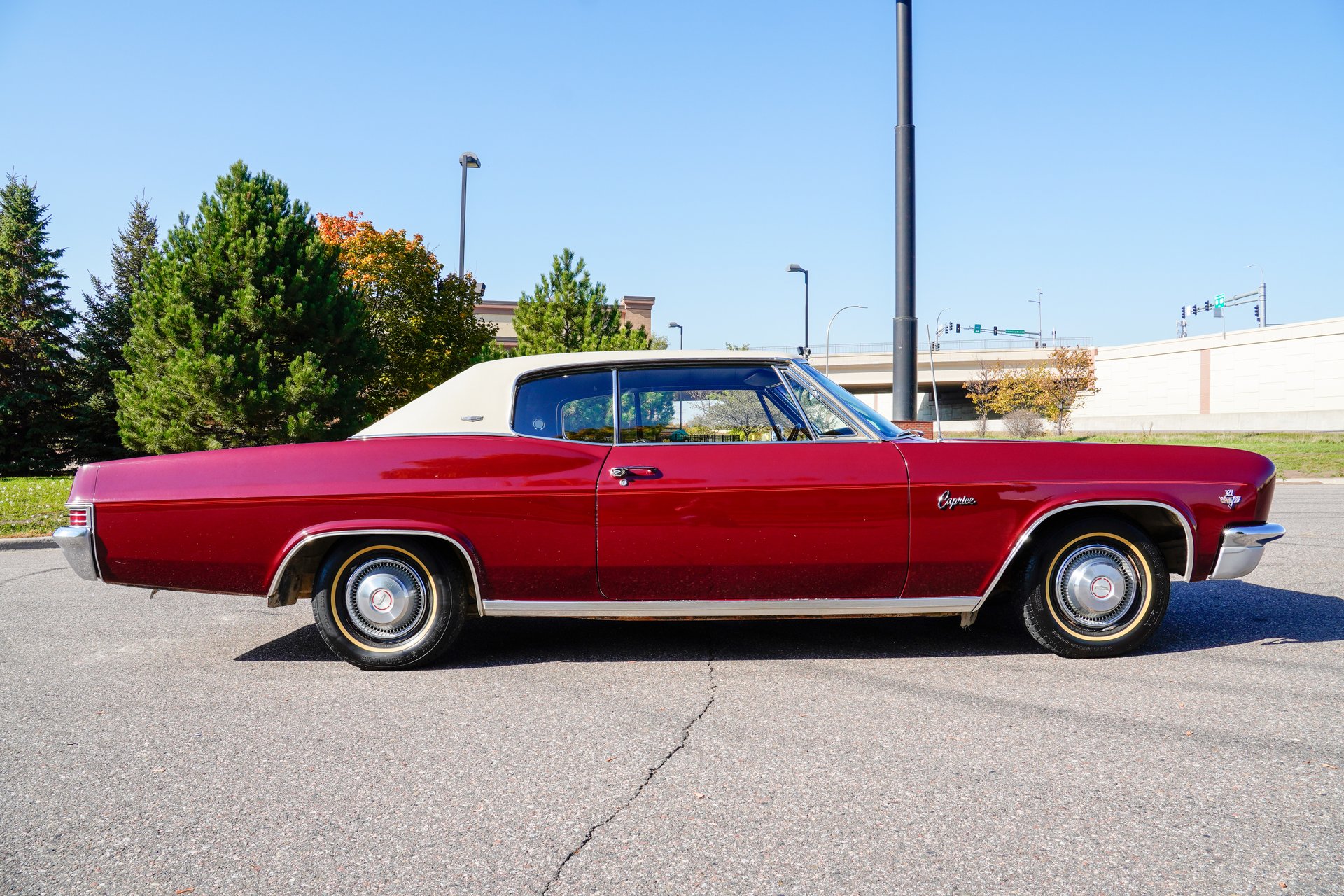
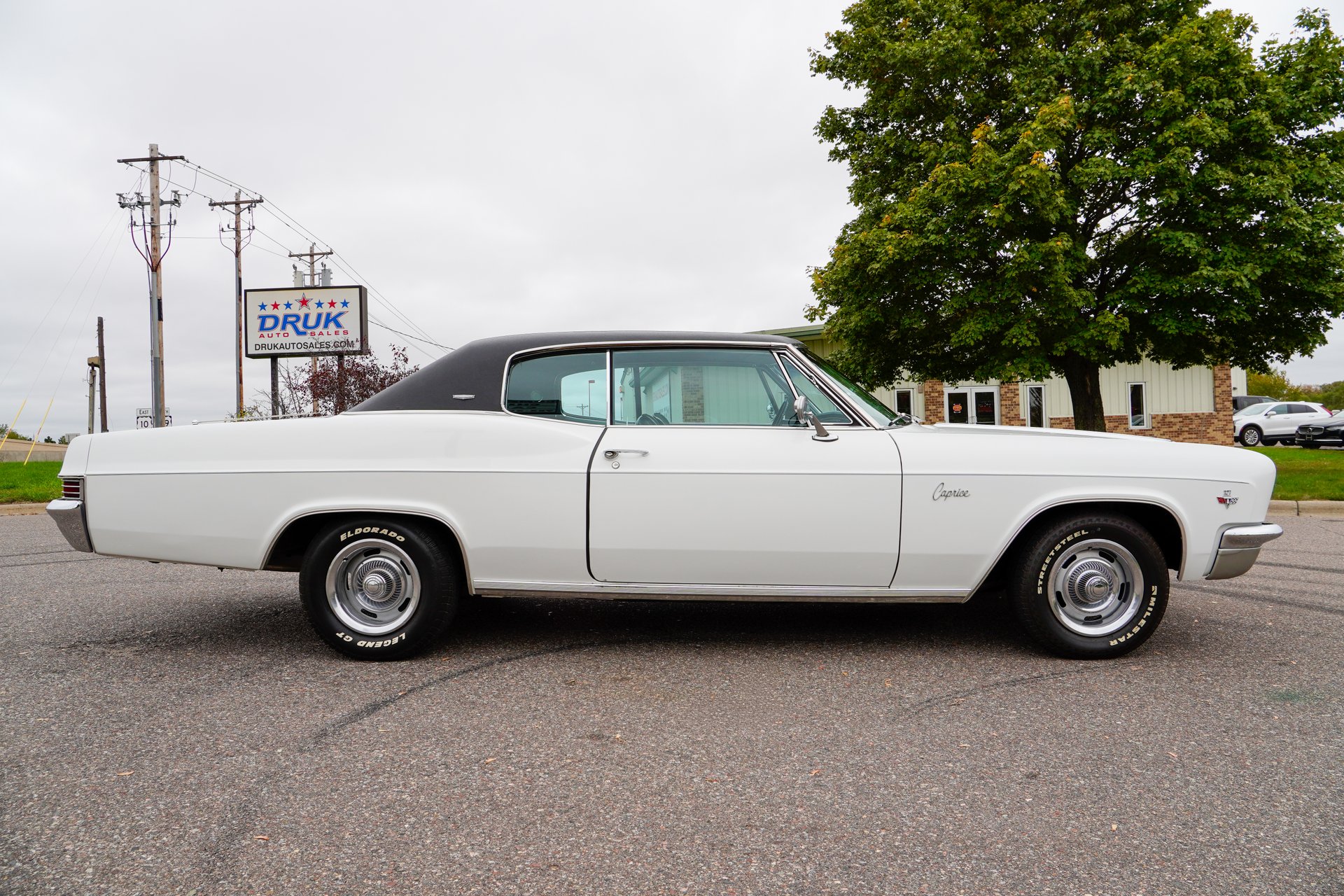
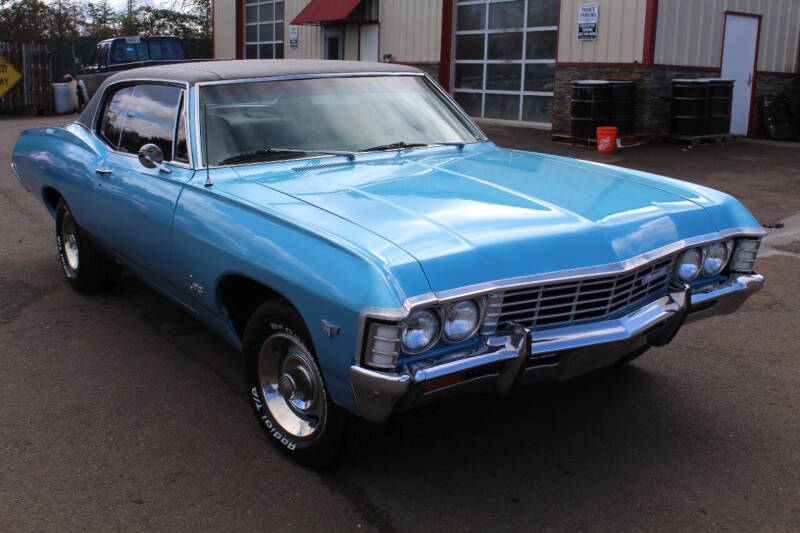
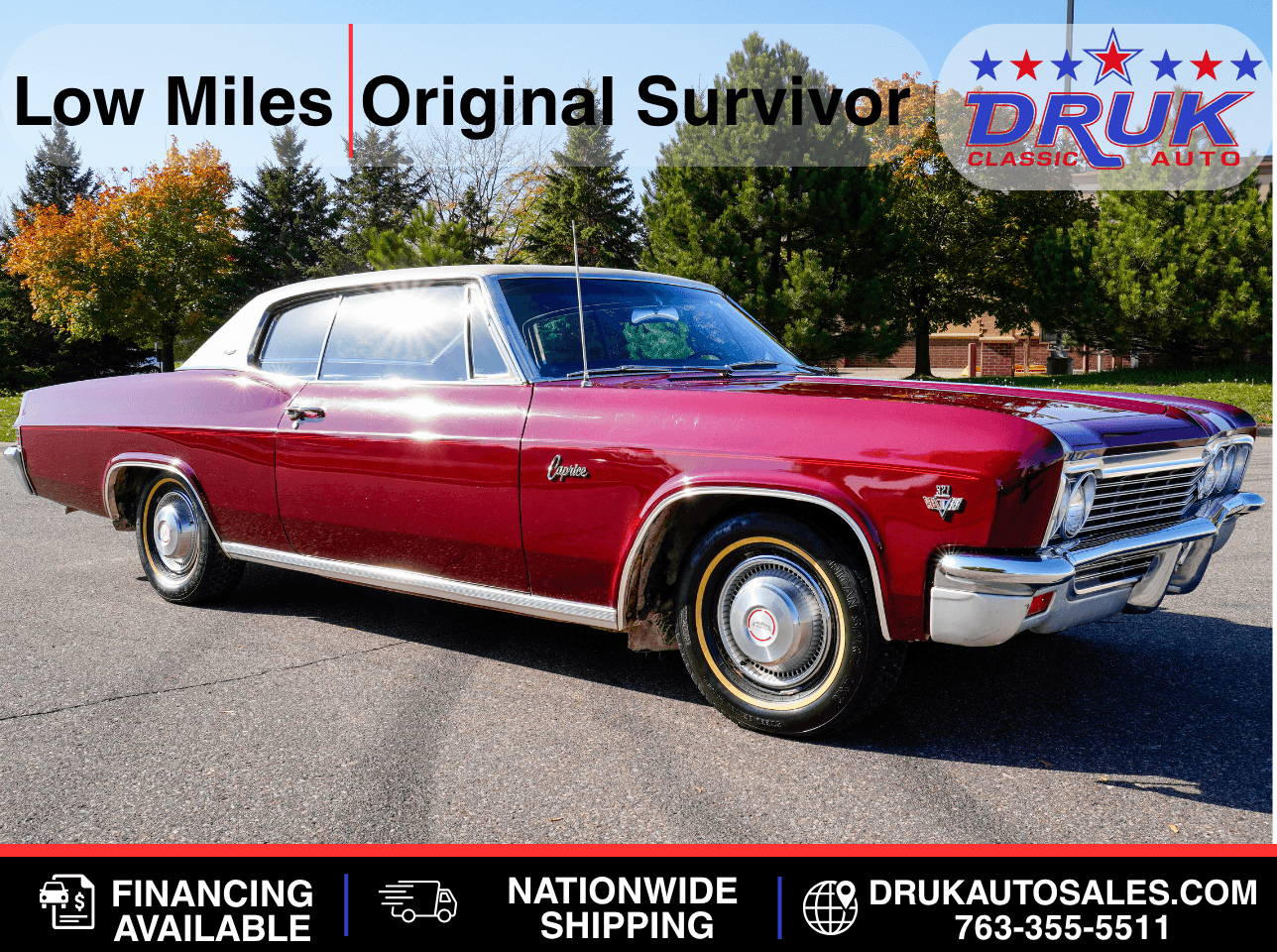
The site's own pool for this guide is small and honest about it: three cars, all currently for sale, all automatics, all two-door hardtops as photographed — two from 1966 and one from 1967, in Madeiras Maroon, white and blue. That is a fair snapshot of how these cars reach the market now: the early, 1965–67 Coke-bottle cars, in the two-door hardtop body most buyers want, almost always with an automatic gearbox. Treat the small sample as a prompt to inspect widely rather than as a census, and read the rest of this guide as the checklist that separates a sound early Caprice from an expensive one.
The models
Caprice hardtops divide first by year, because the B-body shell was restyled on a short cycle, and second by engine, because the engine decides both the character of the car and which gearbox and brakes it could be ordered with. The underlying car barely changes from 1965 to 1970: same basic frame, same suspension layout, same glasshouse concept. What changes is the styling skin, the detail trim, the safety equipment and the engine list — and those changes matter to a buyer because trim and sheet metal are year-specific, while most mechanical parts interchange across the whole run.
For 1965, remember, there is no Caprice two-door at all: the nameplate launches on the four-door Sport Hardtop only, as an Impala-based option package. A claimed 1965 Caprice two-door hardtop is an Impala with Caprice trim added, whatever the seller calls it — the VIN and the cowl tag settle it, because a genuine 1965 Caprice carries the Caprice series identity, not the Impala one. From 1966 the range settles into the pattern this guide covers: two-door Sport Hardtop, four-door Sport Hardtop and a station wagon (covered by its own guide logic — wagons share the mechanicals but have their own rust map in the tailgate and rear load floor). There is no Caprice convertible in these years; open cars stay in the Impala range.
The 1966 car is the purest expression of the first restyle: smooth flanks with a gentle Coke-bottle swell over the rear wheels, stacked-look quad headlamps in a wide grille, full-length side trim, and — a Caprice signature — a formal vinyl roof covering offered on the hardtops, simulated woodgrain interior appliqué, and a more deeply padded, better-trimmed cabin than an Impala's. Strato-bucket front seats with a centre console are an option on the two-door, turning it into a personal-luxury coupe; the standard car has a bench. The 1967 car is a heavier restyle on the same bones: more sculpted front wings that wrap the headlamps, a more pronounced forward thrust to the nose, new rear styling, and a two-door roofline that reads more formal. Detail safety equipment moves on too — an energy-absorbing steering column and dual-circuit brakes arrive for 1967, and front disc brakes join the options list, which is why a disc-braked 1967 is a genuinely more usable car than a drum-braked 1966 in modern traffic.
Inside, Caprice specification means you should find the things that separate it from an Impala: richer cloth-and-vinyl or all-vinyl upholstery, woodgrain instrument-panel appliqué, a Caprice-specific steering wheel, courtesy lighting, and usually a higher take-up of power steering, power brakes and air conditioning than on lesser B-bodies. None of that is proof of identity on its own — trim swaps are easy on these cars — but its absence on a claimed Caprice should make you look harder at the tags.
| Model | Years | Engine | Output | Built | Character |
|---|---|---|---|---|---|
| Caprice Sport Hardtop 2-door (1965: not offered; Impala-based 4-door option only) | 1966–67 in this guide's core years | 283 cu in small-block V8, 2-barrel | 195 hp (gross, period) | Series totals include wagons; reliable hardtop-only splits are not published, so treat any exact figure quoted to you with caution | The honest base car: quiet, torquey enough, cheapest to run and rebuild |
| Caprice Sport Hardtop 2-door / 4-door | 1966–67 | 327 cu in small-block V8, 4-barrel | 250–300 hp in 1966; 250–275 hp in 1967 (gross, period) | As above | The sweet spot — real pace without big-block weight, thirst or cooling demands |
| Caprice Sport Hardtop 2-door / 4-door | 1966–67 | 396 cu in Turbo-Jet big-block V8, 4-barrel | 325 hp (gross, period) | As above | Effortless, heavy, thirsty; the luxury express, not a sports car |
| Caprice Sport Hardtop 2-door / 4-door | 1966–67 | 427 cu in Turbo-Jet big-block V8 | 385–390 hp, and a rare 425 hp version in 1966 (gross, period) | Genuinely scarce; verify by numbers, not badges | The collector car of the range — and the one most often faked from a 396 car |
Two identity traps deserve emphasis before you go further. First, engine badges lie by omission and commission: front-fender flags are held on by nuts and enthusiasm, and a 396 or 427 badge proves nothing except that someone fitted a badge. The engine's stamped code — on the pad at the front of the right-hand cylinder head deck on a small-block or big-block alike — plus the VIN and the cowl tag are the evidence. Second, series identity matters more than trim: Caprice, Impala, Bel Air and Biscayne share a shell, and a lesser car dressed with Caprice trim, vinyl roof and badges is still the lesser car for value, forever. Decode the VIN's series digits and compare the cowl tag's style and trim codes with what is in front of you before you discuss money.
Engines and gearboxes
Every Caprice Hardtop you are realistically going to buy has a Chevrolet V8 under the bonnet, fed by a carburettor, driving the rear wheels. Chevrolet's six-cylinder was theoretically part of the wider B-body world, but Caprice buyers bought V8s, and the three cars in the site's pool are all V8 automatics. The engines fall into two families — the small-block and the Mark IV big-block — and they fail in different ways, cost different money to fix, and suit different buyers. Learn both.
The small-block: 283 and 327
The small-block Chevrolet is the most successful V8 ever made, and in the Caprice it appears as the 283 cu in (4.6-litre) and the 327 cu in (5.4-litre). Both are cast-iron, overhead-valve, pushrod engines with a hydraulic flat-tappet camshaft, a single carburettor — a Rochester 2GC two-barrel on the base cars, a Rochester 4GC or Carter AFB four-barrel on the stronger 327s — and a Delco distributor with contact-breaker points at the back of the block. The 283 is the standard engine: smooth, understressed and slow to complain, but in a car weighing the thick end of two tons with an automatic gearbox it gives adequate rather than brisk performance. The 327 is the engine this chassis wants. In its milder four-barrel form it gives the Caprice genuine overtaking pace; in the higher-compression 300 hp form of 1966 (275 hp in 1967's ratings) it makes the car feel properly quick by period standards, while staying lighter and cooler-running than any big-block.
Mechanically, judge a small-block on four things. Oil pressure and oil condition come first: these engines tolerate wear gracefully, so a tired one still runs sweetly while consuming oil past worn valve guides and hardened stem seals — blue smoke on start-up that clears is the classic stem-seal signature, smoke under load points to rings and bores. Second, listen to the valvetrain from cold: a hydraulic lifter that ticks for a few seconds and then quietens is an old car clearing its throat; a lifter that never quietens, or a rhythmic top-end rattle that rises with revs, is a worn cam lobe or a collapsed lifter, and cam wear is the small-block's one genuinely common internal failure — the lobes are splash- and throw-off-lubricated and suffer first when oil changes have been skipped or modern low-zinc oil has been used without thought. Third, check the timing chain by feel and by behaviour: a slack chain retards the cam timing, makes the idle ragged and the throttle response lazy, and shows as scatter when you watch the timing marks with a strobe. Fourth, look for the external leaks that are normal and the ones that are not: a weeping rear main seal and damp rocker covers are par for the course; coolant in the oil, oil in the coolant, or bubbles in the radiator with the cap off and the engine warm are head-gasket or casting problems and a different conversation entirely.
Carburation faults dominate small-block driveability complaints, and most are misdiagnosed. A flat spot on tip-in is usually the accelerator-pump cup in the carburettor, hardened by ethanol fuel, not ignition. A car that starts from cold, runs for a minute and dies is usually a choke pull-off or a perished vacuum hose, not a fuel pump. A car that is hard to restart hot is very often vapour and heat soak in the carburettor — worse with modern fuel — compounded by a weak starter and tired battery cables, and the cure is systematic (fuel pressure around 4–6 psi at the carburettor inlet, a clean filter, correct float level, healthy cables) rather than a bigger carburettor. Budget $300–700 for a proper carburettor rebuild by a specialist, $800–1,500 for a cam-and-lifter set fitted, and $3,500–6,500 for a quality full engine rebuild if the worst is confirmed — which is exactly why you test before you buy rather than after.
The big-block: 396 and 427 Turbo-Jet
The Mark IV big-block — the Turbo-Jet in Chevrolet's period language — is a different animal: a heavier, wider cast-iron engine with canted-valve cylinder heads, offered in the Caprice as the 396 cu in (6.5-litre, actually 402 cu in in its very late overbore form, though not in these core years) and the 427 cu in (7.0-litre). In a Caprice both are in their mildest, most civilised states of tune: the 396 at 325 hp with a four-barrel Rochester Quadrajet or Holley depending on year and application, hydraulic cam, and torque figures that move this heavy car with an ease no small-block matches. The 427 in its 385–390 hp form is the same idea turned up; the 425 hp solid-lifter version is a Corvette-flavoured engine that very rarely belongs in a Caprice, and any car claimed to have one needs documentary and stamp-pad proof, not a sales pitch.
The big-block's virtues are torque and presence; its vices are weight, heat and thirst. The extra mass sits over the front wheels, so front suspension and steering wear faster, and the engine bay runs hotter, which punishes everything rubber and electrical under the bonnet and makes the cooling system the first thing to interrogate. A big-block that runs hot at idle but cools at speed usually has a fan-clutch, shroud or airflow problem; one that heats steadily under load has a radiator core, water-pump or head-gasket problem, and the distinction matters because the first is a Saturday job and the third is an engine-out conversation. Cooling parts are available, but a correct recore or quality replacement radiator runs $400–900, and you should confirm the fan shroud is present — missing shrouds are common and they matter more on a big-block than on anything else here.
Internally, the big-block shares the small-block's cam-and-lifter vulnerability and adds its own appetite for valve-guide wear and oil consumption at mileage. It is also the engine most likely to have been swapped, rebuilt to unknown specification, or dressed up to impersonate a rarer version. The stamp pad is your friend: the assembly code suffix tells you the engine's original application, displacement and gearbox pairing, and a 427 that decodes as a 396 — or a truck engine — reprices the car instantly. A big-block rebuild costs more than a small-block's in every line item; budget $5,000–8,500 for a proper rebuild and treat a freshly painted engine with no paperwork as an unknown engine, because that is what it is.
A note on the later cars, because you will meet them while you shop and the same buying logic applies. The hardtop range continues to 1970 on the same frame and suspension, restyled again for 1969, and the engine list evolves around the same two families: the 283 gives way to the 307 and then the 350 small-block becomes the common fitment, while the big-block line runs 396 (later nominally 402) through to the 454 that arrives for 1970. Nothing about those changes alters the inspection order in this guide — the frame, the floors and the identity still decide the car — but two later developments are worth money if you find them: front disc brakes become progressively easier to find and eventually standard-fit thinking, and the Turbo Hydra-Matic 350 three-speed automatic joins the Powerglide behind small-blocks from 1969, giving the later small-block cars the flexible three-ratio gearbox the early cars lack. If your heart is not set on the 1966–67 styling, a disc-braked, TH350-equipped later hardtop is the most usable Caprice of the run, and it is usually priced by sellers as a lesser car than the early ones — an inefficiency a practical buyer can use.
Gearboxes: manual, Powerglide and Turbo Hydra-Matic
Three gearboxes matter. The standard offering is a three-speed manual with a column change — honest, rare in a Caprice, and worth checking for worn synchromesh on second and a tired clutch linkage rather than anything exotic. A four-speed manual (Muncie M20 wide-ratio or M21 close-ratio) with floor change, buckets and console exists and is the unicorn specification; if you are shown one, verify the car was built that way, because conversions are common and a converted car is worth converted-car money.
Most Caprices — all three in the site's pool — are automatics, and here the year and engine decide what you get. The two-speed Powerglide, Chevrolet's own cast-iron-then-aluminium automatic, pairs with the small-blocks in these years: only two ratios, but a famously tough torque converter and simple hydraulics, and in normal use it is smooth, slow-witted and nearly indestructible. A Powerglide that flares on the single upchange, delays engagement from cold, or leaks from the front seal and the selector shaft is telling you its age; a rebuild runs roughly $1,200–2,200 and every automatic shop knows the unit. The three-speed Turbo Hydra-Matic 400 pairs with the big-blocks: stronger, heavier, with a distinctive firm shift and an electric kickdown switch rather than a linkage. Judge a TH400 on shift quality and fluid: clean red fluid and three distinct, prompt shifts mean health; brown fluid, a long slide into third, or a car that will not kick down points first to the vacuum modulator and its hose (cheap) before you condemn the internals (a rebuild at $1,500–2,500). On either automatic, check the fluid colour and smell on the dipstick before the test drive and again after it — that ten-second check tells you more than ten minutes of sales talk.
The rear axle is the 10-bolt or, on big-block cars, the stronger 12-bolt Salisbury-type unit, on coil springs with trailing arms. Positraction limited-slip was an option and is desirable; check for it by the tag or by turning a raised wheel, and listen on the test drive for the whine that means worn ring-and-pinion or the clunk that means worn universal joints or excessive backlash. Axle work is conventional and affordable — $600–1,400 for bearings, seals and set-up, more for a full gear change — but a noisy axle on a car you otherwise like is a negotiation point, not a walk-away.

Problem areas
Everything in this section is ordered by cost of getting it wrong. Rust and frame condition come first because they are the only faults that can turn a fairly priced Caprice into a car worth less than the cost of fixing it. Mechanical faults on this car are almost always fixable for knowable money; structural faults are the ones that multiply while you watch.
Rust: the map
Start with the frame, because a Caprice is a body-on-frame car and the frame is both its strength and its trap. The perimeter frame's side rails and crossmembers rot from the inside out, fed by road salt and by mud that packs into the rails and holds moisture against the steel. The places to get a torch and a screwdriver into are the rails just behind the front wheels, the sections under the doors, the kick-up over the rear axle, and the rear crossmember and bumper-mount area. Surface scale is normal at this age; flaking, swelling or metal that dents under firm screwdriver pressure is rot, and rot in the rear kick-up or around the trailing-arm mounts is structural in the true sense — those mounts locate the rear axle. A frame repair done properly, with the body lifted and sections cut out and replaced, starts around $1,500–3,000 for a localised section and climbs steeply from there; a frame that is thin in several places is a reason to walk away from the car at any price that assumes a sound one. Put the car on a lift before you buy it. There is no honest shortcut.
The body shell has its own consistent map. Front wings rot at the bottom rear corner behind the wheel and along the top inner flange where the inner wing traps dirt. Doors rot along the bottom seam — open each door and look at the underside, not the shiny outer skin — and hardtop doors carry a specific extra risk: the long, heavy, pillarless door sags on its hinges, drops at the latch, and then chips paint and wears the striker while letting water past the seals. The sills (rocker panels) rot under their bright Caprice mouldings, which is why the mouldings must come under suspicion rather than admiration: bubbles at the moulding's lower edge or a moulding that sits proud of the panel usually means the metal behind it is going. Rear quarters are the signature B-body failure — the lower quarter behind the rear wheel, the wheel-arch lip, and the dogleg in front of the wheel all trap water thrown up by the tyre, and the quarter is a big, skilled panel to replace well. Budget $1,200–2,800 per side for proper quarter and arch metal work with paint, and distrust fresh underseal or fresh paint over the arches until you have probed them.
Floors and the trunk floor fail together and tell you where the water came in. Lift the carpets — or at minimum press the floor through the carpet for crunch and give — and check the front footwells (water from a leaking windscreen or a blocked cowl drain), the rear footwells, and the panel under the rear seat. The trunk floor rots from the inside because water enters past perished rear-window and trunk-lid seals and sits under the mat; a seller who will not let you lift the trunk mat is answering your question. The windscreen and rear-window channels themselves are a primary source: the glass is set in rubber and sealant that hardens and shrinks, water sits in the channel, and the channel rusts under bright trim that still looks perfect. Staining on the headlining edges, a musty car, or rust freckling at the base of a pillar means the channel is leaking whether or not you can see the hole yet. Vinyl roofs complete the set: the covering traps moisture against the roof skin, especially around the rear window and the sail panels, and a roof that feels crunchy or bubbled under the vinyl is a roof that needs metal work and a new covering — $1,000–2,500 done properly — not a cosmetic afternoon.
The cowl and plenum deserve a sentence of their own, because they connect rust to the electrics and the interior. Leaves enter the cowl intake, compost in the plenum, block the drains, and water then finds its way down the inside of the firewall onto the floor and the fuse area. If the front floor is wet and the windscreen channel is sound, the cowl is your culprit, and clearing it is cheap labour that sellers rarely do.
In the site's own examined pool for this guide the warning is unanimous but the sample is tiny: the photo notes mention rust in 3 of the 3 cars examined. Do not read that as "every Caprice is rusty" — read it as "every Caprice you look at deserves the full rust map above", which happens to be true on the wider evidence of sixty winters anyway.
Suspension, steering, brakes and the rear axle
The front suspension is conventional double-wishbone with coil springs, an anti-roll bar, and ball joints that carry the car's considerable weight — more of it with a big-block. Worn ball joints and perished control-arm bushings are the default condition of an unrestored car, and they announce themselves as vagueness, uneven front-tyre wear, clunks over broken surfaces and a car that wanders under braking. Jack the front up, support it correctly, and lever each wheel: play at the ball joints or movement in the bushings is measurable, not a matter of opinion. A full front-end refresh — ball joints, bushings, tie-rod ends, centre link and idler arm, with alignment — runs roughly $900–1,800 in parts and labour and transforms the car, which is why a Caprice that already drives tightly is worth real money over one that does not. Coil springs sag, especially at the rear, and a car sitting low or unevenly needs springs ($300–600 a set fitted) before it needs anything clever; check the ride height side to side as part of judging the frame, because a bent or rotten frame also presents as a car that will not sit level.
Steering is a Saginaw recirculating-ball box, manual or power-assisted, and wear shows as free play at the wheel rim before the road wheels respond. Some adjustment exists at the box, but a box adjusted tight to hide wear binds at centre and wears faster; a rebuilt or replacement box is $350–800 plus fitting. Power-steering pumps whine when low or tired, hoses weep, and the ram-and-valve hardware on earlier assist systems adds leak points — budget for hoses and seals on any unrestored car. None of this is exotic; all of it is negotiable money if you find it before the seller's price assumes you won't.
Brakes are where the years divide. Standard cars have four-wheel drums with power assistance as an option: adequate when perfectly maintained, prone to pulling when a wheel cylinder weeps or a drum is scored, and always one long downhill away from fade. From 1967 front discs are optional and transform the car's usability; a disc car should have the correct larger wheels and the combination valve undisturbed, and a disc conversion on an earlier car is a plus only if it is a complete, properly valved kit rather than calipers bolted to drum hardware. On any car, budget for the hydraulic system as a system: master cylinder, wheel cylinders or calipers, hoses and hard lines — the steel lines rust along the frame rail and are a safety item, not a cosmetic one. A full hydraulic overhaul runs $700–1,600 depending on specification, and a car that stops straight and hard from 50 mph on your test drive has just saved you most of it. The handbrake (parking brake) cables seize in their conduits; test that it holds on a slope and releases fully, because a dragging rear drum cooks itself quietly.
At the rear, the live axle on coil springs is located by trailing arms whose bushings perish and allow the axle to steer the car subtly under power and braking — a Caprice that feels loose at the rear on a bumpy corner usually needs bushings, not dampers, though the dampers are usually tired too. Universal joints clunk on taking up drive; axle seals leak onto the rear brakes; and a Positraction axle needs the correct limited-slip additive or it chatters on tight turns, a noise sellers love to describe as serious and buyers should price as a fluid change first.
Interior, trim and the hardtop glass
The hardtop body that makes these cars desirable creates their characteristic interior problems. With no B-pillar, the door glass seals against the rear quarter glass through rubber seals that harden, shrink and whistle, and water finds the rear footwells and the quarter trim panels. Window regulators — manual or electric — wear and slow; a rear quarter window that drops crooked or refuses to rise is a regulator and guide problem inside a trim panel you must remove without breaking sixty-year-old clips. Price patience and a trim specialist rather than parts: regulators and motors are findable, correct clips and patience are the scarce resources.
Upholstery is vinyl or cloth-and-vinyl over foam that crumbles with age and heat. Seat covers in correct-pattern material exist for the common trims and colours and a retrim of the front bench or buckets runs $1,200–2,500 in covers and foam before labour; unusual colours and the four-door's patterns are harder. The dashboard pad cracks in the sun, the simulated woodgrain appliqué fades and lifts, and the bright interior pot-metal and plastic chrome age badly. None of this stops the car driving, all of it is visible in the price, and the trap is the reverse of the rust trap: a shabby interior on a structurally sound car is the best value in this market, because interiors can be improved in stages while you use the car, whereas a rotten shell cannot.
Exterior trim is the Caprice's hidden cost centre. The model carries more brightwork than an Impala — full-length mouldings, rocker covers, vinyl-roof trims, specific scripts and badges — in stainless steel, anodised aluminium and chromed pot-metal, and the three materials age differently: stainless polishes, aluminium clouds and cannot simply be rechromed, pot-metal pits from within. Reproduction availability is good for the popular 1966–67 pieces and patchy for year-specific clips, letters and small parts, and a car missing its Caprice-specific trim is missing money: price every absent or damaged piece before you buy, because a "complete except for a few trim bits" car can need $500–2,000 of hunting to finish. Glass is available for the common bodies; the curved rear glass and hardtop quarter glass deserve a check for delamination, scratches from a failed regulator, and chips at the edges where the glass is stressed.
Air conditioning, where fitted, is the Frigidaire-built GM system with an A6 compressor — a heavy, durable unit that most survivors have disconnected, converted or left uncharged. A system that blows cold is a genuine plus; a system that is "all there, just needs gas" usually needs seals, a drier, hoses and a compressor service at $800–1,800 to be reliable, and the under-dash and firewall hardware being complete matters more than the compressor turning.
Electrics, cooling and fuel system
Sixties GM electrics are simple, and their faults are almost all about earths, connections and age rather than design. The charging system is an alternator with an external regulator on these years; a charge light that glows at idle, or headlights that brighten markedly with revs, points to brushes, the regulator or a tired earth strap before it points to anything expensive. The wiring itself is generally sound where it is undisturbed and suspect wherever a previous owner has added alarms, stereos or trailer wiring with twist-and-tape joints — follow any non-factory wire you find. Fuse boxes corrode at the bulkhead connector, giving intermittent faults that come and go with weather; a car with random electrical moods usually needs connector cleaning and earth straps, not a rewire, but budget the diagnostic time. Electric windows, seat and aerial each have their own motors and switches; test every one, twice, because "worked last summer" is the natural state of a failing window motor.
Cooling is a system, and on a big-block it is the system. Radiator cores silt and rot, water pumps weep from the tell-tale hole and then take the bearing out, thermostat housings warp, heater cores leak into the front footwell (sweet smell, misting screen, damp passenger carpet — a $150 part behind $600 of labour), and viscous fan clutches freewheel when they should drive. The test is a hot idle after a hard drive, watching the gauge and looking for leaks under pressure, not a cold glance at a clean radiator. Hoses that feel crunchy, a radiator cap that does not hold its rated pressure, and coolant that is brown rather than green or orange each tell their own story; a full cooling-system recommission — radiator service or replacement, pump, thermostat, hoses, cap and coolant — runs $600–1,400 and is money well spent on any car you intend to drive distance in.
Fuel systems suffer from storage and from modern ethanol fuel. Tanks rust internally and feed the filter a diet of rust flakes; a car that starves or dies after a few miles and then recovers is often sucking debris against the tank pick-up sock, not failing its pump. Rubber fuel lines perish and are a fire risk — replace on sight, at trivial cost. Carburettor internals, as covered in the engine section, harden and shrink with ethanol; a car that has sat for years needs the carburettor rebuilt and the tank at least inspected before any other tuning conclusion is drawn. Finally, the exhaust: manifolds crack, manifold-to-head studs seize and snap during repair, and single exhaust systems rot from the inside on short-trip cars. A blowing manifold gasket ticking when cold that seals when hot is a gasket; one that never seals is a warped or cracked manifold, and the stud extraction is where the labour money goes.

How to inspect one
Inspect in this order: identity, structure, then everything else. A Caprice that fails the first two checks does not get cheaper to own because its engine sounds sweet.
- Paperwork and identity first. Match the VIN plate to the title, then decode the series digits: you are confirming this is a Caprice, not a trimmed-up Impala or Bel Air, exactly as the models section warns. Read the cowl tag for year, body style, trim and paint codes, and compare them with the car in front of you — a colour change is fine if it is declared and well done, a trim-code mismatch is information.
- Engine identity. Find the stamp pad at the front of the engine and read the suffix code. Confirm the displacement the car is sold as. A 427 badge on a 396-coded engine, or any big-block that decodes to a later truck application, reprices the car on the spot.
- Cold start, and insist on cold. Arrive to an engine that has not been run. Watch for blue smoke on start-up (stem seals), smoke that persists under load later (rings), lifter tick that does not fade (cam/lifter wear), and how the choke behaves. A seller who has warmed the car up for you has removed your best evidence.
- Frame inspection on a lift. Torch and screwdriver along the rails, the rear kick-up and the trailing-arm mounts, per the rust map. This is the single most valuable hour of the inspection; a car you cannot get on a lift is a car you price as if the frame is suspect.
- Body rust, panel by panel. Door bottoms from underneath, sill mouldings probed at their edges, rear arches and lower quarters with a magnet and your fingertips, windscreen and rear-window channels, and the vinyl roof felt through the covering for crunch. Bubbling under a vinyl roof or behind rocker trim counts as rust found, not rust suspected.
- Floors and trunk. Carpets pressed and, where the seller allows, lifted; trunk mat up, spare wheel out, and look at the trunk floor and the inner quarters. Water staining tells you which seal is leaking; perforation tells you for how long.
- Under the bonnet, systems check. Coolant colour and level, oil on the dipstick and under the filler cap (mayonnaise means moisture or worse), automatic-transmission fluid colour and smell, brake-fluid level, power-steering fluid, perished hoses and fuel lines, and any non-factory wiring. Check the radiator shroud is present, especially on a big-block.
- Suspension and steering by hand. Front wheels levered for ball-joint and bushing play, steering free play measured at the rim, ride height compared side to side, rear trailing-arm bushings inspected, universal joints checked for play. Compare what you find with the front-end refresh costs in the problem-areas section and note them for the negotiation.
- Every electrical item, twice. Windows (especially the hardtop's rear quarters), lights, indicators, horn, wipers, heater fan, air conditioning if fitted, gauges and warning lights. Intermittent faults found now are cheap; found later they are diagnostic hours.
- The test drive, long enough to get everything hot. Twenty minutes minimum. Judge the automatic's shifts cold and hot — Powerglide flare, TH400 slide into third — listen for axle whine and universal-joint clunk on and off the throttle, feel for brake pull and pedal pulsation, and make one firm stop from 50 mph where it is safe. Note steering wander, rear-end looseness on bumps (trailing-arm bushings), and any temperature climb at idle afterwards.
- Hot restart and idle. Park, switch off, wait five minutes, restart. Heat-soak starting trouble, a hunting idle and a rising temperature gauge all appear now if they are going to. Check for fresh leaks underneath with the engine hot and the systems under pressure.
- Completeness audit before money. List every missing or damaged Caprice-specific trim piece, the condition of the vinyl roof, the state of the interior against retrim costs, and the paperwork for any claimed rebuild or matching-numbers status. Then price the car as the sum of its shell, its identity and its faults — not as the car the seller describes.
Values
The build below this guide carries the live numbers — what Caprice Hardtops on this site are listed at now, and what recorded sales show — and those numbers move. What does not move is how to read them, and a Caprice rewards a careful reader more than most cars because its value spread is driven by things adverts describe badly.
Condition is the first and largest driver, and on this car condition means structure before cosmetics. Two outwardly similar 1966 two-doors can be several condition classes apart underneath: a dry-state car with an original frame, floors and quarters is a fundamentally different purchase from a cosmetically restored car over repaired metal, and the market — correctly — pays for the first and discounts the second once buyers inspect properly. Originality is the second driver. A car with its numbers-matching engine, correct trim and paint codes, and honest patina has a floor under its value that a colour-changed, engine-swapped car does not, even when the swapped car is prettier. Variant premiums follow scarcity and usability together: the 327 cars carry a premium over the 283 because they are simply better to drive; genuine big-block cars carry a larger one; and a verified 427 car sits in a different market altogether — which is precisely why verification, not badging, is what the premium attaches to. Two-door hardtops lead four-doors, which are the value buy of the range for a buyer who wants the cabin and the ride without the coupe premium.
Asking prices and achieved prices part company on these cars in a predictable place: the project and the cosmetically tired driver. Sellers price the restoration they imagine; buyers price the rust map in the problem-areas section, and achieved prices follow the buyers. A car needing quarters, floors and a retrim is worth its identity and its mechanical core, and the gap between that figure and a sorted driver is roughly the cost of the work, done properly, plus the time — if a project is priced close to a driver, buy the driver. Conversely, a genuinely sound, complete, driving car is often underpriced by sellers who compare it with shiny restorations rather than with the cost of making a cheap car sound. Read the live market block with those two ideas in hand — spread by condition, premium for verified identity — and you will read it the way the trade does.
Parts and ownership
Owning a Caprice Hardtop is, by classic-car standards, an easy life mechanically and a more demanding one cosmetically. Service parts for the small-block and big-block V8s — gaskets, pumps, ignition components, carburettor kits, filters, belts and hoses — are available everywhere, often off the shelf, and a routine service is a few hundred dollars in parts at most. Suspension, steering and brake consumables are similarly well supplied for both drum and disc specifications, and gearbox parts for the Powerglide and TH400 are stocked by every automatic specialist. Body and trim are the gradient: repair panels for floors, quarters and arches exist for the popular years, glass is obtainable, but year-specific brightwork, clips, scripts and interior soft trim in the less common colours require patience, swap meets, used parts and the specialist breakers of full-size Chevrolets. The correct ownership strategy follows from that: buy completeness, and treat missing trim as a costed defect, not a detail.
Running the car asks for period sympathy rather than period hardship. Use oil appropriate to a flat-tappet camshaft — the zinc question is real for these engines, and a camshaft is an expensive way to learn it. Expect fuel consumption in the low-to-mid teens per gallon for a small-block in mixed use and single figures to low teens for a big-block driven as its torque invites. Modern ethanol fuel argues for fresh rubber fuel lines, a rebuilt carburettor with ethanol-tolerant parts, and not storing the car with a full tank of stale fuel for a year. The car is large — allow real garage length, real turning space and tyres in a size (originally 14-inch, with 15-inch on disc-brake cars) that you should price before assuming they are cheap. Insurance and registration are unremarkable; a club scene and marque knowledge base for full-size Chevrolets is deep, and almost every fault you will meet has been met, diagnosed and written up by someone before you. Storage is the ownership cost buyers underestimate. A car stored damp loses its window channels, its trunk floor and its interior to the moisture mechanisms described in the problem-areas section, so a dry garage, a breathable cover and a monthly run to full operating temperature — not a five-minute idle, which fills the exhaust and the oil with condensation — are maintenance, not fussiness. Keep a simple spares shelf: points and condenser or the electronic-ignition module if converted, belts, hoses, a carburettor kit, filters and a set of wheel cylinders or caliper seals for your brake specification. None of it is expensive bought in advance, and all of it converts a stranded weekend into an hour's work. Finally, document what you do: a Caprice with a folder of dated receipts for structural and mechanical work is measurably easier to sell than an identical car with a verbal history, because the next buyer is reading this same guide.
Which one to buy
- The all-rounder: a 1967 327 Sport Hardtop, two-door or four-door. The later safety and braking specification, the small-block in its sweetest form, and none of the big-block's weight or cooling demands. The car to buy if you intend to drive distance.
- The value buy: a sound four-door Sport Hardtop with the 283 or 327. Same cabin, same ride, same presence, without the two-door premium — provided the shell passes the rust map, because a cheap four-door with a rotten frame is not value at all.
- The purist's car: a 1966 327 in 300 hp form, buckets and console. The first full Caprice year, the cleanest styling, and genuine pace. Pay for originality and paperwork, and accept drum brakes or a properly engineered disc conversion.
- The express: a verified 396 car, either year. Effortless torque and the full luxury specification. Buy it for how it wafts, check the cooling system twice, and budget fuel accordingly.
- The collector car: a stamp-verified 427. Only with the engine code, the tags and the paperwork agreeing. A claimed 427 without that proof is a 396-priced car wearing a badge, and you should pay for it as exactly that.
- The project to take on: a complete, structurally honest car with a shabby interior. Interiors improve in stages while you drive; missing trim and rotten structure do not.
The overriding rule: buy the frame, the floors and the identity — engine, gearbox and cosmetics can all be fixed for knowable money, but a Caprice Hardtop with a rotten frame or a borrowed identity is the wrong car at any price.
See the 3 Caprice Hardtop cars currently listed.
For sale now
 $27,500 · 11% above typical
Expand
 $23,980 · 3% below typical
Expand
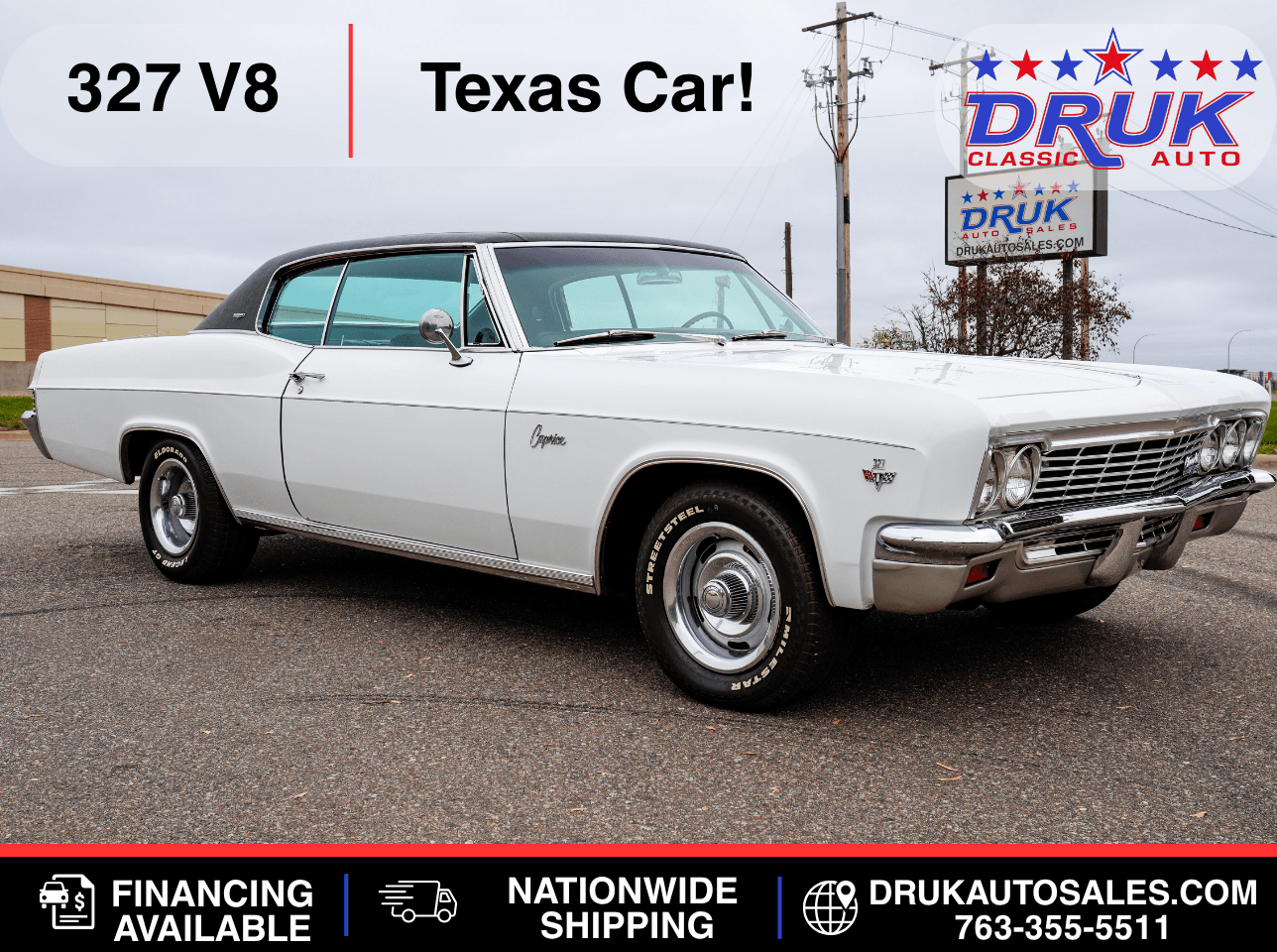 $22,980 · 7% below typical
Expand
What they sell for: Caprice Hardtop sale prices.