
Ford F-Super Duty buyer's guide
Ford F-Super Duty -- the model's own buyer's guide: variants, values and what to check.
Years listed: 1989-1992 · Series: F-Series
# Ford F-Super Duty (1988–1997) — Shopping Guide
Overview and history
The F-Super Duty is the truck Ford built for buyers who had outgrown a one-ton pickup but did not want a medium-duty lorry. Launched for the 1988 model year and built through 1997, it sits a full class above the F-350: a Class 4 chassis cab rated at 15,000 lb gross vehicle weight, sold without a pickup bed and intended from day one to carry something built by somebody else — a dump body, a flatbed, a wrecker, a service body, a box, or an ambulance module. If you are shopping for one today, that is still the proposition. You are not buying a trim level. You are buying a frame, a heavy rear axle, big brakes and an engine, with a body on top whose condition is a separate negotiation.
Two clarifications before anything else, because the name causes endless confusion. First, this truck was never officially sold as an F-450. Sellers, insurers and registration documents call it that constantly, because it occupies exactly the slot the F-450 took over in 1999, but the badges, the door label and the build records say F-Super Duty, and the distinction matters when you order parts. Second, it has nothing mechanically in common with the 1999-onwards Super Duty range beyond the job description. The later truck is a clean-sheet design; this one is the last and heaviest development of the old F-Series line, built at Ford's Kentucky Truck Plant in Louisville alongside the pickups it out-muscled.
Ford sold it in one configuration only: a regular cab, two-wheel drive, dual rear wheels, as an incomplete chassis cab. There was no factory crew cab, no factory pickup bed and — this surprises people — no factory four-wheel drive. Four-wheel-drive examples exist, but they are conversions, most often by Quigley or Marmon-Herrington, and their front axles, transfer cases and paperwork need checking as conversion work, not as Ford work. What you chose at the dealer was the wheelbase — 137, 161 or 185 inches, giving roughly 60, 84 or 108 inches from the back of the cab to the rear axle centreline — the engine, the gearbox, and the rear axle ratio. Everything behind the cab was the upfitter's problem.
The run splits cleanly in two at the 1992 facelift. The 1988–1991 trucks wear the flat, upright “brick nose” of the eighth-generation F-Series; the 1992–1997 trucks wear the rounded ninth-generation front — the shape everyone now calls the OBS — with flush headlamps, a softer grille and a revised interior. Underneath, the story is the same heavy hardware throughout, with the big developments concentrated in the diesel bay: the indirect-injection 7.3 arrived with the truck in 1988, gained a factory turbo for 1993, and was replaced part-way through 1994 by the direct-injection Power Stroke, which carried the model to the end of production in 1997. The 7.5-litre 460 petrol V8 was there from first to last for buyers who did not want a diesel.
Why buy one now? Because it does work that modern trucks do with electronics, computers and emissions equipment, using a mechanical injection pump or a distributor-era petrol V8, a frame you can weld, and brakes and axles sized with real margin. Ex-fire and ex-ambulance trucks in particular surface regularly with low road miles, documented fleet maintenance and enormous idle hours — a combination this guide will teach you to read properly. The pool on this site is tiny — four records at the time of writing, three offered for sale and one recorded sold, spanning 1989 to 1997 — which tells you the honest truth about the market: these were commercial tools, most were worked to death, and the survivors are scattered. You shop nationally, you shop patiently, and you judge the individual truck in front of you, because there is no deep market of alternatives to fall back on.

The models
There is only one model — but there are four distinct trucks hiding under the badge, separated by engine and era, and they drive, break and hold value differently enough that you should decide which one you are shopping for before you travel to see anything.
The petrol truck is the simplest. The 460 EFI V8 was offered for the whole run and suits the buyer who does short, local, heavy work: a dump body on a landscaping round, a flatbed on a farm, a wrecker on local recovery. It is smooth, quiet by the standards of this class, cheap to keep alive, and catastrophically thirsty under load. The early diesel is the indirect-injection 7.3, naturally aspirated from 1988 to 1992: mechanically injected, happy to run forever on indifferent maintenance, and genuinely slow when loaded — a truck that works at the pace of a tractor and lasts like one. For 1993 and the first half of 1994 Ford fitted a factory turbocharged version of the same engine, which closes much of the performance gap without adding a single computer.
The truck most buyers actually want is the last one: the 7.3 Power Stroke, fitted from part-way through the 1994 model year to the end in 1997. Direct injection, an electronically controlled high-pressure oil system driving the injectors, and a proper turbocharger give it the torque to pull a loaded dump body up a grade at road speed, and it responds to the mild tuning the OBS world knows well. It is also the most complex engine here by a wide margin, and the one where a cheap example can hurt you. Section 3 takes each engine apart in turn.
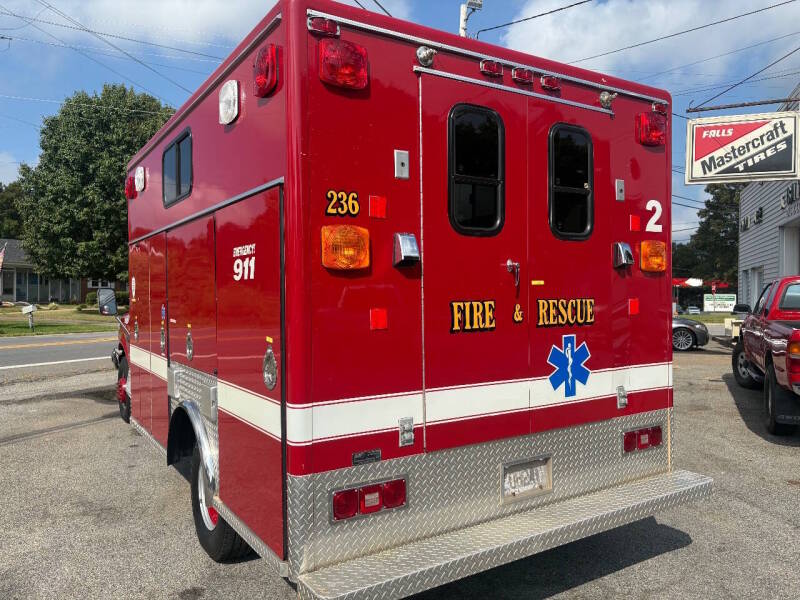
Wheelbase is the other decision, and it is dictated by the body you need. The 137-inch truck with its 60-inch cab-to-axle is the dump and flatbed length — manoeuvrable, and the commonest survivor. The 161-inch, 84-inch cab-to-axle chassis carries longer flatbeds, service bodies and wreckers. The 185-inch, 108-inch cab-to-axle chassis is ambulance and box-truck territory: the red truck pictured in this guide, a 1992 carrying a full fire-and-rescue ambulance module, is exactly what the long chassis was built for. Do not buy a long chassis intending to shorten it into a dump truck, or a short one hoping to stretch it; the frame, the driveshaft and the title all argue against you, and the right length exists if you wait.
Trim is almost irrelevant. Cabs are XL-grade working interiors in the main — vinyl or cloth bench, rubber floor covering on many, wind-up windows on plenty — with XLT appointments appearing occasionally on later trucks. Air conditioning was a common and worthwhile option; cruise control, a tachometer and an auxiliary idle control matter more on an ex-ambulance than anywhere else. What actually differentiates one truck from another is the body behind the cab, and bodies do not appear in any model table: a galvanised steel dump body with a scissor hoist, an aluminium flatbed, a steel service body with rusting door shuts, a fibreglass or aluminium ambulance module with its own electrical system, its own heater and air conditioning, and its own maintenance history. Budget your inspection time accordingly — an hour on the chassis and engine, and at least as long on the body and its hydraulics.
| Model | Years | Engine | Output | Built | Character |
|---|---|---|---|---|---|
| F-Super Duty 460 | 1988–1997 | 7.5-litre (460 cu in) V8 petrol, EFI | Around 230 hp, 410 lb-ft | Not separately published | The simple local-work truck; smooth, strong, very thirsty |
| F-Super Duty 7.3 IDI | 1988–1992 | 7.3-litre V8 diesel, indirect injection, naturally aspirated | Around 180 hp, 345 lb-ft | Not separately published | Mechanical, unkillable, slow; the tractor of the range |
| F-Super Duty 7.3 IDI Turbo | 1993–1994 | 7.3-litre V8 diesel, indirect injection, factory turbo | Around 190 hp, 385 lb-ft | Not separately published | The IDI with the performance gap closed; no computers |
| F-Super Duty 7.3 Power Stroke | 1994½–1997 | 7.3-litre V8 diesel, direct injection, HEUI, turbo | 210 hp rising to around 225 hp, 425–480 lb-ft | Not separately published | The one most buyers want; strongest, most complex |
Ford did not publish a clean F-Super Duty-only production total by engine, and any source that gives you a precise figure for one variant is guessing. Treat the table's outputs as period ratings that varied slightly by year and emissions market, and verify the individual truck by its VIN and door label, as the inspection section explains.

Engines and gearboxes
Three engines, all V8s, all built for torque at low speed, and each with a personality so distinct that the engine choice is effectively the model choice. Learn the eighth character of the VIN before you shop: on these trucks it is the engine code, and it settles arguments. G is the 460 petrol, M is the indirect-injection 7.3 diesel, and F is the Power Stroke. A seller who describes an M-code truck as a Power Stroke is either confused or hoping you are; the under-bonnet evidence in this section will tell you which engine you are actually looking at in under a minute.
The 460 petrol V8 (7.5 litres)
The 460 is Ford's big-block in its last and mildest form: a cast-iron 385-series V8, in production in various guises since 1968, here fitted with multi-point electronic fuel injection from the model's 1988 launch — no carburetted F-Super Duty exists, whatever a listing says. Output sits around 230 hp with 410 lb-ft of torque arriving low, which is the number that matters in a truck that grosses seven and a half tons. It is an understressed, lazy, enormously durable engine that will pull a loaded dump body away from a junction without drama and then drink petrol at a rate you should budget for honestly: single figures per gallon loaded is normal working life, not a fault.
Its weaknesses are age and heat, not design. The exhaust manifolds crack and, more often, snap their outer studs in the heads, giving the classic cold-start tick that quiets as the manifold expands; budget $400–$900 per side to have broken studs extracted and manifolds replaced or planed, and check whether a previous owner has already done the job with the manifolds off, because studs that snap during your ownership are a head-off risk. The TFI ignition module on the distributor is a known heat failure that causes a hot no-start or a sudden cut-out; a $40 spare in the glovebox is cheap insurance. The speed-density injection system depends on its MAP sensor and vacuum signal, so perished vacuum hoses cause hunting idle and rich running that sellers blame on the injectors; the regulator on the fuel rail can leak into its vacuum hose, which you find by pulling the hose and smelling for petrol. Smog-era plumbing — air pump, EGR, miles of vacuum line — is all still present on most trucks and all perishing together. Oil leaks come from the rear main seal and the valve covers, in that order of expense. None of this is exotic, every part is cheap and available, and any competent general mechanic can work on it, which is precisely the 460's appeal in 2026: it is the engine a rural buyer can keep alive indefinitely without a diesel specialist.
The 7.3 IDI diesel (1988–1994)
The indirect-injection 7.3 was designed and built by International — Navistar — and it is a pre-chamber diesel in the old style: a Stanadyne DB2 rotary mechanical injection pump, mechanical injectors, no engine computer of any kind, and a glow-plug system to light it on cold mornings. Naturally aspirated trucks make around 180 hp; the factory-turbo version fitted for 1993 and early 1994, using a wastegated turbocharger, makes around 190 hp with a useful torque increase and transforms a loaded truck on a grade without changing the engine's character. This is the engine for the buyer who values the ability to diagnose a fault with a spanner and a test light over outright pace.
Three systems decide whether an IDI is a good one. First, the cooling system and its chemistry. The IDI's cylinder liners are vulnerable to cavitation erosion — coolant-side pinholing of the cylinder walls caused by liner vibration — if the supplemental coolant additives (SCAs) were never maintained. You cannot see cavitation without stripping the engine, so you buy the paperwork: fleet records showing additive testing, or a coolant test strip in front of you showing the SCA level in range. A truck with no coolant history is priced as a risk, full stop. Second, the fuel system. The DB2 pump wears with age and low-lubricity modern diesel; the classic symptom is a truck that starts cold, then refuses a hot restart after a heat soak, or hunts and stalls as air leaks in through perished fuel return lines and injector caps on top of the engine. A pump rebuild runs roughly $800–$1,500 exchange; return-line kits are cheap and should be treated as a service item. Third, the glow-plug system: the controller and the plugs themselves. Swollen plug tips from cheap or incorrect plugs can break off in the pre-chamber during removal, turning a $100 job into a head-off job, so ask which plugs are fitted — the correct Motorcraft/Beru plugs are the ones you want to hear named.
Beyond those, the IDI asks for the usual diesel diligence: a mechanical lift pump that can leak fuel into the crankcase and dilute the oil (smell the dipstick), a CDR valve on the valve cover that vents crankcase vapour and can clog, and oil consumption that should be modest. Blue smoke at start-up that clears is glow-plug or injector wear; white smoke that persists is air in the fuel or low compression; black smoke under load on a turbo truck is over-fuelling or a boost leak. The engine itself — block, crank, rods — is famously long-lived, and 300,000 miles is unremarkable on a maintained example. What kills IDIs is cavitation, cooked electrics and neglect, not mileage.
The 7.3 Power Stroke (1994½–1997)
The Power Stroke is a different engine wearing the same displacement. Built again by Navistar but to a new design, it uses direct injection with HEUI injectors — Hydraulically Actuated, Electronically controlled Unit Injectors — in which engine oil, pressurised by a cam-driven high-pressure oil pump (the HPOP) to as much as 3,000 psi, does the work of injection under the control of an engine computer and an injector driver module (IDM). There is no throttle cable to a pump, no mechanical governor, and no way to make it run with the electronics dead. Early trucks make 210 hp; ratings rose through the run to around 225 hp, with torque between 425 and 480 lb-ft depending on year and market. In a working truck the difference over the IDI is not subtle: it starts cleaner, pulls harder everywhere, and cruises a loaded truck at speeds the IDI reaches only downhill.
Its failure modes are electronic and hydraulic rather than mechanical, and most are cheap if you know them. The camshaft position sensor (CPS) is the famous one: it fails with heat and age and the engine simply stops, or will not restart hot, with the tachometer dead during cranking as your clue. A quality replacement is $30–$60, fits with one bolt, and every Power Stroke owner should carry a spare — a seller whose truck “sometimes just dies” is describing a CPS until proved otherwise. The wiring that runs under the valve covers to the injectors and glow plugs (the UVCH) chafes and its connectors melt, dropping one bank of injectors and giving a violent misfire that owners misdiagnose as a dead engine; harnesses are inexpensive, the valve covers come off easily, and a truck that runs on four cylinders intermittently is often this $100 fault. The IPR valve and ICP sensor govern oil pressure for injection: a sticking IPR causes surging, stalling and hard starting, and an ICP sensor weeping oil into its connector causes erratic running that unplugging the sensor (the computer defaults to a map) will confirm on the spot. The fuel system is a cam-driven mechanical pump sitting in the valley on these early trucks, feeding a filter bowl whose electric heater can short and blow the fuse that also feeds the computer — a no-start with no wait-to-start light is that fuse until proved otherwise. Turbo pedestal O-rings and the exhaust back-pressure valve weep oil into the valley, where it runs down the back of the engine and is misreported as a rear main seal leak by sellers who should know better; valley oil on a Power Stroke is a diagnosis to make, not a walk-away. Glow-plug relays fail far more often than glow plugs on this engine, and a $40 relay cures the smoky, reluctant cold start that owners blame on the plugs.
Two Power Stroke jobs carry real money and belong in your price negotiation. The oil pan rusts from the outside in, and replacing it properly means lifting the engine — a $1,500–$2,500 job at a shop, which is why you get underneath with a magnet and a light and grade the pan's scaling before you bid. And the up-pipes between the manifolds and the turbo leak at their donut gaskets, sooting the firewall and costing boost; listen for the hiss under load and look for soot. Compression, the bottom end and the turbo itself are strong; a Power Stroke that starts cleanly hot and cold, idles evenly and pulls without surge is usually an engine whose expensive parts are fine and whose faults live in the $50–$300 band. That is the bargain of the range.
Gearboxes
Three gearboxes cover the run, and the parking brake story matters as much as the shift quality. Manual trucks use the ZF S5-42 five-speed, a German-built heavy box with a granny-low first gear that suits a chassis cab perfectly. It is strong, but synchromesh wear on second and third shows as crunching on fast shifts, the diesel trucks were fitted with a dual-mass flywheel whose failure gives a rattling idle and a juddering take-up (many have been converted to a single-mass flywheel and conventional clutch, which is an acceptable, even desirable, modification if documented), and the hydraulic clutch linkage is all-plastic, with a master cylinder mounted on a firewall that flexes and eventually cracks on OBS cabs — look for the crack and for a reinforcement plate already fitted. A clutch is a $700–$1,200 job; a gearbox rebuild roughly $1,500–$2,500.
Automatic trucks began with the C6 three-speed: no overdrive, no electronics, essentially unbreakable behind either engine, and priced accordingly at the fuel pump, because a C6 truck turns serious rpm at motorway speed. From 1989 the E4OD four-speed overdrive automatic took over and most automatics you meet will be E4ODs. It is a good gearbox when it has been kept cool and a money pit when it has not. Heat is its enemy: insist on evidence of an auxiliary cooler on a worked truck, feel for torque-converter lock-up shudder at light throttle around 40–50 mph, and check for the waterlogged MLPS switch on the side of the case, whose corrosion causes harsh or missing shifts, failure to start in Park and other electrical ghosts that are blamed on the gearbox itself. A full E4OD rebuild with updates runs roughly $2,500–$4,000, so a vague, flare-y shift quality is a four-figure deduction, not a shrug.
Finally, the parking brake. Automatic F-Super Dutys use a driveline parking brake — a drum on the transmission output — rather than relying on the rear wheel brakes alone, because there is no parking pawl arrangement rated for this weight. The drum wears, the cable stretches and the mechanism seizes, and because it sits behind the transmission it is ignored until it either fails to hold the truck on a ramp or drags and cooks itself. Test it on a slope at every viewing, price its overhaul into any automatic, and never trust it as your only security while you are underneath: chock the wheels.

Problem areas
Everything in the engine section is about the engine you chose. Everything here is about the truck all of them share: a heavy chassis, a working cab and a body somebody else built, all now between twenty-nine and thirty-eight years old. A note on evidence before the catalogue: this site's own photo-note sample for the F-Super Duty is a single examined car, in which none of rust, smoke, leaks or damage was recorded. A sample of one proves nothing in either direction — it neither clears the model nor condemns it — so the guidance below rests on the model's documented behaviour in service, and your own inspection carries the full weight it should.
Rust, frame and cab structure
Rust on a pickup is cosmetic until it isn't. Rust on a chassis cab is structural sooner, because the frame is the truck. Start with the frame rails themselves, behind the rear axle and around the spring hangers, where road salt and body washings collect and where a dump body dribbles its loads. Surface scale is normal at this age; lamination — layers of rust flaking like pastry, swelling the rail — is a walk-away on a truck you intend to load, because the rail sections around the rear hangers carry the body's weight. Tap with a small hammer or screwdriver handle and listen for the change from ring to thud. Check the crossmembers under the cab and body, the fuel tank straps and the tank itself, and the spare-wheel carrier area at the very back, which rots quietly out of sight.
The cab rusts in the OBS pattern: cab corners behind the doors, the bottoms of the doors themselves, the rocker panels, the rear wheel-arch lips of the cab (there is no bed to hide behind on a chassis cab, which makes the cab's condition unusually visible — use that), the drip rails, and the floor where wet boots and a perished windscreen seal feed it. Cab mounts deserve their own check: the rubber perishes, the steel cups rust, and a cab sitting visibly crooked on the frame or thumping over bumps is telling you the mounts have gone. On a truck with a heavy body, also sight down the frame from behind: a chassis that was overloaded in a previous life can carry a permanent set, and a body that sits level on a bent frame is evidence, not luck.
Bodies rust to their own rules, and you inspect the body as a second vehicle. Steel dump bodies rot at the floor-to-side seams, around the hoist ram and along the subframe rails; check the hoist hydraulics for weeping ram seals and chafed hoses, and never — under any circumstances — work or reach under a raised body that is not propped with its safety stand: a body that drops kills, and sellers who raise a body for your inspection without propping it are telling you something about their standards. Aluminium bodies do not rust but crack around mounts and door hinges and corrode where they meet steel subframes. Ambulance modules like the red 1992 truck in this guide are usually aluminium or fibreglass over a steel subframe, so the rust hunt concentrates on the subframe, the module mounts, the rear step bumper and the compartment door frames; the module's own enemies are water ingress through roof seams and marker-light holes, and delamination or soft floors where leaks have stood.
Steering, suspension and brakes
The front end is heavy-truck simple: a solid beam axle on leaf springs, unique to the F-Super Duty in the F-Series line, with steering through a linkage that wears at every joint it has. Jack the front up — properly, with stands — and rock each wheel top and bottom and side to side: play at the pivots and wheel bearings shows in the first test, steering linkage play in the second. On the road, wander that the driver corrects constantly, a steering box with a dead band either side of straight-ahead, and uneven front tyre wear are the same story told three ways. The steering box itself wears and leaks at the sector shaft; a box adjustment can mask wear briefly, so a truck that steers sweetly but shows a freshly turned adjuster deserves a second look. Leaf springs sag, crack leaves (look along each pack for the tell-tale stepped leaf end) and wear their bushings and shackles; rear springs on dump trucks live the hardest life of any component on the vehicle, and a truck sitting low at the back under an empty body has springs that are done, at $600–$1,200 a side fitted to replace properly.
Brakes are the F-Super Duty's period party piece — four-wheel discs at a time when one-ton pickups still ran rear drums — powered through a Hydroboost unit driven by the power-steering pump rather than a vacuum servo, because diesels make no vacuum. The system is strong, and its faults are specific. Hydroboost units weep power-steering fluid at the accumulator and input shaft, and a hard pedal with a whining pump is fluid or pump, not pads. Rear calipers seize on trucks that sit — and ex-fleet trucks sit for months between sale and disposal — so a truck that pulls under braking or shows one hot rear wheel after a test drive is showing you a caliper, at $150–$300 a corner plus discs if they have been cooked. Brake pipes corrode along the frame rail and above the rear axle, flex hoses perish, and the rear-wheel anti-lock system (RABS) valve can give a soft, long pedal that bleeding never quite cures. Add the driveline parking brake from the gearbox section — test it loaded, on a slope — and you have the full brake inspection. None of it is exotic; all of it is heavy, and a truck that stops straight, hard and repeatedly from speed is worth real money over one that nearly does.
Tyres are a chassis-cab expense buyers under-budget: six of them, in a commercial size on ten-lug 16-inch steel wheels, and on a dually the inner rears are the ones nobody checks. Look at all six, read the date codes, and remember that a set of six respectable tyres fitted is a four-figure bill that a seller with six bald ones has quietly transferred to you. Mismatched sizes across an axle, or a space-saver mentality about the inner dual, tells you how the truck was kept.
The driveline behind the gearbox works as hard as anything on the truck and complains in a vocabulary of its own. The Dana 80 rear axle is close to unbreakable in service, but its pinion seal weeps with age, its wheel seals can contaminate the rear brakes with gear oil — a fault you find as a greasy inner dual and a brake that grabs rather than fades — and its oil is changed on a schedule that worked trucks rarely saw, so budget a drain, an inspection of what comes out, and a refill into any purchase. Driveshafts on the longer wheelbases are multi-piece with centre carrier bearings whose rubber mounts perish, giving a shudder on take-up that owners misdiagnose as clutch or converter trouble; universal joints dry out and chirp before they fail, and a joint that fails at speed under a loaded truck can take the shaft, the brake pipes and the floor with it. Wheel hardware deserves a literal hands-on check: ten studs a corner, duals that must seat flat against each other with nothing trapped between them, and a history — ask it — of wheels run loose, because a dually that has fretted its wheels on elongated stud holes needs wheels and studs, not a torque wrench and optimism.
Cooling, electrics and the working systems
Cooling decides diesel life, and both diesels run big radiators that silt up internally and rot externally at the end tanks. The fan clutch is the silent partner in every overheating story: a truck that runs cool empty and hot loaded, with a fan you can stop with a rolled newspaper at working temperature, needs a clutch, not a radiator. On the IDI, add the SCA chemistry from the engine section. On the Power Stroke, add the water pump weep hole and the degas bottle cap that no longer holds pressure. The 460 simply needs its hoses, its fan clutch and its radiator to be as young as the seller claims.
Electrics are OBS-standard and mostly honest. The ignition switch and its actuator rod in the column cause intermittent no-crank and accessory faults; the headlamp switch overheats its connector on trucks that tow with lights on, melting the plug and dimming the lamps; the alternator — especially the early 2G unit with its plug-in connector on 1988–1991 trucks — is a documented fire risk at the connector and should already have been replaced or upgraded on any survivor, so look and ask. Diesel trucks run two batteries and a web of heavy cables whose corrosion hides under the insulation: voltage-drop symptoms — slow cranking blamed on the starter — are cables until proved otherwise. The wait-to-start and glow-plug circuits on both diesels deserve a cold-morning test, because a truck that starts beautifully at noon in July can be a different animal at dawn in January.
Fuel storage is its own small system on a chassis cab, because the tanks were specified by the upfitter's needs as much as Ford's catalogue: most trucks carry a large aft-axle tank, some carry dual tanks with the OBS selector valve and its dash switch, and every variation shares the same enemies — rusted straps and tank seams, perished filler hoses, and selector valves that stick between tanks, return fuel to the wrong tank and either starve the engine or overflow the fuller tank, a fault owners report as a gauge that lies and a truck that runs out with a quarter showing. On diesels add the tank pickup itself: the plastic shower-head strainer on the pickup tube breaks up with age and heat, and its fragments, drawn against the tube, produce a truck that starves and stalls at around a quarter tank and runs perfectly above it — one of the great misdiagnosed faults of the whole OBS era, cured by dropping the tank, not by changing pumps. Exhaust systems rot from the muffler forward and, on diesels, leak at the manifold joints; on a truck you intend to work, a blowing exhaust under the cab is also a fumes-in-cab fault, and it fails inspections in states that still inspect.
Then there are the systems that make the truck earn: the PTO and hydraulics on dump and wrecker bodies, the liftgate circuits on box trucks, the shoreline power, inverter, module heating and air conditioning on ambulances. Every one of them is upfitter equipment, wired and plumbed to standards that range from aircraft to agricultural, and every one needs operating, not describing. Run the hoist through its full cycle twice. Run the liftgate loaded if you can. On an ambulance, plug in the shoreline, run the module air conditioning, and check the oxygen and suction fittings only for presence — you are buying the module as a camper or workshop shell, and its value is in its structure, its insulation and its storage, not its medical fit-out. Hours matter here as much as miles: municipal trucks idle for a living, an hour meter (where fitted) or fleet records convert a low-mileage truck into the high-hour machine it really is, and engines wear by hours as surely as by miles.


How to inspect one
Inspect in this order: identity first, structure second, engine third, body last — because a truck that fails an early test does not deserve your time on the later ones. Take a torch, a magnet, a small hammer, a tyre gauge, a code reader if it is a Power Stroke, and a friend to work pedals and switches while you watch.
- Settle the identity. Read the VIN plate at the windscreen base and the certification label on the driver's door pillar, and make them agree with the title. Confirm the engine from the eighth VIN character — G for the 460, M for the IDI, F for the Power Stroke — and confirm the truck itself from the hardware: ten-lug wheels and a Dana 80 rear axle say F-Super Duty; eight lugs say you are looking at an F-350 chassis cab wearing the wrong description, and you should price it as one.
- Read the door label properly. Note the GVWR (15,000 lb), the wheelbase code, the axle code and the transmission code, and check them against the truck: the axle ratio fitted should match the code, and a swapped axle in a worked truck is a question, not a detail.
- Do the frame walk. Torch and hammer along both rails, concentrating behind the rear axle, around the spring hangers and under the body mounts, as the rust section describes. Lamination or a bent set in the frame ends the inspection here.
- Grade the cab. Cab corners, door bottoms, rockers, floors and mounts. Open both doors and look at the shut lines; a cab sitting crooked is mounts or frame, and you already know which from step 3.
- Cold-start it — genuinely cold. Arrange to arrive before the engine has run. On a diesel, watch the wait-to-start behaviour, listen for even cranking, and read the exhaust: white smoke that persists is air or compression on an IDI, blue smoke that clears is wear talking, and a Power Stroke that needs two attempts and a prayer has glow-plug relay, battery or cable trouble. A seller who has warmed the truck up for you has answered a question you did not ask.
- Apply the engine tests from section 3. IDI: ask for the coolant SCA history or test it, smell the dipstick for fuel, watch for return-line leaks on top of the engine. Power Stroke: look in the valley for oil and fuel, check the oil pan's rust with your magnet, unplug the ICP sensor if it runs erratically, and confirm it restarts hot after a ten-minute heat soak. 460: listen cold for the exhaust-manifold tick and pull the regulator vacuum hose to sniff for fuel.
- Check the fluids as evidence. Engine oil level and smell, coolant colour and oil contamination either way, transmission fluid colour and burnt smell on an automatic, power-steering fluid level (it runs the Hydroboost brakes as well as the steering). Dirty fluids in a fleet truck are a maintenance confession.
- Jack the front and work the steering. Wheel rock for pivot and bearing play, then lock-to-lock with your friend turning while you watch the linkage for lost motion. Check the steering box for leaks and fresh adjustment marks.
- Brake it properly. Static pedal feel first, then repeated hard stops from speed on the test drive: straight, no pull, no fade, no hot corner afterwards. Then the parking brake test on a real slope — on an automatic this is the driveline brake from the gearbox section, and it must hold the truck alone.
- Drive it loaded with questions. An empty chassis cab rides like a pogo stick and tells you little; even so, feel for E4OD lock-up shudder at light throttle, ZF synchro crunch on second and third, axle whine on the overrun, and wander at speed. If the seller will allow weight in the body or a trailer behind, take the offer — half the faults in this guide only report for duty under load.
- Operate the body as a second vehicle. Hoist up and down twice (propped before you look underneath), PTO engaged and disengaged, liftgate cycled, ambulance shoreline plugged in and module systems run. Weeping rams, chafed hoses and cracked body floors are priced as body repairs, separately from the truck.
- Count the tyres and close the file. Six tyres, six date codes, pressures including the inner duals you have to kneel for. Then the paperwork: title status, fleet maintenance records if it is an ex-municipal truck, recall and lien sanity, and — on a conversion — the converter's plate and documentation for any four-wheel-drive or special body work. A truck that passes steps 1–11 with honest paperwork is the truck to negotiate on; the negotiation itself belongs to the Values section.
Values
The F-Super Duty market is thin, scattered and unusually honest, because the buyers are mostly people who need the truck to work and the sellers are mostly fleets and small businesses who have finished with it. Learn to read it on those terms. There is no meaningful price guide for a model sold in these numbers with this variety of bodies, and the spread between the cheapest and dearest example on sale at any moment tells you almost nothing until you decompose it — because you are never comparing like with like. A price here is a chassis price, an engine price and a body price added together, and the same money buys a worn diesel under a rotten dump body or a sound petrol truck under a good flatbed.
Condition drives the spread more than year or mileage. The step from project to working truck is the widest in the model's market: a non-running or structurally tired example is worth its engine, its axle and its body hardware to the man who breaks it, while a truck that starts cold, stops straight, hoists its body and holds its driveline brake is worth a multiple of that to the man who will put it to work on Monday — and both men are bidding in the same small market. Hours complicate mileage in a way unique to this class: an ex-ambulance showing modest miles may have idled the equivalent of several times that distance, and a fleet-maintained high-miler may be the younger engine in every way that matters. Price the evidence — records, cold starts, SCA history on an IDI, oil-pan condition on a Power Stroke — not the odometer.
Variant premiums follow usefulness. The Power Stroke carries the strongest demand and the clearest premium, because it is the only version that pulls modern loads at modern speeds, and a late, straight, well-documented example is the model's blue-chip. The factory-turbo IDI is the connoisseur's compromise and is quietly appreciated for it. The naturally aspirated IDI is valued by the mechanical-purist minority and priced gently by everyone else. The 460 is the value end of the market for local work and the hardest to sell to anyone who counts fuel costs by the month. Bodies move money as much as engines: a sound aluminium dump body or a clean, dry ambulance module adds real value; a rusted steel body subtracts its removal cost.
Asking prices and achieved prices part company at the extremes. Municipal and fleet disposals — auctions, sealed bids, surplus sales — set the floor honestly and are where the bargains and the horrors both live, sold as seen with the paperwork as the only inspection. Dealer asking prices for prepared trucks carry the preparation: tyres, brakes, fluids and a body that works, and on a truck where six tyres alone are a serious bill, that preparation is worth paying for if it is real and itemised. Private sellers of ex-fleet trucks often ask dealer money for auction condition; the gap between the two is your negotiation, and it is conducted with the inspection list in your hand, item by item — oil pan, parking brake, hoist seals, tyre dates — rather than with a percentage off. Buy the best-documented truck you can find, in the wheelbase your work needs, and let the engine premium fall where the evidence puts it.
Parts and ownership
Ownership is the F-Super Duty's quiet strength: it is a Ford truck of the most numerous era, built from the same parts bin as millions of F-150s, F-250s and F-350s, and the supply chain has never really closed. Cab, glass, interior, lighting, steering and front-end service parts interchange widely with the pickups and are available new, used and reproduction. Engine service parts for all three engines are ordinary over-the-counter items — filters, belts, hoses, water pumps, starters, alternators — and the 7.3 diesels enjoy a specialist aftermarket that borders on an industry: injection pumps and injectors for the IDI on exchange, and for the Power Stroke a complete ecosystem of sensors, harnesses, high-pressure oil components and proven upgrades sold by diesel specialists who know the engine by its first name.
The F-Super Duty-specific hardware needs more thought but no panic. The Dana 80 rear axle is shared with later heavy Fords and contemporary Dodge one-tons, so bearings, seals, gears and brake parts are findable; the four-wheel disc brake hardware is specific enough that you should order by VIN and expect the occasional superseded number rather than a bare shelf. Ten-lug 16-inch wheels are no longer a new-item at every tyre shop, but good used wheels circulate and the tyre size itself remains a live commercial fitment. Driveline parking-brake components for the automatics are the closest thing to a hunt on the truck — serviceable through transmission and brake specialists rather than the general counter, and another reason to keep yours adjusted and working rather than letting it seize into obsolescence.
Running one is a commercial vehicle's routine, not a classic car's hobby schedule. Grease and fluid discipline, coolant chemistry maintained on the IDI, fuel filters on schedule on both diesels, transmission fluid and cooling respected on the E4OD, and an annual date with the frame, the brake pipes and the body mounts. Insurance and registration follow its commercial nature in most states — weight-based registration, and a conversation with your insurer about the body fitted — and some owners are surprised by commercial-vehicle requirements at this GVWR, so settle both before purchase rather than after. Fuel is the running cost that dominates every other: the diesels earn their premium back in working economy, and the 460's appetite is the price of its simplicity, as section 3 warned. Find your people early: an OBS Ford forum, a 7.3 specialist within towing distance, and a hydraulic shop for the body. With those three, there is very little on this truck that cannot be fixed, which — thirty years on — is the whole point of it.
Which one to buy
- The all-rounder: a 1995–1997 Power Stroke on the 137-inch chassis with a dump or flatbed body. The strongest engine in its most developed form, under the most useful body lengths, with the best parts support. This is the truck to buy if you are buying one truck.
- The value buy: a 460 on any chassis with a sound body. Petrol trucks are the cheapest way into the class, cost the least to keep alive, and make perfect sense for local, seasonal, low-mileage work where fuel is a minor line in the budget.
- The purist's pick: a 1993–1994 IDI Turbo with a manual gearbox. Mechanical injection, a factory turbo, no engine computer anywhere, and a ZF five-speed. Slower than a Power Stroke and simpler than anything built since.
- The conversion base: an ex-ambulance on the 185-inch chassis, IDI or Power Stroke. A dry, insulated, wired module on the longest chassis is a camper, workshop or expedition shell that would cost a fortune to replicate — bought for the price of a used truck, if the subframe and module mounts pass inspection.
- The fleet bargain: a documented ex-municipal truck, any engine, bought on its records. Fleet maintenance paperwork is worth more than low miles on this model; a serviced 200,000-mile truck beats a neglected 90,000-mile one every time.
The overriding rule: buy the frame, the brakes and the paperwork — engines can be repaired, bodies can be swapped, but a laminated frame or an undocumented diesel ends the argument. The best F-Super Duty is the one whose structure is honest and whose history you can read, whatever engine sits in it.
See the 2 F-Super Duty cars currently listed.
For sale now
 $19,950 · 41% above typical
Expand
What they sell for: F-Super Duty sale prices.