
Mercedes-Benz S-Class buyer's guide
Mercedes-Benz S-Class -- the model's own buyer's guide: variants, values and what to check.
Years listed: 1986-1991 · Series: W126
Overview and history
The 560SEL is the flagship of the W126 S-Class range and, for the American market, the biggest and most powerful sedan Mercedes-Benz sold in the 1980s. The W126 itself was launched in Europe in late 1979 as the successor to the W116, styled under Bruno Sacco with a drag coefficient that embarrassed sports cars of the day, and built around Béla Barényi's safety-cell thinking: a rigid passenger cage, deformable ends, offset-collision strength designed in rather than added on. It was the car that made "S-Class" a byword, and it stayed in production for twelve years — a long run that tells you how right Mercedes got it the first time.
The range was refreshed for the 1986 model year in North America with the second-generation cars, and that is where the 560SEL arrives. Until then the top US model had been the 380SEL and then the 500SEL — respectable, neither truly fast by American flagship standards. The 560 answered that: a 5.6-litre version of the M117 V8 in the long-wheelbase SEL body, with every piece of equipment Mercedes knew how to build already standard. This was not a car you optioned up. Heated seats front and rear, an electrically reclining rear bench, burl walnut, self-levelling rear suspension, anti-lock brakes, a driver's airbag — the catalogue was thrown at it, because it was sold against the best Cadillac and Lincoln could build.
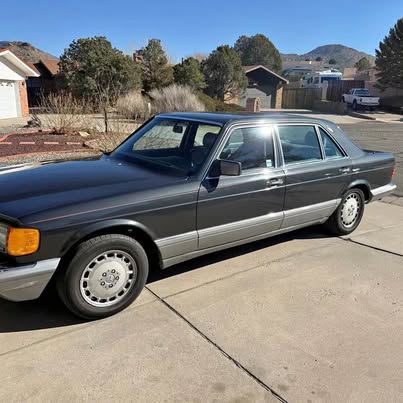
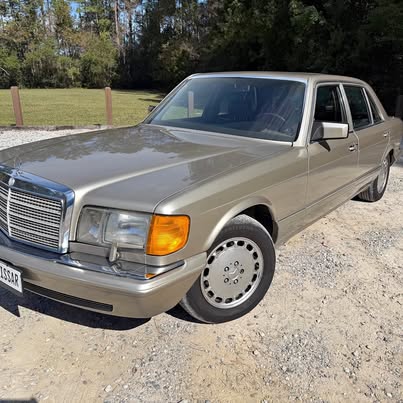
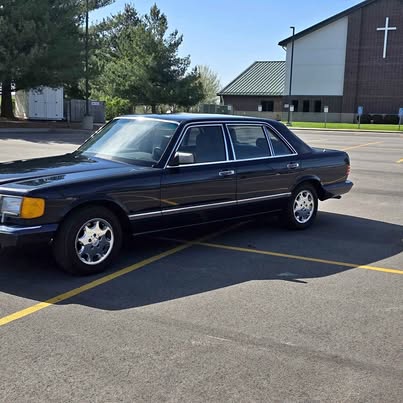
The SEL part of the badge matters. The L adds 140 mm — about five and a half inches — to the standard wheelbase, every millimetre of it in the rear doors and rear legroom. Stand beside one and read the proportions: the rear door is visibly longer than the front. That is the SEL tell, and it is worth learning, because the shorter 560SE was a European-market car never officially sold in the United States; a short-wheelbase "560" in America is either a grey import or a badge, and the long rear door settles which car you are looking at before you ever open the paperwork.
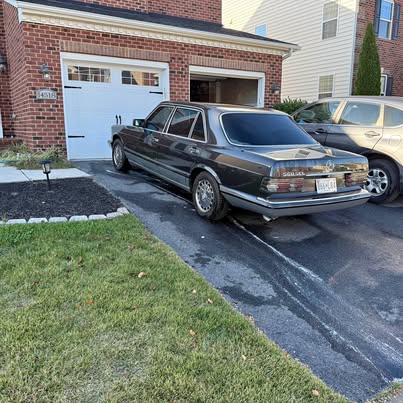
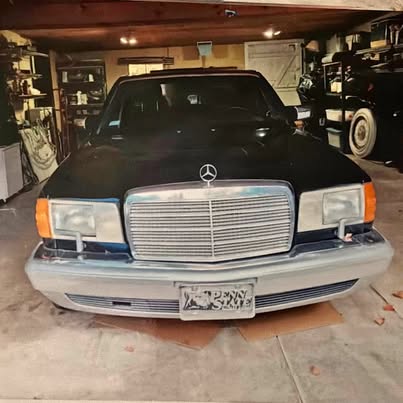
On our own listings we currently track five 560SELs, all of them for sale and all sourced from Facebook Marketplace sellers, spanning 1986 to 1990 and spread across Illinois, Louisiana, Iowa, Washington DC and Pennsylvania. That small, scattered sample is a fair picture of where these cars live now: not in dealer showrooms, but in private hands, in ordinary colours — black twice in our five, plus gold, blue and charcoal — being sold on by owners who have often had them a long time. The newest of them is now well over three decades old. Every 560SEL you inspect is an old car, and should be bought as one: on condition, on history, and on the state of a short list of known systems, all of which this guide works through.
What makes the 560SEL worth the effort is that the fundamentals are superb. The M117 V8 is one of the most durable petrol engines Mercedes ever built. The body was galvanised and wax-injected to a standard the earlier generations never enjoyed, so the terminal structural rust that kills a W116 is the exception here rather than the rule. The interior was built from materials — thick leather, real wood veneer, deep carpet — that age gracefully when the car has been garaged and disgracefully when it has not, which makes the cabin an honest witness. A good 560SEL is a genuinely usable modern-road classic: quiet, torquey, and capable of crossing a continent at the speed limit in a way no 1970s sedan can match. A bad one is a parts car wearing a flagship badge. The distance between the two is what the rest of this guide is about.
The models
There is only one 560SEL, but it is not one car. Production ran from the 1986 to the 1991 model year in the United States, the specification evolved in detail across that run, and the European-market cars — built in the same years but rarely seen in America — are different machines again, with substantially more power. Knowing which version you are standing in front of matters, because the premium, the running costs and the parts questions all shift with it.
| Model | Years | Engine | Output | Built | Character |
|---|---|---|---|---|---|
| 560SEL (US) | 1986–1988 | 5.6 V8 (M117.968), KE-Jetronic | 238 hp | part of 75,071 | The original US flagship; earlier interior trim |
| 560SEL (US) | 1989–1991 | 5.6 V8 (M117.968), KE-Jetronic | 238 hp | part of 75,071 | Updated cabin, passenger airbag era, the most refined |
| 560SEL (ECE, Europe) | 1985–1991 | 5.6 V8 (M117.968), KE-Jetronic | 272 hp | part of 75,071 | Catalyst European car; stronger than the US version |
| 560SEL (RÜF, Europe) | 1985–1987 | 5.6 V8 (M117.968), K-Jetronic era spec | 300 hp | small share of total | The uncatalysed high-compression car; the fastest W126 sedan |
| 560SE (Europe) | 1988–1991 | 5.6 V8 (M117.968), KE-Jetronic | 272 hp | 1,251 | Short-wheelbase sister; never officially sold in the US |
(Outputs are period figures: SAE net for the US cars, DIN for the European ones, which is part of why the gap looks as large as it does — though most of the gap is real, and comes from compression ratio and emissions equipment. Total 560SEL production across all markets was 75,071 cars. The 560SE figure is the commonly quoted production total for that short-wheelbase variant.)
The US cars. Every officially imported 560SEL is the same basic proposition: the long-wheelbase body, the 238 hp catalysed M117.968, the four-speed automatic, self-levelling rear suspension, and an equipment list that left almost nothing on the options page beyond a car phone. Within the run, the split that matters is 1989. The later cars received a revised interior with improved seats and updated trim, and — as the run went on — a passenger-side airbag joined the driver's bag fitted from the start. None of this changes the driving experience; it changes how fresh the cabin feels and how a collector reads the car. Buy on condition first, but given two equal cars, the 1989–91 is the one most buyers would rather own.
The European cars. A European-delivery 560SEL is a meaningfully quicker car. The catalyst ECE version makes 272 hp, and the early uncatalysed RÜF version — RÜF is simply the factory designation for the version built without catalyst preparation — makes 300 hp from a higher-compression engine, enough to make it the fastest production sedan Mercedes had ever sold to that point. These cars reached America only as grey imports, and they carry the usual questions: federalisation work of variable quality, lighting and bumper conversions, re-faced speedometers, and emissions paperwork that matters in states that test. A documented, cleanly imported ECE or RÜF car is genuinely desirable and worth a premium. An undocumented one is a research project. The chassis number tells you what the car was born as — a US 560SEL is chassis type 126.039 — and the data card settles the original market and equipment, so decode both before paying a European-car premium for a US car with European bumpers, or the reverse.
What the badge does not tell you. Because the 560SEL sat at the top of the range, it has attracted the usual badge games. Lesser W126s — 300SELs, 420SELs — have been re-badged as 560s, and the defence is mechanical, not visual: the 560's engine is the 5.6, its number stamped on the block, and no other US W126 V8 shares its displacement. Judge the car by the chassis number, the engine number and the data card, never by the boot lid — the same rule the W108 guide gives for the 3.5, and for the same reason: the premium rides on the badge, so the badge is the thing that gets faked.
Engines and gearboxes
The M117.968 V8
There is one engine in a US 560SEL: the M117.968, a 5,547 cc all-alloy V8 with a single overhead camshaft per bank, two valves per cylinder and hydraulic lifters. It is a development of the M117 that powered the W116 450SEL and the R107 SL, and it is built the way Mercedes built engines in that era — massively, with a bottom end effectively unburstable in normal use. US cars make 238 hp and, more importantly, 287 lb-ft of torque, arriving low and staying late. This is not an engine that needs revs: it moves the car's two tons with a shrug, which is precisely why so many are still healthy at mileages that would finish lesser engines.
A good M117.968 starts from cold without drama, settles to a smooth, near-silent idle, and pulls without hesitation. Oil pressure should be strong — the gauge pinned at its maximum at road speed, and healthy at a warm idle. These engines do not normally burn oil in quantity; a car needing a quart every few hundred miles is telling you about valve stem seals at best and ring and bore wear at worst, distinguished the old way: blue smoke on the overrun and after a long idle, clearing under load, is seals and guides; smoke under hard acceleration is rings, and that is an engine-out conversation at $4,000–7,000 for a proper rebuild.
The engine's one scheduled-life component, and the single most important mechanical check on the whole car, is the timing chain drive. The chain is a single-row design running over plastic guide rails, with a hydraulic tensioner. The chain stretches slowly; the rails are the problem. The upper rails go brittle with age and heat cycles, and a rail that breaks can let the chain jump — on an interference engine, that means valves meeting pistons and a top-end rebuild at minimum. The service convention is chain, rails and tensioner at around 100,000 miles or ten years, at roughly $1,500–2,500 done properly. The test on a viewing is the cold start: a brief rattle while the tensioner takes up is acceptable on a car that has been sitting; a rattle that persists, or any slapping from the front of the engine at idle, is the chain drive asking for money. Ask for the invoice. On a car with no record of the job and six figures on the odometer, price it into your offer as a certainty, not a possibility.
Valve stem seals harden with age and are the commonest cause of oil consumption and a puff of blue on start-up after sitting. The job can be done with the heads in place by a specialist, roughly $800–1,500. Hydraulic lifters that tick for the first seconds after a cold start and then quieten are normal; a lifter that ticks permanently is either starved by low oil pressure — check the gauge's story first — or collapsed, and lifter replacement is a cam-cover-off job usually combined with the stem seals and a chain inspection. The camshafts wear if the oil spray bar tubes above them block or oil changes were skipped; a look through the oil filler for scoring and sludge takes ten seconds and is worth doing on every car.
Cooling deserves respect. The M117 runs a viscous fan coupling, a large radiator and an electric auxiliary fan, and the alloy heads do not forgive an overheat the way an iron engine might. A temperature gauge that climbs in traffic points first to the viscous coupling — test it by the resistance it offers when the engine is hot and switched off — then to a radiator furred up after decades of indifferent coolant, then to the auxiliary fan and its relay. Budget $600–1,200 for a radiator and coupling refresh on a car that runs hot, and walk away from any car with evidence of a serious past overheat unless the price already reflects a head-gasket conversation; head gaskets on this engine are a $2,000–3,500 job at a specialist, and they are rarely the only thing found.
Fuel injection, ignition and engine management: KE-Jetronic
The 560SEL uses Bosch KE-Jetronic — CIS-E in American terminology — a development of the continuous mechanical K-Jetronic system with an electronic control unit trimming the mixture through an electro-hydraulic actuator (the EHA) on the fuel distributor, working from an oxygen sensor in closed loop on US cars. It sits at the hinge point between mechanical and electronic injection, and inherits the fault-finding style of both: the base metering is mechanical and very durable, and most running faults come from the electronic trim, the idle control circuit, or simple air leaks — not from the fuel distributor itself.
Understand the cast, because sellers and generalist mechanics misdiagnose these cars expensively. The fuel distributor meters fuel continuously to all eight injectors in proportion to airflow, measured by the air sensor plate. It is expensive — a rebuilt unit runs roughly $800–1,500 exchange — and it is condemned far more often than it fails; internal failure usually follows contaminated fuel or years of standing, not wear. The EHA, the small black actuator bolted to the distributor, adjusts mixture under ECU command; its seals weep fuel with age, and any smell of petrol around the distributor on a running car is the EHA or its O-rings until proven otherwise — a modest parts cost, a fire risk if ignored. The idle speed control valve meters bypass air to hold the idle; when it gums up or fails, the idle hunts, hangs high, or stalls at junctions, and cleaning cures more of them than replacement. The overvoltage protection relay — the OVP — supplies protected power to the ECU and the ABS; its internal fuse and solder joints fail with age, and the classic presentation is a car that is hard to start cold, idles badly, and shows an ABS light, all at once, all from a relay that costs roughly $50–100. It is the first thing a knowledgeable owner checks and the last thing a parts-swapping mechanic does.
Cold starting is handled by a cold-start injector and a thermo-time switch. The diagnostic approach that works is the one the system was designed for: fuel pressures first, measured with a gauge set — system pressure should sit around 5.2–5.6 bar, with control pressure varying by temperature and ECU trim — then duty cycle at the diagnostic socket to see what the ECU thinks it is doing, then components. A specialist who knows CIS will find a running fault in an hour. A mechanic who does not will sell you a fuel distributor. Treat a car with a documented history of KE-Jetronic attention from a known Mercedes specialist as worth a real premium over a car "maintained by my guy" for a decade.
Ignition on the US cars is electronic, distributor-based, with the EZL control unit managing advance and knock protection. It gives little trouble beyond the consumables: cap, rotor, leads and plugs, all ordinary service items at ordinary prices. A misfire under load on a car with old leads is leads until proven otherwise. The EZL unit itself can fail, usually as an intermittent hot cut-out or non-start; good used units exist, and the part number must match the engine, because EZL mapping differs between variants. A car that cuts out hot and restarts cold, every time, is describing this fault or a failing crank position sensor — diagnosable, and not a reason to reject a good car, provided the price knows about it.
Standing is the enemy of all of it. CIS systems hate stale fuel: varnish in the distributor, gummed injectors, a fuel pump that seizes or screams. A car that has sat for years needs the tank drained and inspected, the filter changed, the pumps tested and the injectors cleaned before any verdict on how it runs — a recommissioning service at $500–1,500 depending on what the tank looks like inside. A car in regular use is worth more than a lower-mileage car that has slept, and with this fuel system that rule holds double.
Gearboxes: the 722.3 four-speed automatic
Every US 560SEL is an automatic: Mercedes' own 722.3 four-speed, the W4A 040 in factory designation, a torque-converter box with a hydraulic-mechanical control system and no electronics to speak of. It is a strong gearbox with one famous characteristic that traps buyers on test drives: it pulls away in second gear by design. First gear comes only on full throttle from rest or on kickdown. A second-gear start is correct behaviour, not slip, not a fault, and not a negotiating point — the same trap the W108's four-speed sets, in a newer box.
Changes should be firm, prompt and consistent: a clean 2–3 and 3–4 under light throttle, a decisive kickdown when you ask for it. The faults, in the order you will meet them. Flaring — revs rising between gears as one clutch pack lets go before the next takes up — is wear, and it does not heal; a rebuild at a specialist runs roughly $2,500–4,500. A long delay engaging reverse, especially from cold, is the classic 722.3 age fault, caused by hardened internal seals; it can be lived with for a while, but it is the gearbox announcing that a rebuild is in its future. Harsh changes are usually cheaper news: shift quality on this box is governed by vacuum, taken from the intake through a modulator on the side of the box, and a perished vacuum line or a failed modulator gives thumping shifts on a mechanically sound gearbox — tens of dollars in parts and an hour of diagnosis. Fluid condition is your window into the box: it should be red and smell of nothing much. Dark, burnt-smelling fluid in a box that still shifts well is a service overdue; the same fluid in a box that flares is evidence. The service itself is cheap — $200–350 at a specialist including the torque converter drain too many shops skip — and a car with records of regular fluid changes is a car whose gearbox has been given its best chance.
The rest of the driveline is conventional and tough: a two-piece propshaft with rubber flex discs at each end, and a limited-slip differential was standard on the US 560SEL — a specification to verify on any car that has had a diff swap. Flex discs crack with age and announce themselves as a vibration or a clunk on take-up; they are a $400–800 job for the pair fitted and should be inspected on any lift visit, because a disc that lets go at speed does real damage.
Problem areas
The W126 is a better-protected car than the S-Class generations before it, and the problem list is correspondingly different: less structural rust, more systems. A 560SEL carries a self-levelling suspension, a vacuum-operated climate system, an electric rear seat, memory front seats, a sunroof, cruise control and a thicket of relays — and at thirty-five years old, the car you are buying is really two purchases: the durable mechanical core, which is rarely the problem, and the systems layered over it, which is where the money goes. Almost everything here is fixable at a price you can plan for; the skill is knowing the price before you own the car.
Rust: the map
Start with the good news, because it is real. The W126 shell was built with extensive use of galvanised panels, wax injection in the cavities and thick factory underseal, and a 560SEL does not dissolve the way a W116 does. A car from the dry states, garaged, can be essentially rust-free underneath at thirty-five years old in a way no earlier S-Class manages. Now the exceptions, because they are specific and they are where you look.
The rear window frame. The single most characteristic W126 rust spot. Water sits under the rear window seal, the frame beneath it corrodes, and the first signs are bubbling at the lower corners of the rear glass and a damp trunk. Left alone, the rust eats the frame and the panel below it, water runs into the trunk and the parcel shelf area, and the repair becomes a glass-out welding job: roughly $800–2,000 done properly with the glass removed, the frame repaired and the seal renewed. Catch it at the bubbling stage and it is a localised repair. Run a fingertip around the lower edge of the rear glass on every car, and look inside the trunk at the corresponding corners for staining and tide marks. A milky, delaminating edge on the rear glass itself is a related tell — the laminated glass clouds at its edges with age and water ingress, cosmetic in itself, but it tells you the seal area has been wet.
The battery tray and the bulkhead below it. The battery sits on a tray that rots from the top down, exactly as on the W108, and for the same reason: acid and standing water, invisible with the battery in place. On the W126 the damage path runs into the bulkhead around the fuse box and blower intake, which is why it matters more here. Lift the battery, or rock it and inspect the tray edges and the metal below with a torch. A tray is cheap; bulkhead repair is fabrication, priced per car.
Front wings, jacking points and sills. The bottoms of the front wings behind the wheels trap mud thrown up by the tyres, and bubble from inside. The sill jacking points — this car is lifted by a jack engaging reinforced points in the sills — corrode where grit and water collect, and a jacking point that crumbles is both a rust verdict and a practical problem: you cannot safely lift the car by it. Press along the sills, inspect all four jacking points, and be suspicious of fresh underseal localised exactly there. Welding repairs run roughly $600–1,500 per side depending on how far the rot has travelled.
The trunk floor and the sunroof drains. The trunk floor rusts where the rear window leak delivers water, and around the spare wheel well; lift the spare and look. The sunroof drain tubes run down inside the pillars; when they block or perish, water arrives in the footwells and the trunk instead, and wet carpets start floor rust on a car whose underside looks clean. Damp in a footwell on a dry day is a drain or a seal, never a mystery: find which before you price the car. Floor pans are well protected and usually sound, but lift every carpet anyway — on this car, wet interiors do more long-term damage than road salt.
The smaller traps. Door bottoms, where the drain slots block; the front subframe and its mounting areas, inspected on the lift for perforation rather than surface colour; the exhaust, which on a low-use car rots from inside with condensation and is a $600–1,200 replacement in standard form; and the screen surrounds generally. None alone kills a W126. Together they are the difference between a car that has lived under cover and one that has lived outside, and the shell keeps the score honestly if you look at the specific places above rather than at the paint.
Self-levelling suspension, suspension and steering
The 560SEL's signature system is its hydropneumatic self-levelling rear suspension, standard on the US car. The rear rides on coil springs assisted by hydraulic struts fed from an engine-driven pump, with a pair of nitrogen-filled accumulator spheres providing the hydraulic side's compliance and a height corrector valve, linked to the rear anti-roll bar, holding ride height constant regardless of load. It lets a 560SEL carry four adults and their luggage at exactly its unladen ride height, and it is derived from the full hydropneumatic suspension of the W116 450SEL 6.9, simplified to the rear axle only.
The failure mode is simple, common and diagnosable in one look. The accumulator spheres lose their nitrogen charge over the years — a ten-to-fifteen-year service life is normal — and when they do, the rear suspension becomes harsh and bouncy over sharp bumps, because the hydraulic struts have lost their cushion, and the car may sit low or sink at the rear after standing. The spheres are inexpensive, roughly $100–200 each, and fitting the pair with a hydraulic fluid flush is a $400–700 job at a specialist. The struts weep with age; a light misting is tolerable, a wet strut that is losing fluid is a replacement at several hundred dollars each. The engine-driven pump rarely fails outright but its seals weep, and the reservoir in the engine bay — level and fluid colour — is a ten-second check. The functional test is the one the W108's compensating spring also answers to: load the trunk heavily, start the engine, and watch the rear rise back to level. A car that stays down has a system fault priced as an overhaul at $1,000–2,000 unless it isolates to the spheres alone. A car "fixed" by removing the system and fitting conventional parts has lost a defining feature; the conversion exists, and it should be priced as a deduction, not an upgrade.
The rest of the chassis is conventional Mercedes of the period: over-engineered and wear-item based. At the front, double wishbones with coil springs; the wear points are the ball joints, the track rod and drag link joints, and above all the guide rod mountings — the brake support struts that locate the front wheels under braking. Their bushes perish and the symptom is a clunk and a shudder under braking and a car that wanders; a front-end refresh of joints, guide rod bushes and alignment runs roughly $800–1,800. At the rear, the semi-trailing arm suspension wears its subframe mounts and arm bushes, giving a vague, steery feel from the back on throttle changes; mounts are cheap parts and moderate labour. Front shock absorbers are conventional, a set fitted at $400–800. Judge the whole car on a drive: a W126 should track arrow-straight, ride silently over broken surfaces, and brake without shudder or pull. Every departure from that is a named part and a price, not a mystery.
Steering is a recirculating-ball box with power assistance, and it is the one place where the W126 feels its era: a small amount of play at the straight-ahead is there by design. Wear adds to it, and a box adjusted tight to hide wear will bind off-centre and wear faster. The honest test is free play at the wheel rim of no more than about an inch, smooth assistance lock to lock, and no groaning from the pump. A rebuilt box fitted runs roughly $800–1,400; pump and hose leaks are routine and cheap.
Climate control, vacuum systems and electrics
The automatic climate control is the system most likely to be broken on the car you inspect, and the one whose repair bill varies most with diagnosis. The W126 uses a pushbutton control unit in the dash commanding a system of vacuum-operated flap actuators (pods) behind the dashboard, a heater water valve — the monovalve — and the air conditioning compressor. Every part of that chain has a known failure, and they present differently, so diagnose by symptom.
No heat, or heat that comes and goes, is usually the monovalve: its diaphragm and insert wear, and the valve sticks or passes water when it should not. The insert is a cheap part, roughly $30–80, and accessible in the engine bay — the friendliest repair on the car. Air from the wrong vents, or a system that defaults to the defrost vents, is vacuum: the pods' diaphragms perish, and the system is designed to fail safe to defrost. Pod replacement ranges from an hour for the accessible ones to a dashboard-out job for the centre vent pod — $200 in parts for a full set, and labour from $300 to $1,500 depending on which have failed. Test every vent position and both temperature extremes on the test drive; a seller's "the air just needs a recharge" is a claim about the cheapest component in the system. Air conditioning that does not cool on a US car means the R12 question: many cars have been converted to R134a with varying thoroughness, and a conversion done with a can and a prayer leaves the compressor, receiver-drier and seals to argue about it later. A documented conversion is fine. An undocumented system that "just needs gas" should be priced as a system recommission — $800–2,000 to do the compressor, drier, seals and charge properly — because that is what it so often becomes. The pushbutton unit itself fails as cracked solder joints, presenting as intermittent or dead controls; rebuilt exchange units run roughly $300–500 and fit in an hour.
Vacuum runs more than the climate system. The central locking works from an electric pump in the trunk, and leaks present as locking that is slow or partial, with a pump that runs on and on; the fault is found with a hand vacuum pump, door by door. The engine's vacuum lines and rubber elbows perish throughout the bay and cause idle and gearbox-shift complaints that masquerade as expensive faults — a set of rubber connectors costs almost nothing and belongs in every recommission. Cruise control fails most often in the amplifier's solder joints; rebuilt amplifiers exist and the fault is well understood.
Electrically, the W126 is sound in design and aged in execution. The fuse box uses the old ceramic torpedo fuses whose contacts corrode invisibly — a remarkable number of "failed" accessories are a fuse that looks intact and is not conducting; rotate every fuse in its holder on any car you buy, and replace the set with brass-contact fuses for a few dollars. Window regulators wear and the console switches are consumables; a slow window is a regulator or a tired motor at $150–400 a corner fitted. The large steel sunroof sticks and tilts badly when its mechanism is dry and its cables stretch; a service and adjustment is $200–500, while a neglected one that has been forced can need the full mechanism. Seat electrics are extensive: eight-way power seats with memory on the driver's side, controlled by door switches whose contacts tarnish; a seat that moves in some directions and not others is usually the switch, cleanable or replaceable at $100–300, not the motors. Heated seats fail at the elements, usually in the driver's cushion first, and are a trimmer's job. None of this is exotic. All of it is the difference between a flagship that works and a flagship that apologises — and a car where everything works has almost always been owned by someone who fixed things as they failed, the single best predictor of its mechanical state too.
Interior and trim
The 560SEL cabin was the best Mercedes knew how to make, and it ages in specific places. The leather is thick and usually survives; what fails is the driver's seat cushion and bolster, where a lifetime of entries has crushed the pad and worn the hide, and the foam pads crumble at the edges and let the cover sag. Sit in the driver's seat first, always: a seat you can feel the frame through is a retrim conversation — $600–1,200 per seat for pads and local repair, and a full professional leather retrim runs into five figures, which is why a good original interior is worth real money and a bad one is the hardest fault on the car to fix well.
The rear seat is electric in this car — the SEL's party piece, a bench that reclines and slides at the touch of a switch. Test it. The motors and drives are durable; the switches and the wiring through the door shuts are the usual faults, and a dead rear seat is usually electrical and modest money — but test it, because "usually" is doing work in that sentence. Headliners sag as the foam backing disintegrates; a replacement is $500–1,000 at a trimmer and transforms a cabin. The burl walnut veneer cracks its lacquer, most visibly on the centre console and dash strip; refinishing the set is $800–2,000 at a specialist, and distinguish lacquer failure (a refinish) from veneer that has lifted or been sanded through (a reveneer, priced differently). Door cards warp at their tops where sun reaches them, and good used cards in the right colour are hunted parts now.
The dashboard top cracks in sun states, starting around the speaker grilles and defroster vents, and a cracked dash is a $1,000-plus problem to solve properly, while a dash mat hides it for the price of the mat and the knowledge that it is under there. Judge sun-state cars by the dash, the parcel shelf trim and the steering wheel rim, which loses its finish. Carpets are deep and durable; what they should not be is damp, which returns you to the sunroof drains and window seals of the rust section. The interior, taken as a whole, is the car's diary: a clean, working, unsagging cabin in a thirty-five-year-old flagship means an owner who cared — and that owner usually changed the timing chain too.
How to inspect one
Allow an hour and a half — a 560SEL has more systems to test than any earlier S-Class, and the systems are where the money is. Bring a torch, a cloth-wrapped magnet, and a friend to work the controls while you watch. If the car passes you, a lift inspection at a Mercedes specialist is worth every cent before money changes hands.
- Start with the paperwork and the identity. Match the title to the chassis number on the plate in the engine bay and the stamping in the body. A US 560SEL is chassis type 126.039. Ask for the data card and decode the original market and equipment. Check the engine is the 5.6 — the M117.968 — and not the 5.0 or 4.2 from a lesser car wearing a 560 badge; the badge is the thing that gets faked, the numbers are not. A thick history file, especially with chain and sphere invoices, is worth thousands on this model.
- Cold start, and listen to the front of the engine. Insist the engine is stone cold when you arrive. It should start at once and settle. A second of chain rattle while the tensioner takes up is acceptable on a car that has been standing; a rattle that persists, or slapping from the front covers, is the timing chain drive from the engines section asking for $1,500–2,500. Watch the exhaust for a blue puff (stem seals) and smell the tailpipe for unburnt fuel (mixture and EHA questions).
- Oil pressure, temperature and the gauge story. On the drive and at a hot idle, confirm the oil pressure sits high at speed and healthy at idle, and that the temperature gauge settles and stays settled. Then let it idle in traffic conditions: a gauge that creeps is the viscous coupling, radiator or auxiliary fan conversation from the engines section, and on an alloy-head engine it is priced as money, not as a quirk.
- The dipstick and the filler cap. Oil that is black and thin with a smell of fuel points to a car that has run rich or done only short trips; sludge under the filler cap and scoring visible on the camshaft through the filler point to skipped oil changes. On this engine the top end tells the truth about the service history in ten seconds.
- The rear suspension test. Note how the car sits: a 560SEL should sit level, rear at its proper height. Load the trunk heavily — your friend sitting on the trunk edge works — start the engine, and watch the rear rise back to level as the self-levelling system works. Then drive it over broken ground: a harsh, bouncy rear ride is the accumulator spheres from the problem areas section, a $400–700 job; a car that will not rise at all is a system overhaul, priced accordingly. Check the hydraulic reservoir level and fluid colour while you are there.
- Under the car. On the lift: the four sill jacking points first — this car's rust verdict and its lifting points in one — then the front wing bottoms, the battery tray area from below, the subframe mounts, the propshaft flex discs (cracks mean $400–800 and they are not optional), the steering and suspension joints, and every hydraulic line of the self-levelling system for weeping. Read the underseal as you go: honest and patchy is factory; a fresh uniform coat over everything is a question.
- The rear window and the trunk. Run a fingertip around the lower edge of the rear glass feeling for bubbling under the paint, look for milky delamination at the glass edges, then lift the trunk mat and the spare wheel and look at the well and the corners for the staining and tide marks that say the frame above has been leaking. This is the W126's characteristic rust, from the rust section, and glass-out repair money starts at $800 — find it now or pay it later.
- The gearbox test. From cold, engage reverse and count the delay: a pause that stretches beyond a second or two is the hardened-seal fault from the gearbox section, the box announcing its future rebuild. On the road, confirm the second-gear start (correct, not a fault), firm 2–3 and 3–4 changes, and a decisive kickdown. Flaring is wear; thumping is usually vacuum and cheap. Check the fluid afterwards: red and clean is a serviced box, dark and burnt is evidence.
- Climate control, every position. Whatever the weather, run the system through everything: full cold, full heat, every vent position, the air conditioning. Heat faults are the monovalve (cheap); air from the wrong vents is vacuum pods (up to dashboard-out money); a system that defaults to defrost is telling you its vacuum has gone. Price what you find using the climate section — and disbelieve "just needs a recharge" until the system has been tested as a system.
- Every switch in the car. This is a flagship: work both front seats in every direction, the memory function, the heated seats, the electric rear seat recline, all four windows, the sunroof through its full travel and tilt, the central locking (and time the pump — it should stop promptly, not run on), the cruise control on the drive, the mirrors, washers and every light. Each dead item is a named part from the electrics section. A car where everything works is a maintained car; a car with six dead systems is a project wearing a nice suit.
- The drive itself. Fifteen minutes minimum, including highway speed. The car should track straight with no more than about an inch of play at the wheel rim, ride silently, brake straight without shudder (guide rod bushes if it shudders), and pull cleanly and strongly without hesitation. Any flat spot or hunting idle afterwards returns you to the KE-Jetronic cast list — OVP relay first, then vacuum leaks, then the idle valve, and the fuel distributor last, whatever the seller's mechanic has told you.
- Interior last, from the driver's seat. Sit where the owner sat. Feel for the frame through the cushion, check the bolster, the dash top for cracks, the headliner for sag, the wood for lacquer failure versus lifted veneer. Lift a corner of carpet in each footwell: dry is a car whose drains and seals work, damp is a water path to find and price. End by standing back and looking at the stance — level, long and calm is a 560SEL as it should be.
Values
The build's market block beneath this guide carries the live numbers — what is listed now and what recorded sales have achieved — and this section is about how to read them, because the 560SEL market punishes people who read a single figure and stop.
The first thing to understand is the condition spread, which on this model is wider than the specification spread. A 560SEL is one car in one specification, yet the market contains tired, system-dead examples that are effectively parts cars with a title, honest drivers with working systems and a file of invoices, and a small top layer of low-mileage, garaged, fully documented cars that collectors compete for. Those three populations barely overlap in price, and a median drawn across all of them describes none of them. Compare a car against its own population: ask which of the three it is, and be honest, because the seller's asking price usually assumes the population above the car's actual one.
The second thing is the asking-versus-achieved gap. These cars are disproportionately sold by private owners with an emotional number in mind — our own current listings are all private Marketplace sellers — and the gap between first asking price and eventual sale price on a mid-tier car is routinely wide. Auction results are the corrective: read the recorded sales in the block below as the market's honest voice, and asking prices as an opening position. A car that has sat listed for months is not evidence the market is wrong; it is evidence the price is.
What carries a premium is, in order: documented timing chain and suspension work, because every informed buyer prices those jobs into a car that lacks them; a working everything — climate, self-levelling, seats, sunroof — because the systems are the car's running cost made visible; originality of engine and specification, verified by the data card; and the late 1989–91 interior, a gentle premium rather than a strong one. European ECE and RÜF cars carry a real premium when the import is documented and clean, and none when it is not. Colour moves money only at the margins.
The project-versus-driver gap is the trap and the opportunity. A project 560SEL looks cheap against a sorted car by an amount that seems to leave room for the work — and then the chain service, the spheres, the climate pods, the flex discs and the deferred servicing arrive together, because they were all deferred by the same owner for the same reason. Add the jobs honestly, using the problem areas section, and the sorted car at the higher price is usually the cheaper purchase. The exception is the buyer who does the work himself; for him the project is rational, provided the shell and the interior — the two things that cannot be fixed economically — are sound. Negotiate on systems and invoices, not on the badge: a seller with a folder of recent specialist invoices has already spent the money you are trying to save.
Parts and ownership
The 560SEL is one of the best-supported flagships of its era to keep. Mercedes-Benz built over 800,000 W126s of all kinds, the 560SEL's mechanical core is shared with the 560SL and 560SEC — which keeps the specialist trade stocked and knowledgeable — and the factory's Classic operation still supplies a wide range of parts for the model. Ownership is a matter of finding the right specialist and keeping up, not of hunting unobtainium.
Easy: service items across the board — filters, plugs, belts, hoses, brake discs and pads, and the hydraulic brake refresh any standing car needs. The consumables of the known faults are friendly too: accumulator spheres, the monovalve insert, vacuum pods and connectors, flex discs, fuses, switches, and the OVP relay that should be in every owner's glovebox as a spare. Order today, fit this weekend, at prices that will not frighten anyone used to modern German cars.
Harder and dearer: KE-Jetronic components — a rebuilt fuel distributor is exchange money, and EHA and idle control valves are priced as the low-volume parts they now are; self-levelling struts and the height corrector valve; climate pushbutton units (rebuilt exchange is the sensible route); rear window frame repair if rust has taken hold; crack-free burl walnut sets and unwarped door cards in the right colour; and a quality repaint, which on a car this size is the reason the standing advice of this guide is to buy the body and the interior and fix the systems. A timing chain service, done once a decade, is the model's one scheduled big bill — budget it like a cambelt on a lesser car, except that here the consequence of skipping it is an engine.
Running costs. A sorted 560SEL is a realistic regular-use classic with two honest caveats. Fuel consumption is heavy by modern standards — expect the mid-teens in mixed use, worse in town — because it is a 5.6-litre V8 moving two tons, and no tune changes that arithmetic. And the first year with any deferred car is a catch-up year: $2,000–5,000 to bring a running but neglected car up to standard at a specialist is normal, and a car that has stood for years needs the fuel system, brakes, tyres and every fluid addressed before use, at $4,000–8,000 depending on what the tank and hydraulics look like inside. Against that, servicing is ordinary independent-specialist work, and a sorted example asks for maintenance rather than repairs. Buy the car that has been used and kept up over the lower-mileage car that has slept; with CIS injection and a hydraulic suspension, use is a preservative and standing is a solvent.
Which one to buy
- The all-rounder: a 1989–91 US car with a history file. The updated interior, the fullest safety specification, and the deepest pool to choose from. Given the chain and sphere invoices, this is the 560SEL to drive and enjoy.
- The value buy: an honest 1986–88 driver. Identical mechanicals and equipment that matters, a plainer cabin, and a market that prices the earlier cars gently. A sorted early car is the cheapest route into a good 560SEL — provided the sorting was done by the previous owner.
- The enthusiast's car: a documented European ECE or RÜF car. Substantially more power and the fastest W126 sedan in RÜF form. Worth its premium only with the import paperwork and the data card in order; without them it is a research project at flagship money.
- The project: a sound-shell, sound-interior car with dead systems. Rational only for the buyer who does his own work. The systems are all fixable at priced costs; the shell and the cabin are the parts that must be right, because they are the parts money cannot fix well.
- The one to avoid: the shiny car with no file. Fresh paint, a detailed engine bay, six dead systems and no invoices. On a 560SEL the cosmetics are the cheapest part of the car to fake and the systems are the most expensive part to fix, and this combination is priced as if the opposite were true.
And the rule that overrides all of the above: buy the car whose systems all work and whose history file proves the chain has been done — on a 560SEL, condition is not a trim level, it is the whole car. Engines and gearboxes are durable, rust is findable in the specific places this guide names, and every system fault has a price you can know in advance. The car that needs everything is never the bargain it appears to be, and the car that needs nothing is worth stretching for.
See the 27 S-Class cars currently listed.
For sale now
$14,000Expand
$8,800Expand
What they sell for: S-Class sale prices.