
Chevrolet Styleline buyer's guide
Chevrolet Styleline -- the model's own buyer's guide: variants, values and what to check.
Years listed: 1950-1951 · Series: Full Size
# Chevrolet Styleline (1949–1952) — Buyer's Guide
Overview and history
The Styleline is the car that restarts Chevrolet after the war, and you need to understand what that means before you understand any individual car. Chevrolet sells warmed-over pre-war cars from 1946 to 1948 because it has nothing else. For 1949 it finally gets an all-new body — lower, wider, with the front fenders blended into the doors and the rear fenders standing proud of a body learning to be a ponton but not there yet. Two notchback families share that body: the Styleline, the subject of this guide, and the Fleetline, the same car with a fastback roofline. Under the skin sit two trim levels, Special at the bottom and Deluxe above it, and those two words matter more to what a car is worth and how it is trimmed than almost anything a seller tells you.
The mechanical package is deliberately conservative, and that conservatism is the car's whole character. Chevrolet keeps its overhead-valve inline six — an architecture it has built since 1929 — in two sizes, keeps a three-speed manual driving through an enclosed torque tube, and keeps six-volt electrics. What is genuinely new for 1949 is the chassis layout around that hardware: independent front suspension with coil springs, a 115-inch wheelbase, and a Fisher all-steel shell (the station wagon excepted, early on) far more rigid than the pre-war car. In January 1950 Chevrolet does the one radical thing in the whole run: it offers Powerglide, a two-speed automatic, in the cheapest price class in America. Ford and Plymouth have nothing to answer it with. That option, and the bigger 235-cubic-inch six that comes with it, splits the range into two mechanically different cars, and telling them apart is a core buying skill this guide returns to repeatedly.
The yearly changes are facelifts, not redesigns. The 1949 car has a split windscreen, a grille built around a heavy horizontal bar, and parking lamps perched in the grille ends. The 1950 car is close enough that you separate them by trim detail and paperwork rather than silhouette, and 1950 is the year the Bel Air hardtop joins the Styleline Deluxe line — remember that the Bel Air starts life as a Styleline, because sellers price the badge and buyers forget the car underneath is the same. For 1951 the grille is cleaned up, the parking lamps move into the grille corners under the headlamps, the rear fenders lose some of their separate hump, and the brakes improve. The 1952 car adds vertical teeth to the grille and more chrome, until Korean War material restrictions start flattening the brightwork on late cars. At the end of 1952 the names die: the 1953 range renames the same basic idea as the 210 (where Deluxe sat) and 150 (where Special sat), with the Bel Air promoted to a series of its own.
Why buy one now? Because this is the honest end of the classic-car market. A Styleline gives you the full early-fifties American experience — column shift, bench seats, a torquey six, styling from the last years before fins — in a car built by the million, understood by every older mechanic in the country, and reproduced down to its weatherstrips by a mature parts industry. It is also a car the custom world adopted wholesale: many survivors are modified, some superbly, some in ways that destroy what you are paying for. Your job is not finding a Styleline. It is establishing which Styleline — stock or altered, Deluxe or Special, 216 or 235, sound shell or pretty filler — is actually in front of you.
The models
Everything in the range is the same 115-inch-wheelbase car wearing different roofs, doors and trim, so read the table as variations on one shell rather than as separate models. Two trim levels run through every year. The Styleline Special is the base car: painted rather than plated detail where Chevrolet could save money, simpler cloth, less stainless, and it is the only level at which you get the business coupe and the cheapest sedans. The Styleline Deluxe adds the stainless side mouldings, brighter interior trim, a better grade of cloth or vinyl, more chrome inside, and access to the bodies people actually collect — the convertible, the Bel Air hardtop and the better station wagons. Deluxe is not a performance package. It buys trim, choice and resale liquidity, nothing mechanical, except that only Deluxe buyers could order Powerglide in 1950.
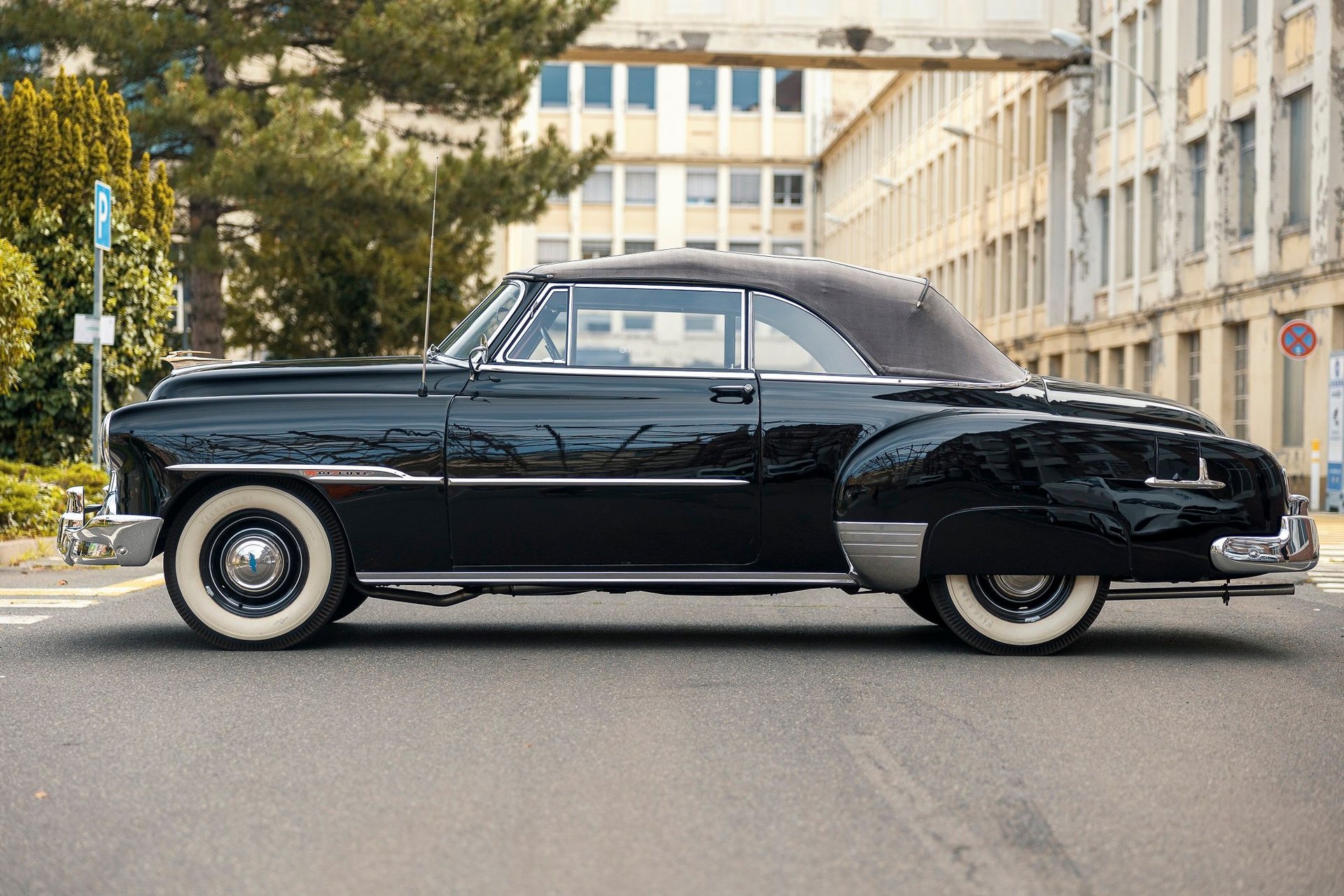
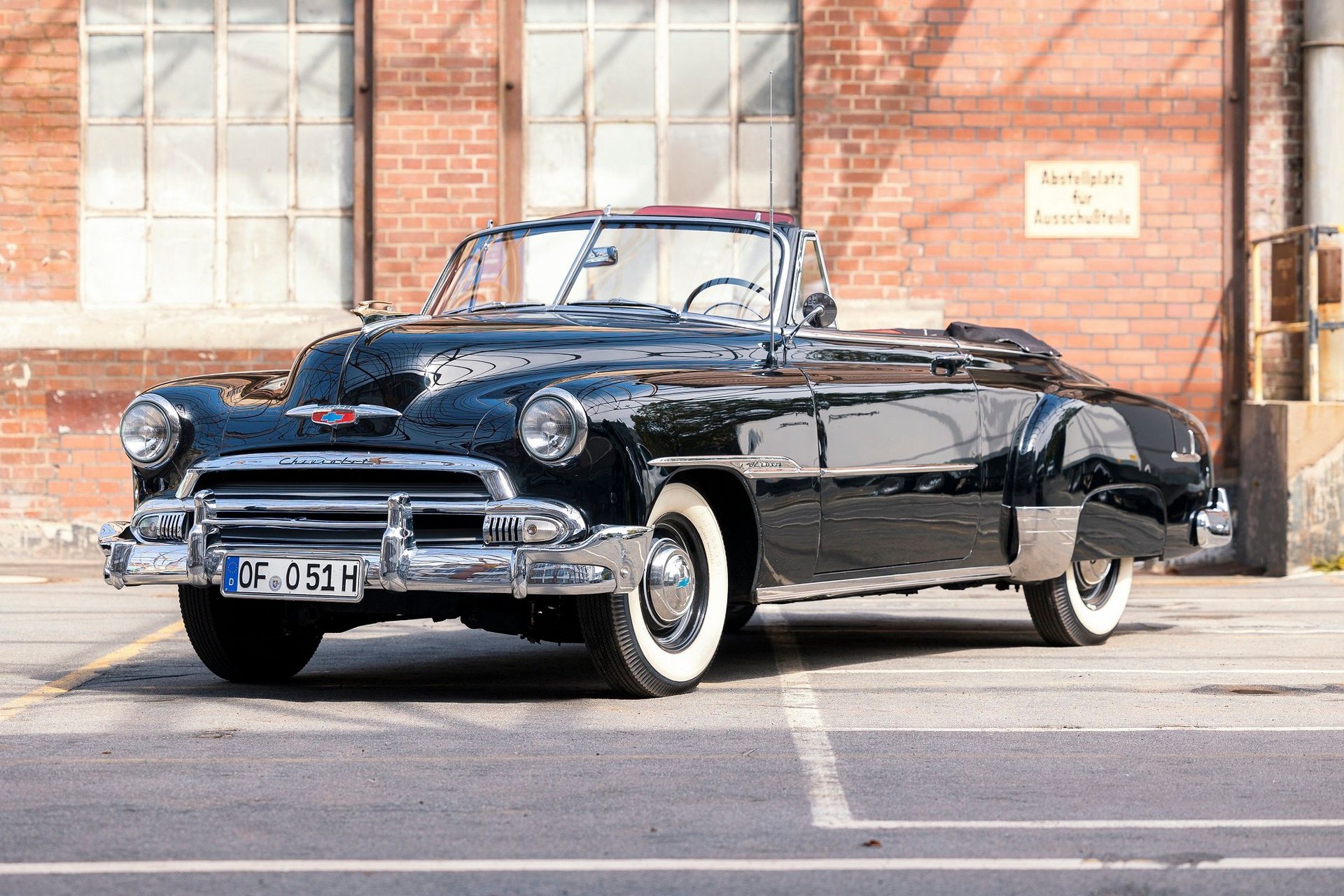
The body list is long because Chevrolet covered every niche of the low-price market. The two-door and four-door sedans are the volume cars and the rational buys. The sport coupe shortens the sedan's roofline into a sleeker profile with a small rear seat. The business coupe deletes the rear seat for a salesman's sample platform and is the plainest, lightest car in the range — precisely why the custom world hunted them, and why a stock one is now genuinely scarce. The convertible is the Deluxe-only flagship: power top on most, full Deluxe trim, and the heaviest price and rust bill in the range. From 1950 the Bel Air hardtop gives you convertible looks with a steel roof and no B-pillar, and it is a Styleline Deluxe in every mechanical respect. The station wagon starts with real wood in its construction and becomes an all-steel wagon wearing wood-effect trim — the tin woodie — either way a Deluxe-level car with a tailgate's worth of extra rust traps. Finally, the sedan delivery is the commercial: a wagon body with blanked steel panels instead of rear side glass, sold to florists and laundries, worked hard, and now rare because almost none were cosseted.
| Model | Years | Engine | Output | Built | Character |
|---|---|---|---|---|---|
| Styleline Special 2dr / 4dr Sedan | 1949–1952 | 216 cu in six | 90 hp | Very high — the volume of the range | The honest base car; plain trim, manual gearbox, the rational driver buy |
| Styleline Deluxe 2dr / 4dr Sedan | 1949–1952 | 216 six, or 235 with Powerglide | 90 hp / 105 hp | Very high | The same car with the trim you actually see; the market's centre of gravity |
| Sport Coupe (Special / Deluxe) | 1949–1952 | 216 six, or 235 with Powerglide | 90 hp / 105 hp | Moderate | Sleeker roof, small back seat; style premium over the two-door sedan |
| Business Coupe (Special) | 1949–1952 | 216 cu in six | 90 hp | Moderate when new, scarce stock now | No rear seat, salesman's platform; the custom world's favourite victim |
| Styleline Deluxe Convertible | 1949–1952 | 216 six, or 235 with Powerglide | 90 hp / 105 hp | Low | The flagship; power top, full trim, the biggest restoration bills |
| Styleline Deluxe Bel Air Hardtop | 1950–1952 | 216 six, or 235 with Powerglide | 90 hp / 105 hp | Moderate | Pillarless hardtop; a Styleline wearing the badge that later became a series |
| Styleline Deluxe Station Wagon | 1949–1952 | 216 six, or 235 with Powerglide | 90 hp / 105 hp | Low | Wood-bodied at first, all-steel tin woodie after; family rarity, rust-prone |
| Sedan Delivery | 1949–1952 | 216 cu in six | 90 hp | Low | Blanked-panel commercial wagon; worked to death, survivors are curiosities |
Two traps live in that table. The first is the Fleetline: the fastback cars look like Stylelines in a thumbnail photograph and are advertised as Stylelines constantly. They are a separate family with different rear panels, different rear glass and a different (generally softer) market. If the roofline slopes unbroken into the tail, you are not looking at a Styleline, whatever the listing says — price it as a Fleetline. The second trap is trim fraud, gentle rather than sinister on these cars: a Special wearing Deluxe stainless and a Deluxe badge is still a Special in its interior, its paperwork and its value. The cowl-mounted body tag and its trim codes settle what Fisher built; badges settle nothing. Check them before you pay a Deluxe price, because the stainless is cheap to add and the difference in value is not.

Engines and gearboxes
There are two engines in a stock Styleline, both overhead-valve inline sixes from the family everyone calls the Stovebolt, and they are not interchangeable in character, in maintenance or in what their presence tells you about the car. Learn to identify them by number, because sellers routinely do not know which one they have, and the difference is worth real money.
The 216 — Thriftmaster, 216.5 cubic inches
Every manual-gearbox Styleline, and every automatic car before Powerglide existed, runs the 216. It displaces 216.5 cubic inches (3.5 litres) from a 3.50-inch bore and 3.75-inch stroke, breathes through a single Rochester Model B one-barrel downdraught carburettor, and is rated at 90 hp. It is an old engine even in 1949 — the architecture dates to 1937 — and its defining feature is the one you must understand before you buy: lubrication. The 216 does not pressure-feed its connecting-rod bearings the way a modern engine does. Oil is sprayed and splashed: dippers on the rod caps scoop oil from troughs in the sump, and the rod bearings themselves are poured Babbitt metal, shimmed for clearance, rather than the replaceable precision inserts you expect. The main bearings are inserts; the rods are not, on the 216.
That design is not the death sentence forum folklore makes it, but it sets the rules of ownership. A 216 in good order, with clean oil, correct rod clearances and a working pump, is a smooth, torquey, long-lived engine at the speeds these cars cruise. What it will not forgive is sustained high rpm, dirty oil, or a tired pump, because the splash system adequate at 50 mph runs marginal at a sustained 70. The practical consequences: a 216 car is a 45–55 mph cruiser, full stop; oil changes are measured in thousands of miles, not seasons — every 1,000–2,000 miles in regular use, because the splash system has no full-flow filter to protect it (many cars carry only a bypass filter, or none); and any deep bottom-end noise is a specialist job, because re-pouring and line-boring Babbitt rods is a shrinking trade. Budget $2,500–4,500 for a proper 216 bottom-end rebuild by someone who still does Babbitt work, against which a noisy engine should be priced hard.
Valve gear is the other 216 routine. It uses solid lifters, so valve lash is a periodic manual adjustment, and a 216 that ticks loudly at hot idle usually wants its clearances set before it wants parts. Ignition is a Delco-Remy distributor with points, vacuum advance taken from the carburettor, and a starting system that on 1949–1950 cars still uses the floor-mounted stomp starter pedal — a charming feature and a useful originality check, because converted cars lose it. Fuel delivery is a mechanical AC pump on the side of the block, and on cars with vacuum windscreen wipers the pump is a combined fuel-and-vacuum unit whose vacuum section keeps the wipers sweeping when manifold vacuum collapses under acceleration; remember that pump when the wipers stall on hills, because the fault is as often in the pump as in the wiper motor.
The 235 — the Powerglide engine, 235.5 cubic inches
From January 1950, ordering Powerglide changes the engine, not just the gearbox. Automatic cars get the 235.5-cubic-inch six (3.56-inch bore, 3.94-inch stroke), rated at 105 hp, with a higher compression ratio than the 216 and — the change owners feel every day — hydraulic valve lifters. No lash adjustment, a quieter top end, and a more relaxed cruising character from the extra capacity. The 235 shares the family's layout, the Rochester one-barrel and the Delco ignition, and visually it is near-identical to the 216, which is why identification must be done properly. The engine number is stamped on a machined pad on the block just behind the distributor; the prefix and suffix letters in that stamping encode the engine's size, year and original application, and the casting numbers and date code on the block confirm it. A seller claiming a 235 in a manual car, or a 216 in an original Powerglide car, is describing either an engine swap or a mistake, and either way the stamping pad — not the valve cover, not the air cleaner decal — is what settles it.
Do not let anyone sell you the myth that the 235 is simply the better engine and the 216 a defect to be priced away. The 235 is a stronger, lazier unit and the hydraulic lifters remove a real chore, but it shares the family's period lubrication philosophy and Babbitt-era bottom-end thinking in the early cars, drinks a little more fuel, and only ever comes attached to a two-speed automatic that gives back in cruising effort much of what the engine gains. The honest summary: the 235/Powerglide car is the easier tourer; the 216/manual car is the more engaging machine, and its engine rewards an owner who changes oil and sets valves. What you should actually fear in either engine is not the design but the decades: cracked exhaust manifolds, a Rochester B with a warped top cover and a flooding idle, sludge in a splash-fed sump that has seen five-year oil, and perished core plugs. All of that is covered, system by system, in the problem areas below.
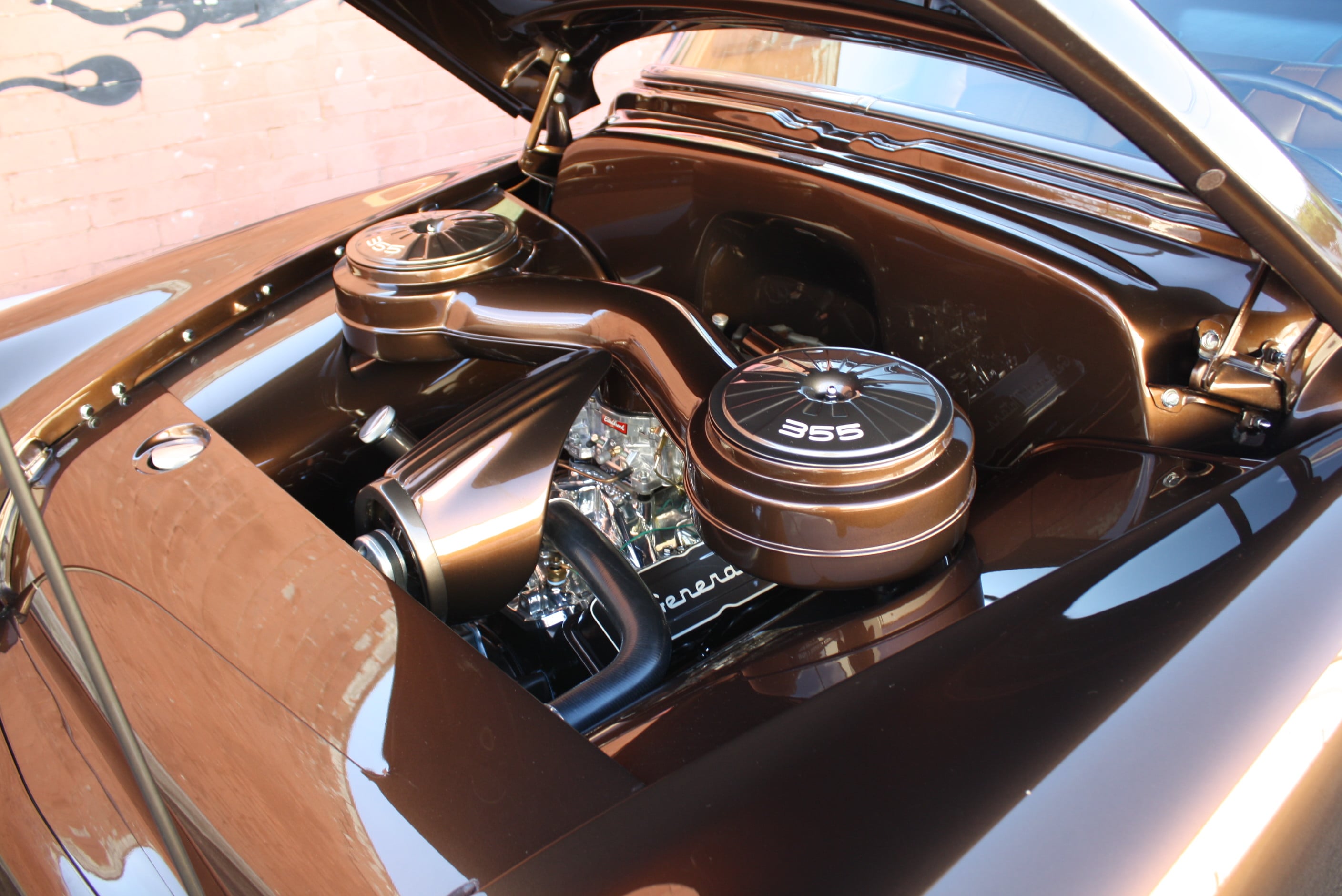
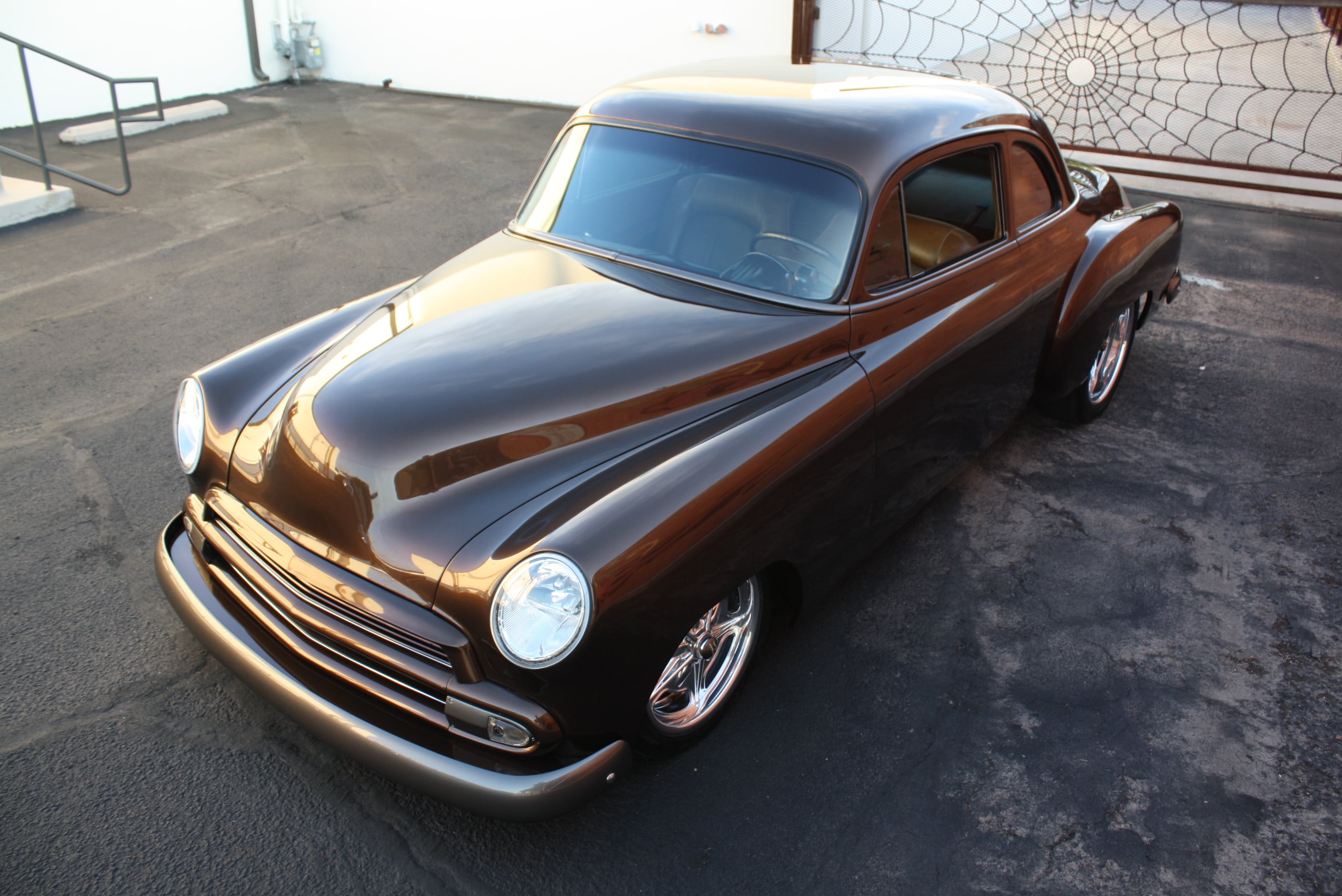
Swaps deserve a paragraph of their own because you will meet more swapped Stylelines than stock ones. The Chevrolet small-block V8 drops into this bay with well-documented mounts, and the custom world has been doing it for fifty years; later 235s, 261 truck sixes and modern LS engines all appear too. A swap is not automatically a bad car — the brown coupe photographed in this guide runs a 355-cubic-inch small-block and is plainly a well-finished custom — but a swapped car is a different purchase: you are buying the quality of somebody's fabrication, wiring and cooling decisions, with no manual covering the result. Price it as a custom, verify it as a custom, and never pay stock-original money for it.
Gearboxes — Synchro-Mesh three-speed and Powerglide
The standard gearbox is Chevrolet's three-speed Synchro-Mesh manual, shifted by a column lever — three on the tree — with synchromesh on second and third and a sliding first gear you engage at a standstill or a crawl. Drive passes through an enclosed torque tube to the rear axle, so there is no exposed propshaft and no conventional universal-joint maintenance; instead the torque tube's front bushing and seal, at the back of the gearbox, are the wear items, and a worn bushing announces itself as vibration and a leaking gearbox tail. Axle ratios are chosen for torque rather than speed: manual cars run a short axle of about 4.11:1, which is why a 216 car feels willing off the line and busy at 60 mph. The clutch is a single dry plate with mechanical linkage, and judder on take-up is more often oil on the plate from a leaking rear main or gearbox seal than a worn disc — diagnose before you budget a clutch.
Powerglide, offered from 1950 on Deluxe models, is a two-speed planetary automatic with a torque converter, in a heavy cast-iron case. It has no park position — you leave it in neutral and use the handbrake — and its quadrant runs neutral, drive, low and reverse. It is famously tough in its converter and famously unhurried in its shifts: the single upchange arrives when it arrives, and kickdown is a linkage adjustment, not a promise. Automatic cars run a taller axle of about 3.55:1 behind the 235, which is why a Powerglide car, despite two speeds, cruises more calmly than a manual car. Its real vices are leaks — the case, its seals and its filler arrangement give fluid several ways out — a burned smell to the fluid from a slipping band, and a shudder or flare on the one shift it makes. A Powerglide overhaul by a shop that knows the cast-iron unit runs roughly $1,500–3,000; a manual box rebuild is simpler and cheaper, $800–1,500, and both figures belong in your negotiation when a gearbox misbehaves on the test drive.
Problem areas
A Styleline's problems are the problems of a seventy-year-old, mass-produced, steel-bodied car that spent its first decades as transport rather than as a collectible. Nothing here is exotic. Everything here is capable of turning a cheap car into an expensive one, and the order below is the order of financial danger: the shell first, because the shell is the one thing you cannot unbolt and replace.
Rust: the map
Start underneath, always, because the Styleline floor is a structure, not a carpet support. The floor pans rust from both sides: road salt and trapped water from below, and — the side everyone forgets — wet carpet and a leaking windscreen seal soaking them from above for forty years. Press and tap the full length of both pans, paying attention to the front footwells where heels and water meet, the seat mounting points, and the rear footwells. Perforation in a footwell is a welding bill; perforation around seat mountings is a safety conversation. Expect $800–2,000 per side for proper floor and rocker work done with the car stripped enough to do it honestly, and treat fresh black underseal over un-sounded metal as concealment until you have tapped it and heard solid metal answer.
The rocker panels — the sills — are the next structural stop. They rot from the inside out, fed by drain holes that block with road dirt, and the visible outer skin is the last part to go. A sill that looks sound but flexes or crunches under a firm thumb press at its lower edge is a sill full of scale. From the sills, work the map outward: the bottoms of the front fenders behind the wheels, where mud packs against the cowl; the cowl sides themselves and the lower A-post area, which is structural and awkward to repair; the door bottoms, where the skin folds over a frame that traps water; the rear fender lower edges and the dogleg where the fender meets the sill ahead of the rear wheel; and the trailing edge of the boot or trunk floor, where water sits in the spare-wheel well and rusts it in a ring you only see with the spare out. Lift the spare. Always lift the spare.
Two areas separate a cosmetic car from a structural one. The first is the body mounts and the frame beneath them. The Styleline has a separate frame under a bolted body, which is good news — frame rust is repairable and the frame is a stout affair — but a car whose mounts have sunk into rusted pads sits wrong, shuts wrong and cracks its paint at the seams, and re-shimming a settled body is skilled work. The second is the convertible and wagon problem set. A convertible has no roof to stiffen it, so its sills, floor and cowl carry everything; scuttle shake in a convertible with rusty sills is not a quirk, it is arithmetic. Check the top well behind the rear seat, which collects every drop the top leaks and rusts unseen. On a wagon, add the tailgate frame, the rear floor extensions and, on early wood-bodied cars, the wood itself: soft, blackened or filler-sculpted wood is a coachbuilding bill that starts where a steel repair ends, while the later tin woodie trades that risk for ordinary panel rust under wood-effect trim that hides it beautifully.
Fresh paint is your enemy at every one of these points, not because paint is dishonest but because it is opaque. A magnet in a cloth tells you where filler lives — it feels dead over thick filler — and wandering panel gaps, doors that need a lift to latch, and a boot lid sitting proud on one corner are the body telling you about its mounts and accident history in a language paint cannot cover.
Engine and lubrication
Begin any engine assessment cold, and be suspicious of a car that is already warm when you arrive: a warmed engine hides cold-start smoke, choke faults and the first thirty seconds of bottom-end noise. On a 216, listen at start-up for a deep, rhythmic knock that fades as oil pressure builds — that is rod clearance talking, and on a splash-fed, Babbitt-bearing engine it is the sound of the expensive rebuild described in the engines section. A light top-end tick that settles as it warms is usually valve lash or a sticky lifter on a 235; a tick that never settles on a hydraulic-lifter 235 points to a collapsed lifter or low oil pressure feeding it. Oil pressure itself is read on the dash gauge: these engines run modest pressure by modern standards, and what matters is that pressure is present, rises with rpm and does not fall away to nothing at hot idle.
Blue smoke on start-up that clears is valve-guide and seal wear — liveable, budgetable. Blue smoke under load is rings and bores. White vapour that smells sweet and never clears is coolant, and on a six with a long head, a head-gasket failure or a warped head must be proved or excluded with a compression test and a cooling-system pressure test before you agree a price; a six-cylinder head is long enough to warp properly, and skimming plus gasket work runs $600–1,200 if the casting is sound, more if it is cracked. Cracks, when they come, favour the exhaust side and the valve-seat area, and a crack is a replacement head, not a repair.
Oil leaks are a family trait and mostly tolerable: the side cover, valve cover, timing cover and rear main all weep on engines that are used, and a dry engine on a seventy-year-old Chevrolet usually means a recently degreased one. Judge leaks by rate, not presence — a drip every few seconds at hot idle, or oil reaching the clutch, is work; a misting film is maintenance. The one leak to price seriously is the rear main, because on a torque-tube car, reaching it means separating the driveline. Finally, look at the oil itself: grey emulsion (water), glitter (bearing metal), and a level overfull and smelling of petrol (a flooding carburettor washing fuel past the rings into a splash-fed sump — the combination that kills Babbitt fastest).
Fuel, cooling and exhaust
The Rochester Model B carburettor is simple, rebuildable and old. Its classic faults are a warped top cover from decades of heat cycles, which lets it flood and dribble fuel internally; a worn throttle shaft that admits air and makes the idle impossible to set twice the same way; and a hardened accelerator pump cup, giving the flat spot on take-off that owners blame on ignition. The distinguishing test is observation: fuel weeping from the carburettor body on a hot engine, a fuel smell in the oil, and a hunting idle point at the carburettor; a clean, dry carburettor with a flat spot points at the pump cup or vacuum advance. A professional rebuild runs $250–450 and transforms most cars — never let a seller discount a car heavily for carburettor behaviour, or charge you for a "rebuilt carburettor" without a receipt.
Vapour lock and hot-start trouble are period facts amplified by modern fuel. The mechanical pump and steel line run close to exhaust heat, modern petrol boils lower than 1950s fuel, and a car that cranks uselessly after a hot soak but starts instantly when cool is showing you vapour lock, not a dying starter. Fixes range from heat shielding and line rerouting to an electric helper pump — all cheap compared with the starters and batteries sellers replace chasing the wrong fault. The fuel tank rusts from inside when a car sits, shedding scale that blocks the pickup in a cycle of starvation mimicking pump failure; if a car dies after twenty minutes and recovers after a rest, suspect the tank before the pump, and budget $300–600 for a replacement, because cleaning and sealing a scaled tank is a recurring argument.
Cooling is a pressurised system with a copper-and-brass radiator that will now be on its second or third core if maintained, or furred solid if not. Overheating at speed with a clean radiator points to a slipping belt, a tired water pump or a thermostat stuck partly shut; overheating in traffic points to airflow and core capacity. A pump whose bearing rumbles or shaft rocks is about to eat its seal, and the weep hole under the pump snout is designed to tell you so — look for the coolant trail. A heater core replacement is a dashboard-out afternoon and $150–350 in parts, so a bypassed heater (two hoses joined in the bay, no flow to the cabin) is a tell that the core leaks, priced accordingly. Exhaust manifolds crack, usually at the centre where the heat riser lives, and the heat-riser valve seizes — shut, which cooks the intake and worsens vapour lock, or open, which slows warm-up. A ticking loud cold and quiet hot is a manifold crack or gasket until proved otherwise.
Gearbox, torque tube and rear axle
The manual box should engage second and third cleanly at moderate speed with no more than period crunch. Synchromesh wear shows first on the change down into second; a box that crunches into second both ways, jumps out of third on the overrun, or whines in every gear but top is a box coming out, at the rebuild figures quoted earlier. Column-shift linkage wear is the great imitator here: worn bushes and rods in the long linkage from column to box produce vague selection, missed gates and apparent synchro faults that vanish when the linkage is rebushed for tens of dollars. Test for it by having someone move the lever while you watch the linkage at the box — slop you can see is slop you do not have to rebuild a gearbox for.
The torque tube hides its wear. Its front bushing supports the shaft at the gearbox, and when it wears you get a vibration that arrives at a particular road speed, feels like wheel balance, and survives wheel balancing — the classic misdiagnosis on these cars. Oil at the back of the gearbox and a shudder under load complete the picture. The rear axle is a hypoid unit, strong and long-lived on oil; a whine that changes with throttle load is pinion bearing or mesh wear, a rumble constant with road speed is wheel bearings, and oil on a rear brake backplate means an axle seal has gone and the shoes on that side are soaked and scrap. Powerglide cars add their own list: fluid brown and smelling burned, a flare or shudder on the single upchange, delayed engagement from cold, and leaks from a case whose seals have had seventy years to harden. None of these is automatically terminal — bands adjust, seals renew — but all are specialist labour on a heavy unit, and a Powerglide that does everything wrong at once is the $1,500–3,000 conversation from the gearbox section.
Suspension, steering and brakes
The front suspension is independent, with coil springs, upper and lower arms and kingpins — and kingpins are the wear item the whole front end turns on. They need grease at period intervals (think every 1,000 miles, not at annual services), and most have not had it. Jack the front up, grip the wheel top and bottom and rock it: movement at the kingpin, felt as a clunk and seen as the wheel tilting on the pin, means kingpin and bush work at $400–900 a side fitted, and a car that wanders, wears its front tyres on one edge and needs constant correction is telling you the same story at road speed. While the wheel is up, spin it for bearing rumble and rock it side to side for tie-rod and centre-link wear — the recirculating-ball box drives a linkage with several joints, wear accumulates across all of them, and a car can have an inch of free play at the rim with no single joint obviously scrap. Budget for the set, not the joint. Tired dampers give a car that pitches and crashes over sharp bumps; rear leaf springs sag until the car sits tail-down, and a broken leaf announces itself with a crack over bumps and a lean you can measure at the rear arches.
Brakes are drums all round, hydraulically operated from a single-circuit master cylinder — one circuit, one failure away from the handbrake, which is why the state of every component matters more here than on any modern car. The 1949–1950 cars use the older Huck-type brake; the 1951-on cars get Bendix duo-servo brakes that are stronger and self-energising, one of the concrete reasons the later cars are easier to live with. Faults are the drum-brake liturgy: a pedal that pumps up means air or adjustment; a pedal that sinks slowly under steady pressure means the master cylinder is passing internally; a pull to one side means a contaminated, seized or badly adjusted brake on the opposite side — or a collapsed flexible hose acting as a one-way valve, which also causes a brake that drags and overheats. Wheel cylinders weep behind their dust boots long before they fail openly, so peel a boot back where you can. Any Styleline still on ancient fluid, perished hoses and unknown cylinders needs a full hydraulic overhaul — master, wheel cylinders, hoses, fluid — at $600–1,200 in parts and labour. Write that into the cost of any car without receipts for it; it is the best money you will spend on the car.
Electrics and instruments
Six volts is not a defect; it is a specification modern owners keep misdiagnosing. The system uses a generator (not an alternator), a voltage regulator, and a battery whose cables and earth straps are now its weakest links. A six-volt starter turns slowly by twelve-volt standards and needs every volt it is given: corroded terminals, a thin replacement cable or a rusty earth strap will cost it the volt it cannot spare, and the result — a car that cranks as if the battery is flat with a good battery fitted — is cured with cable and cleaning work for tens of dollars, not with a twelve-volt conversion. Test any car by cranking it cold and watching the lights: bright lights and a strong, even crank mean the basics are sound. Dim lights at idle that brighten with rpm are normal generator behaviour, not a fault.
The conversion question deserves a straight answer, because half the cars you view will have been converted. Twelve volts buys easy starting, brighter lights and cheaper batteries; it costs originality, requires the gauges, bulbs, heater motor and radio to be dealt with properly, and is done badly as often as well. A converted car with a receipted, complete conversion is a practical driver. A converted car with an alternator, six-volt gauges fed through a dropping resistor of unknown parentage, and a dead radio is a wiring project wearing a finished car's price. Either way, inspect the loom: seventy-year-old insulation crumbles where it flexes, and any car whose under-dash wiring is a nest of rainbow crimp connectors has electrical work in its future. Instruments are simple and mostly robust; the fuel gauge lies when its sender or earth fails, and vacuum wipers slow to a stop on hills on a healthy car — period behaviour — but stop entirely when the pump vacuum section or wiper motor seals fail, which is a $150–300 repair, not a character trait.
Interior, glass and trim
Interiors decide what a Styleline costs you after the welding, because trim is where reproduction coverage thins out. Seat cloth in the correct patterns, door cards, headlining and carpets are available for the common bodies, and a full retrim in correct materials runs $3,000–6,000 fitted; what is not easily available is the small stuff — Deluxe interior chrome, the correct steering wheel (which cracks at the rim and hub and costs real money to restore well), switch knobs, and the pot-metal parts. Pot metal ages worst of any trim material on these cars: it pits, blisters and crumbles from within, and a pitted grille surround, tail-lamp housing or interior handle cannot be polished back — it must be repaired and replated, at $150–400 per significant piece, or replaced from dwindling old stock. Count the pitted pot metal before you fall for the paint.
Glass is flat in section, which makes windscreens and side glass replaceable without drama, but the split windscreen's centre divider and rubbers, the convertible's frame rubbers and the wagon's many panes add up, and perished rubbers are the root cause of the wet carpets that rotted the floors in the rust section — when you find floor rust, look up and find the failed seal that caused it, or you will weld the same floor twice. Window regulators wear until glass drops or refuses; door latches wear until doors need a slam that bends things. None of it is hard. All of it is time, and time at trim-shop rates is how a cheap Deluxe becomes an expensive one.


How to inspect one
Inspect in this order, cold car first, and do not let the seller warm it up, move it to a prettier spot, or start the conversation at the paint.
- Establish identity before anything else. Read the body tag on the cowl for the Fisher body style and trim codes, read the engine number on the stamped pad behind the distributor, and compare all of it with the paperwork. Confirm you are looking at a Styleline and not a Fleetline fastback, at the trim level the price assumes, and at the engine the car is claimed to have — the 216/235 checks from the engines section settle the mechanical identity in two minutes.
- Walk the shell with a magnet and a torch. Work the rust map from the problem areas in order: footwells, sills under thumb pressure, cowl and A-post bases, door bottoms, rear fender doglegs, boot floor with the spare lifted out. Crouch and sight down each flank for filler waves and wandering gaps. Any structural perforation you find here re-prices the car before you have heard it run.
- Get underneath, or get the car on a lift. Look at the frame rails, the body mounts and pads, the floor from below, the torque tube, and the rear axle backplates for seal leaks. A seller who will not allow the car to be lifted is telling you the answer to the question you were about to ask.
- Cold start, bonnet up, and listen. The car must start from cold in front of you. Listen for the fading start-up knock of worn Babbitt rods, watch the exhaust for the colour of the smoke and whether it clears, and watch the oil pressure gauge as it warms. Note whether the starter is the original floor stomp pedal and whether the six-volt crank is strong or laboured.
- Interrogate the engine bay. Rochester carburettor dry or weeping? Dipstick oil clean, emulsified, glittering or petrol-smelling? Coolant clean or oily? Heat-riser free? Manifold ticking cold? Heater hoses connected, or joined in the bypass that confesses a leaking heater core?
- Work the gearbox stationary, then note the linkage. With the engine off, find every gear with the column lever. Slop and missed gates here are the linkage wear from the problem areas — cheap — and you want to have felt them now so you can separate them from gearbox faults on the road.
- Drive it far enough to get it fully hot — twenty minutes minimum. Use second and third both ways for the synchromesh, lift off in third for jump-out, and hold a steady 45–50 mph to find the torque-tube vibration that survives wheel balancing. In a Powerglide car, judge engagement from cold and the single upchange for flare or shudder.
- Brake it, repeatedly and hard, from speed. The pedal should be firm without pumping, hold without sinking, and stop the car straight with your hands light on the wheel. A pull, a sink or a pump-up pedal is the hydraulic overhaul from the problem areas, priced into your offer on the spot.
- Steer and ride it over a bad road. Constant correction, a dead inch at the wheel rim and one-edge front tyre wear are the kingpin and linkage story; measure rear ride height against the front for sagging springs, and listen for the crack of a broken leaf.
- Test every electrical item, including the ones that "nobody uses". Lights, indicators, horn, heater fan, gauges — and the vacuum wipers under load on a hill, where a tired vacuum pump shows itself. On a twelve-volt converted car, ask what was done about the gauges, heater motor and radio, and look under the dash at the quality of the answer.
- Operate the special features of the body in front of you. Convertible: run the top through a full cycle, inspect the top well for rust and the frame for bent pivots. Wagon: work the tailgate and inspect the wood or rear floor. Sedan delivery: check the rear door hinges and the cargo floor, which carried loads for a living.
- End with the paper, not the car. Receipts for brake hydraulics, engine work, Babbitt or Powerglide specialists, and rust repair with photographs outrank every verbal assurance. A car with a folder is a known quantity; a car with a story is a hypothesis. Price them differently.
Values
The Styleline market is wide, shallow and honest, and it rewards buyers who understand what actually moves a price here — because it is rarely the thing the advertisement leads with. The listings and recorded sales gathered beneath this guide show the current spread; read them as a condition market, not a model market. The gap between the cheapest Styleline and the dearest is not explained by year, and barely by body style. It is explained, in order, by the state of the shell, by originality or the quality of modification, and by how much of the expensive work is already done and receipted.
Body style sets the ceiling. Convertibles and Bel Air hardtops sit at the top because they were the glamour cars when new, survive in smaller numbers, and offer open or pillarless style a sedan cannot match at any condition. Wagons follow on rarity and family appeal, with early wood-bodied cars pulling a premium that evaporates fast if the wood is poor. Sedans — the volume of the range — set the floor and the centre: a four-door Deluxe is the easiest Styleline to buy and to sell on, and the one where condition differences show up most honestly in price, because there is always another one. Coupes sit a step above their sedan equivalents on style, the business coupe carries a scarcity premium in stock form that modified examples do not deserve, and the sedan delivery is a thin market where the right buyer pays well and the wrong audience pays nothing. Specials trail equivalent Deluxes consistently, and a Special dressed as a Deluxe should be valued as what its body tag says it is.
Within any body style, condition spreads prices by multiples, and the mechanism is the repair arithmetic in this guide. A car needing floors, sills, a hydraulic overhaul and an interior is not a slightly cheaper version of a finished car; it is a finished car's price plus a restoration, minus a discount nobody offers voluntarily. Originality cuts both ways. A genuinely unmodified, documented stock car — correct engine by its stampings, correct trim by its tag — commands a premium from the originality buyer and a shrug from the custom buyer, while a well-built custom with a V8 swap commands its own premium from its own audience and is unsaleable at that price to the first one. What neither audience pays for is the car in the middle: modified enough to lose the originality buyer, not finished enough to satisfy the custom buyer. More Stylelines are mispriced in that middle than anywhere else.
Asking and achieved prices part company predictably. Sellers anchor on the dearest comparable they can find — usually a convertible, usually finished, usually not comparable — and cars priced on that anchor sit. The cars that move are priced against the condition they are actually in, and documented faults are your legitimate leverage: rust you can photograph, a Powerglide that flares, hydraulics without receipts. A seller who has done the work and can prove it has little reason to move; a seller asking finished money for an unfinished car has every reason, whether they know it yet or not. Buy the shell and the paperwork. The rest of a Styleline can be bought from a catalogue, and that fact should set your ceiling on every car you view.
Parts and ownership
Ownership is where the Styleline repays its mass production. Chevrolet built these cars by the million and the American classic industry has supported them ever since, so the parts situation is about as good as the early-fifties hobby gets. Mechanical consumables — brake cylinders and shoes, kingpin kits, clutch parts, water pumps, carburettor kits for the Rochester B, ignition parts, gaskets and seals — are available from several competing specialists, usually off the shelf. Body repair panels for the common rot points (floor pans, rockers, lower fenders, boot floors) are reproduced in steel, which changes the economics of the rust section entirely: you pay for skilled labour, not unobtainable metal. Rubber seals, weatherstrips and glass are reproduced for the common bodies, chrome trim selectively, and the gaps in coverage are exactly where this guide has warned you — pot-metal castings, convertible hardware, wagon wood and tailgate parts, sedan-delivery panels, and correct-pattern interior materials for the less common bodies. Before you buy any of those cars, price the two or three parts it needs that you already know are scarce.
Specialist support divides by system. General six-cylinder work is within any competent older-engine shop's ability, but Babbitt bearing work on a 216 is a specialist trade — find your machinist before you need one, because the list of shops that still pour and bore Babbitt is short and their queues are long. Cast-iron Powerglide work is similarly concentrated among transmission shops that advertise the unit by name. Everything else is ordinary period engineering a good general classic workshop handles without drama, and the factory shop manual, widely reprinted, covers the whole car in one volume. Buy the manual with the car. It is the cheapest part you will ever fit.
Running one is a routine of short intervals, honestly kept. Engine oil every 1,000–2,000 miles, because the splash-fed 216 has no full-flow filter to forgive you longer; chassis grease, kingpins included, on the same sort of interval; valve lash on the 216 as part of an annual service; coolant, brake fluid and gearbox and axle oils on a two-year rhythm regardless of mileage, because time degrades them in a car that sits. Six-volt batteries last if the car is used and kept on a maintainer when it is not. Expect fuel consumption in the mid-teens to high-teens per gallon, tyres in the original 6.70-15 size or a modern radial equivalent that transforms the steering feel at the cost of the period look, and insurance and club life to be easy: the model is well known to every classic insurer, and the early-Chevrolet club scene is large and technical. The ownership proposition is a car you can maintain on a driveway, with parts by post, provided you bought a shell that does not need a body shop. That proviso is the whole guide in one sentence.
Which one to buy
- The all-rounder: a Styleline Deluxe four-door or two-door sedan with the 235 and Powerglide, sound in floors and sills, with receipted brake hydraulics. The easiest Styleline to buy, run, tour in and sell, and the car the market understands best.
- The driver's pick: a manual-gearbox 216 car, Deluxe two-door sedan or sport coupe, from a dry state with an unwelded shell. You trade cruising ease for the full period experience — column shift, stomp starter, valve lash and all — and you get the most engaging car in the range for the least money.
- The value buy: a Styleline Special sedan in honest, original condition. The market discounts the plain trim heavily and the car underneath is identical; if you drive rather than show, the Special is the same experience bought at a discount — provided nobody has dressed it as a Deluxe and priced it as one.
- The style buy: the Bel Air hardtop. Pillarless looks, Styleline running costs, a badge with a future that keeps demand liquid — and a car you must buy on shell condition, because hardtops flex and rust in the same places as everything else in this guide.
- The flagship: the Deluxe convertible, bought only with a rot-free top well, working top mechanism and the best shell you can find. Dearest to buy and dearest to restore; a cheap convertible is the most expensive Styleline there is.
- The left-field buy: a stock sedan delivery or business coupe. Thin markets, real scarcity in unmodified form, and a commercial honesty nothing else in the range has — but go in knowing your exit audience is small.
- The custom buy: a finished, documented V8-swapped car, bought as a custom at a custom's price after inspecting the fabrication, cooling and wiring as carefully as a shell. Never pay originality money for it, and never buy a half-finished swap at a finished car's price.
The overriding rule: buy the shell and the stampings, not the paint and the story — a Styleline with solid floors, sills and mounts and an engine whose number matches its description beats any shinier car that fails those checks, because everything else can be bought, rebuilt or retrimmed, and the shell cannot.
See the 5 Styleline cars currently listed.
For sale now
 $58,500 · 21% above typical
Expand
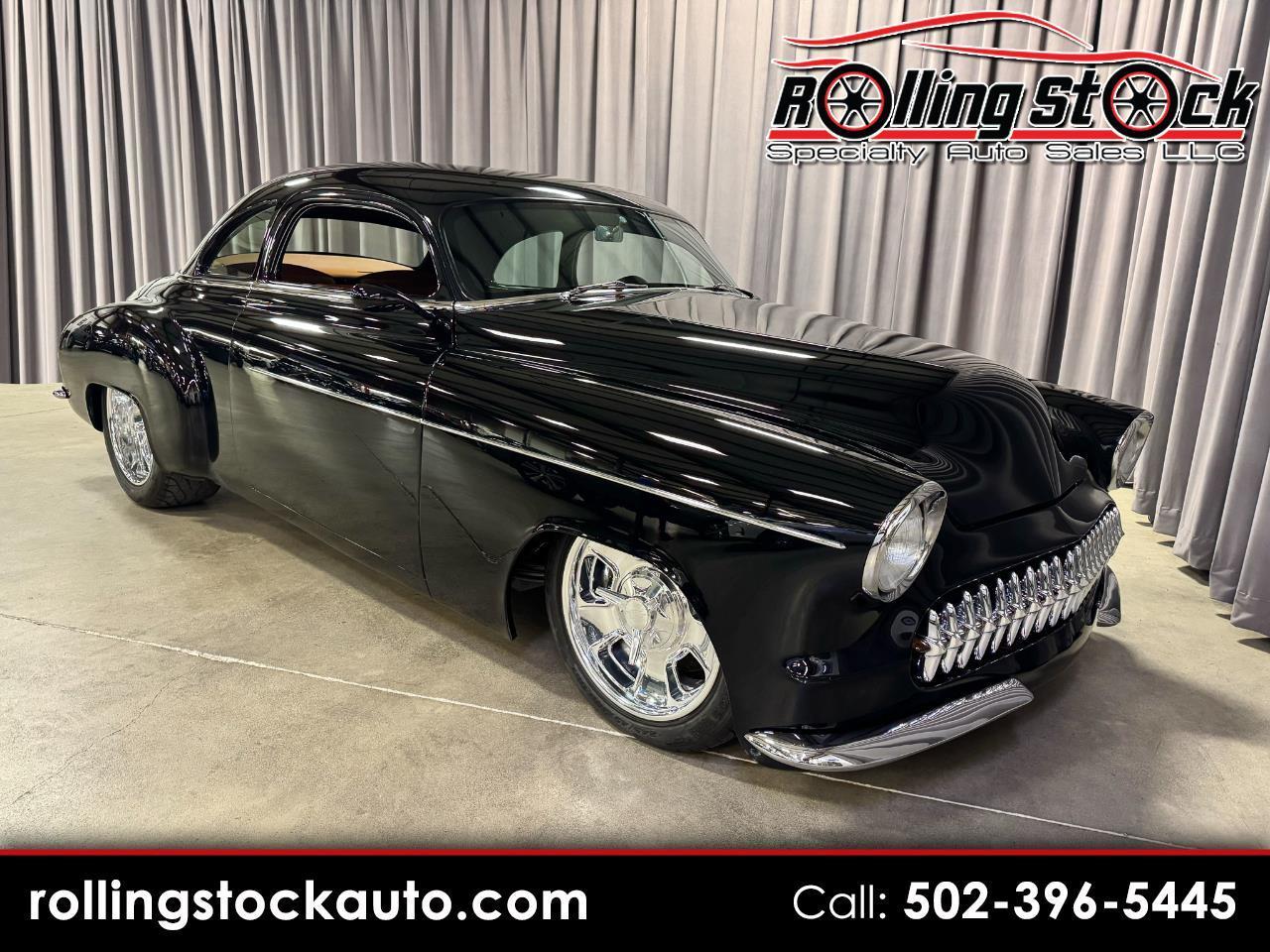 $185,000 · 281% above typical
Expand
What they sell for: Styleline sale prices.