
Ford 5 Window Coupe buyer's guide
Ford 5 Window Coupe -- the model's own buyer's guide: variants, values and what to check.
Years listed: 1932-1936 · Series: Full Size
# Ford 5 Window Coupe: The Buyer's Guide
Overview and history
The Ford 5 Window Coupe is not one car but a body style that sits on the most important cheap cars Ford ever built. Count the glass and you understand the name: a windscreen, two door windows and two small quarter windows behind the doors make five, and that upright, formal little cabin defines the standard Ford coupe from 1932 to 1936. Its stablemate, the 3 Window Coupe, is the Deluxe car — no quarter windows, a more sloped profile and, in most years, rear-hinged "suicide" doors. Learn that difference before you learn anything else, because sellers blur it, advertisers mislabel it, and the two cars carry different values, different doors and different parts despite sharing chassis and engines.
The story starts in March 1932, when Ford replaces the Model A with two cars on a new 106-inch-wheelbase chassis: the four-cylinder Model B and the Model 18, powered by the first mass-produced V8, the 221-cubic-inch flathead. The styling — a proper grille shell, flowing fenders, a body that looks designed rather than assembled — makes the 1932 Ford, the "Deuce", an instant classic, and the 5-window coupe is its volume coupe body. For 1933 the wheelbase stretches to 112 inches, the grille slants, the fenders gain skirts, and the line becomes the Model 40. Detail changes follow for 1934, a fuller, roomier restyle arrives as the Model 48 for 1935, and the run ends with the Model 68 of 1936, whose wraparound grille and cleaner hood sides point clearly towards the streamlined cars that follow.
Two later histories shape every car you will look at today. The first is hot rodding. The Deuce above all, but 1933–36 coupes too, become the raw material of the lakes, the drag strips and the street: fenders off, flathead hopped up or replaced, roof filled, stance dropped. The second is oval-track racing, where 1930s coupes are cut down into modified stock cars and raced for decades. The result is a market in which a genuinely stock 5-window is now the unusual find. Most cars offered are street rods, restored originals, older restorations, race survivors or some layered combination of all four — and each of those is a different purchase, judged by different rules. This guide covers the 1932–36 cars as built and as you will actually find them, because on this model the modifications are not a footnote. They are half the market.
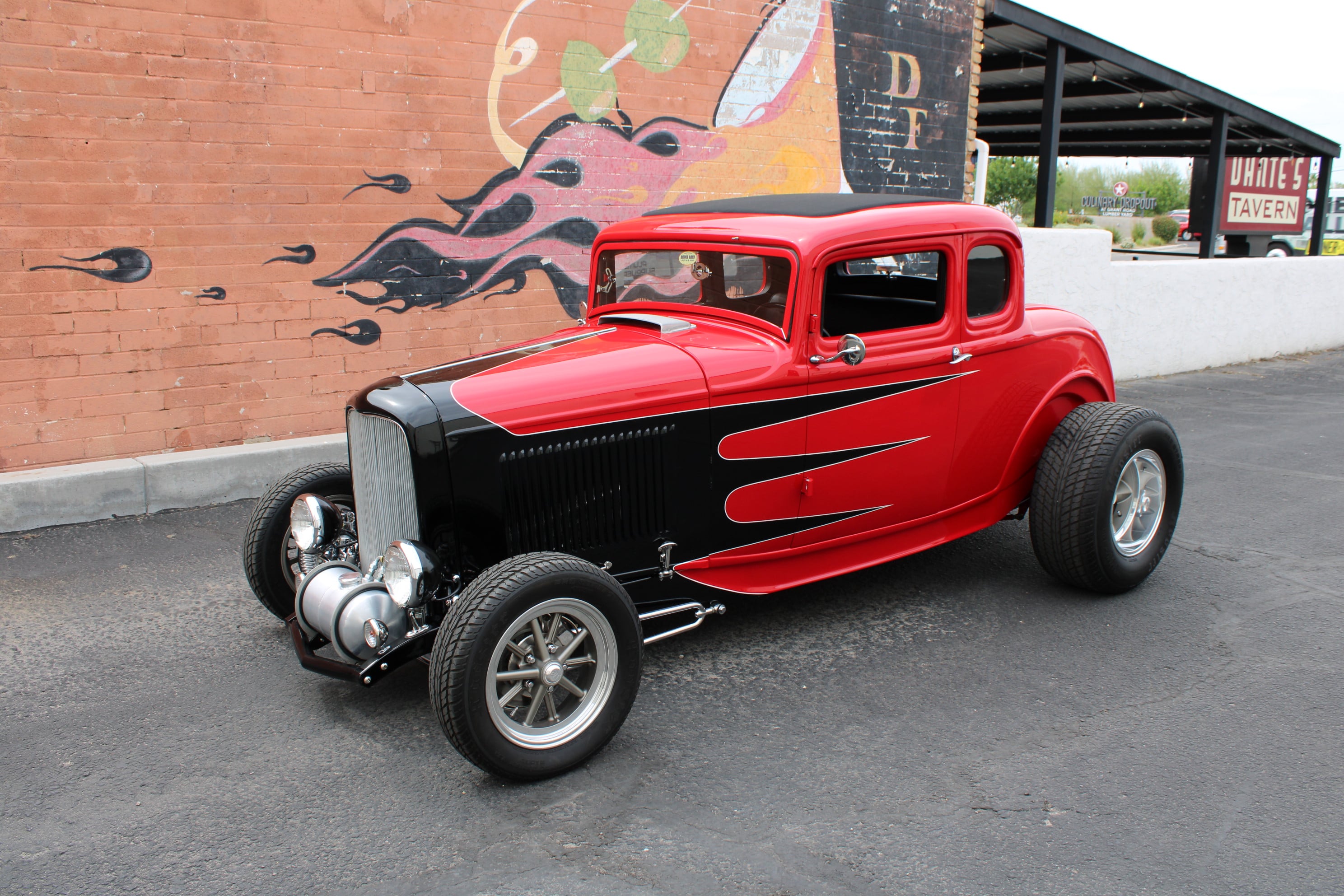
The models
Every 1932–36 5-window sits on the same basic architecture: a steel ladder frame, a beam front axle and a live rear axle, each carried on a single transverse leaf spring, an enclosed torque-tube driveshaft, mechanical rod-operated drum brakes and a three-speed manual gearbox. What changes year to year is wheelbase, styling, engine output and refinement — and those changes are your primary identity tools, because year-swapping panels is a ninety-year-old habit with these cars.
The 1932 car is the icon and the outlier. Its frame is a one-year design with a distinctive pressed reveal along the rails, its grille shell is upright, its fuel tank sits exposed at the rear and its body carries more wood framing than the later cars. You choose between the Model B four-cylinder and the Model 18 V8 at the same body price level, and Ford builds far more 5-windows than 3-windows — correct the common myth here: the 5-window is not the rare coupe; the Deluxe 3-window is. The 5-window's premium today comes from demand and survival, not from period scarcity.
For 1933, the Model 40 grows onto the 112-inch wheelbase it keeps for the rest of the run. The grille leans back, the hood louvres curve with it, fenders are skirted and the whole car looks lower and longer. The V8 climbs in output; the four-cylinder continues for buyers who trust it, now with a counterweighted crankshaft in its improved form. In 1934 the recipe is refined rather than changed — a slightly revised grille and hood side treatment, more power again from the V8, and Deluxe trim that brings extras such as twin horns and better upholstery depending on the package. Four-cylinder production for passenger cars ends during this period, and from here on the 5-window story is a V8 story.
The 1935 Model 48 is a bigger-looking, more civilised car. The body is wider and roomier, the engine sits further forward in the chassis for a better ride, the grille narrows and the hood sides carry neat horizontal louvre panels. A proper luggage trunk becomes part of the conversation alongside the older rumble-seat layout, so check what a given car actually has behind the cabin rather than assuming. The 1936 Model 68 finishes the run with the most modern face of the group: a tall, rounded grille that wraps into the hood sides, horizontal hood louvres, teardrop headlamps faired into the fenders and, late in the year, the first insert-bearing version of the V8. A good 1936 is the easiest of these cars to live with stock; a good 1932 is the one the whole hobby orbits.
Trim splits the range further. Standard cars are plain: one tail lamp, painted details, simple trim. Deluxe cars add chrome, cowl lamps or twin horns, better fabrics and two-tone possibilities, varying by year. Neither badge saves you from checking identity, because Deluxe jewellery bolts onto Standard bodies in an afternoon.
| Model | Years | Engine | Output | Built | Character |
|---|---|---|---|---|---|
| Model B 5 Window Coupe | 1932–1934 | 200.5 cu in four-cylinder | 50 hp | Volume production | The honest cheap coupe; torquey, simple, now the minority survivor |
| Model 18 5 Window Coupe | 1932 | 221 cu in flathead V8 | 65 hp | Volume production | The original Deuce coupe; the hot-rod icon in its first form |
| Model 40 5 Window Coupe | 1933–1934 | 221 cu in flathead V8 | 75 hp (1933), 85 hp (1934) | Volume production | Longer, sleeker, skirted fenders; the connoisseur's pre-war Ford |
| Model 48 5 Window Coupe | 1935 | 221 cu in flathead V8 | 85 hp | Volume production | Roomier, softer-riding, more civilised; trunk or rumble seat |
| Model 68 5 Window Coupe | 1936 | 221 cu in flathead V8 | 85 hp | Volume production | The most developed stock car of the run; late cars get insert main bearings |

One boundary is worth drawing before you shop. Ford keeps building coupes with this window arrangement after 1936 — the 1937 cars bring an all-steel roof and headlamps faired into the fenders, and hydraulic brakes arrive across the Ford line for 1939 — but those are different cars in a different market, and they are not what sellers mean, or what this guide covers, when the years 1932–36 are on the table. The confusion to guard against runs the other way: later panels, engines and brake parts fitted to an early car during ninety years of repairs do not move the car forwards a generation. Date the car by its frame, its body structure and its serial number, and treat everything bolted to them as a component with its own date.
A note on the "Built" column: Ford's surviving production reporting does not give a clean, verifiable split for every body-and-engine pairing across these five years, so this guide does not quote per-body production figures it cannot stand behind. What is certain is the shape of the range: these are volume cars from the best-selling line in America, built in large numbers, and rarity today is a matter of body style, engine and survival — not of the model line itself.

Engines and gearboxes
The Model B four-cylinder
The four is a development of the Model A engine: a 200.5-cubic-inch side-valve four making 50 hp, with three main bearings, splash-and-pressure lubrication and a single updraft-pattern carburation layout feeding through a simple manifold. In 1933 the improved version with a counterweighted crankshaft — often called the "Model C" engine by enthusiasts, though Ford never sold it under that name — smooths the car noticeably. Identification is easy: four cylinders, a flat head with the plugs in a row, and a serial prefix for the four-cylinder line rather than the V8's.
Judge a four on its own terms. It is torquey, understressed and happy at the speeds these chassis enjoy, and a well-sorted Model B coupe is a charming car. Its weaknesses are age weaknesses: poured babbitt main and rod bearings that wear and are expensive to re-pour and line-bore correctly, a crankshaft you must check for cracks at overhaul, water-pump and cooling neglect, and the vibration that loosens everything attached to it over ninety years. Parts and knowledge are shared with the huge Model A world, which helps. What a four is not is a cheap V8 substitute: converting a four-cylinder car to a V8 means engine, and ideally the heavier-duty details that went with it, so price a four as a four and enjoy it as one. A four-cylinder car with a later V8 already fitted is a conversion — judge it in the swap section below, not as a factory V8 car.
The 221 flathead V8, 1932–36 form
The engine that made these cars is the original flathead: 221 cubic inches, side valves in the block, the exhaust passages winding through the water jacket, aluminium pistons in early form, a single downdraft carburettor and 21 studs holding each cylinder head. Output climbs across the run — 65 hp in 1932, about 75 hp in 1933 with detail and compression improvements, and 85 hp from 1934 on the higher compression and better breathing that define the mature early flathead. The 1932 cars breathe through a Detroit Lubricator single-barrel; the Stromberg 97 two-barrel that becomes the flathead's signature carburettor takes over from 1934. The distributor sits at the front of the engine, driven from the camshaft, with a vacuum-operated advance mechanism, and the twin water pumps mount at the front of the cylinder heads — both facts matter when you diagnose the car, because ignition and cooling service both start at the front of the block.
Two internal changes matter to a buyer. First, main bearings: engines through 1935 and into 1936 use poured babbitt mains, while the late-1936 "LB" block introduces replaceable insert main bearings — a genuinely better engine to rebuild and to live with, and worth identifying by its casting and bearing arrangement rather than by a seller's say-so. Second, everything is rebuildable but nothing is tolerant of sloppy machining: valve seats are integral in the block, the valve guides are removable assemblies, and a proper rebuild is a specialist job. Budget $6,000–12,000 for a thorough flathead rebuild with machining, more if the block needs seat work, sleeving or babbitt work on an early engine — and understand that a cracked block, covered in the problem areas, can end the arithmetic before it starts.
Oil and fuel behaviour complete the picture of a healthy early flathead. The lubrication system is a proper pressure system by the standards of its day, and a warm engine that holds steady pressure at speed but flickers low at idle is showing you bearing clearance, not a faulty gauge — verify with a mechanical gauge teed into the gallery before you negotiate. These engines were designed for the fuel of their era and run happily on modern regular fuel at stock compression; what modern fuel does attack is the soft parts, as the problem areas describe, and storage behaviour — a flathead laid up on stale fuel gums its carburettor jets and sticks its fuel-pump valves, so a car that has sat for years gets its fuel system cleaned before it gets its first start attempt, not after. Valve adjustment on an original solid-lifter engine is a fiddly, engine-out-of-the-car-in-spirit job done by grinding valve stems to set clearance, which is why so many rebuilt engines carry the later adjustable lifters; neither arrangement is a demerit, but ask which one you own before you book a service, because the labour conversation is entirely different.
Counting studs is your fastest field check on any flathead offered to you. The 1932–36 engines are 21-stud. The later 24-stud 221 and the 239/255-cubic-inch engines from the 1939-onwards Ford and Mercury lines are common, worthwhile swaps — smoother, stronger, easier to get parts for — but a 24-stud engine in a 1934 does not make the car a 1934-engined car, and the price conversation should reflect a swap, honestly described. Look also for the period speed equipment that follows these engines everywhere: aluminium high-compression heads, twin-carburettor intake manifolds, and headers. Good period equipment from recognised makers adds character and sometimes value; it also raises compression and heat on an engine whose cooling you now need to verify twice as carefully.
The engines you will actually find: swaps
Because these coupes are the backbone of hot rodding, a large share of the cars for sale carry a later engine, and the commonest is the Chevrolet small-block V8, typically a 350, usually with an automatic gearbox, power steering and air conditioning — a combination sellers advertise openly because buyers want it. Ford small-blocks, later flatheads, and occasionally a modern fuel-injected V8 appear too. There is no shame in any of this; there is only good work and bad work.
Judge a swap as engineering. The engine should sit square on proper fabricated or kit mounts, not on stacked washers and hope. The cooling system must be sized for the engine actually fitted — a small-block making three times a flathead's power through a tired original radiator is a car that overheats by design, so look for a modern crossflow radiator, an electric fan with a shroud, and hoses routed without kinks or chafe. The steering must clear the exhaust through its full lock. The front suspension must be rated for the weight and the brakes for the speed; a 350 in front of unrebuilt mechanical brakes is a mismatch you should price as unfinished work, not as charm. Ask who built the car and what the parts are. A swap built from a recognised chassis-and-engine package with receipts is an asset. A swap nobody can explain is a liability you will pay to reverse-engineer.
Gearboxes and the driveline behind them
As built, every car in this guide uses Ford's three-speed manual: a top-shift floor lever, sliding-gear engagement with the upper ratios made civilised by period synchromesh practice, and a single dry-plate clutch. First gear is a get-you-moving ratio; you take it at a crawl and you do not hurry the change. The gearbox drives through the enclosed torque tube to the "banjo" rear axle, so named for its round centre housing, and that architecture defines how the car feels — and how it must be repaired, because the closed driveline means gearbox, tube and axle come apart as a system.
The gearbox everyone wants is the 1939 Ford unit, whose improved synchronisers and stronger internals make it the classic upgrade, often paired with an open-drive conversion or a later rear axle in rodded cars. Column-shift conversions from 1940-onwards parts also appear. In swap cars you will meet the usual automatics — the Chevrolet Turbo 350 and overdrive 700R4, Ford's C4 — and an automatic is no demerit in a street rod; check instead for correct shifter linkage, a working kickdown or TV cable setup on the overdrive box, a proper transmission cooler and mounts that do not let the driveline shake itself. On any car, original or modified, test the driveline as a system: clutch take-up without judder or slip, no whine that climbs with road speed from the torque tube or axle, no clunk on the on-off throttle transition that betrays worn axle keys, splines or U-joint, and no oil weeping from the torque-tube joints onto the exhaust side of the car.

Problem areas
Body, frame and rust: the map
Start with what the car is made of. A 1932–36 Ford body is steel panels over a structure that still uses wood — in the roof framing, around the body framing and in the floor construction, most extensively on the 1932 cars and decreasing as the decade goes on. That gives you two enemies instead of one: rust in the steel and rot in the wood, and rot is the sneakier of the two because a body can hold its shape on paint and habit while the wood that locates its panels turns to fibre. Push on the door apertures, watch for doors that have dropped on their hinges, and treat a car whose gaps wander as a structural question, not a cosmetic one.
Rust follows a predictable map. Work it in this order: the bottoms of the cowl sides where water sits behind the front fenders; the lower door skins and the door bottoms themselves; the panel below the trunk or rumble opening; the rear quarters ahead of and behind the rear wheel openings, where road grit is thrown against single-skin steel; the floor pans and the body sub-rails that carry them; and the roof, where the fabric insert fitted to every car in this guide — Ford does not go to an all-steel roof until after this run — perishes, leaks and rusts the surrounding rails from the inside. A filled roof on a rod is normal and often well done; a filled roof on a car sold as stock is a question. Bubbling at the bottom of a panel means the rust is working from behind, and on these cars behind is usually a double-skin trap you cannot see into. Probe with a magnet over a cloth for filler, tap panels and listen for the dead note of filler versus the ring of steel, and get the car on a lift: the underside of a pre-war Ford tells the truth that the topside is painted to hide.
The frame needs the same suspicion. The 1932 frame is a one-year stamping and correct cars sit on it; later frames are longer and different in detail, so a "1932" on a frame that does not match the pattern is a car assembled from parts — which may be fine, if it is priced and titled as such. On all years, look for rust thinning around the crossmember rivets and the rear kick-up, cracks radiating from body-mount holes, and accident repair: these frames bend, and a bent frame shows as uneven panel gaps and a car that crabs. On rodded cars, frames are commonly "boxed" — plated along the open channel rails for strength with a V8 swap. Boxing is good practice done well and a moisture trap done badly: look for drain provision, continuous tidy welds rather than intermittent blobs, and no rust blistering along the plate edges, which means water has been living inside the rail.
Identity lives on the frame, so settle it here. Ford stamps the serial number into the top of the left-hand frame rail, in more than one place along the rail including the front section near the steering box, typically framed by star marks; the number's prefix identifies the engine line the chassis was built with, V8 or four. That stamping — not the engine, not a plate added later — is the number your title should follow. Read it yourself, wire-brush it if you must, and walk away from any car where the stamping has been ground, restamped or "lost" under boxing plates without paperwork explaining why. Reproduction bodies complicate this further: new steel bodies for the 1932 coupe are made today, and fibreglass bodies have been made for decades. A magnet, a look at the inner panel structure and an honest question settle which you are buying. A reproduction body on a titled chassis is a legitimate hot rod; a reproduction body sold as a Henry Ford original is fraud, and the price difference between those two descriptions is the whole negotiation.
The flathead: cooling, cracks and babbitt
The flathead's reputation for overheating is the first myth to correct properly: a stock flathead in good order, with a clean radiator, sound pumps and correct ignition timing, does not overheat in normal use. When one does, a specific fault is causing it, and your job is to find which one rather than accept "they all do that" as a diagnosis. Work the causes in order of likelihood. Retarded ignition timing makes a flathead run hot and is free to check. A radiator silted with ninety years of scale and stop-leak restricts flow; the early system is unpressurised, so it has no margin — it boils at the temperature plain water boils, and a weak mixture or a high day eats the difference. The two head-mounted water pumps wear their bushings, wobble, leak from the seals and move less water; look for staining and play at the pulleys. Sludge in the block — these engines accumulate casting sand, scale and sediment in the jacket, especially around the rear cylinders — insulates the metal from the coolant. And on a hopped-up engine, raised compression and a bigger bore have raised the heat load beyond what the stock radiator was ever asked to shed.
The distinguishing tests are simple. A cold engine that pressurises its hoses within a minute of starting is pushing combustion gas into the water — head gasket or worse. An infrared thermometer walked across the radiator core shows you the cold, blocked tubes as stripes. A car that is fine at forty and boils at sixty has a flow problem; a car that boils in traffic but cools on the move has an airflow problem; a car that boils everywhere has a capacity or combustion-leak problem. Keep those three patterns separate and you will not be sold a fan as the cure for a cracked block.
Cracks are the flathead's real structural risk. The classic sites are in the block deck: between a valve seat and the adjacent cylinder bore, and around the exhaust seats, where heat concentrates. Some cracks are cosmetic folklore; cracks that connect a water passage to a cylinder or a valve seat are terminal for that block in economic terms. You cannot see them on an assembled, running engine, which is why a flathead with unknown internals is worth project money until proven otherwise: proof is a rebuild invoice naming the machine shop, a magnaflux or pressure-test record, or a long, hot test drive ending with clean oil, clean coolant and no pressurisation. Valve gear itself is durable; the adjustable-lifter conversions fitted to many rebuilt engines make service easier than the original solid arrangement. Oil pressure that fades as the engine warms points at bearing wear — and on a babbitt-main engine through 1935 and most of 1936, that wear is a four-figure machining conversation, not an adjustment. Ask directly which main-bearing arrangement the engine has and when it was last done; on the late-1936 insert-bearing LB block, a rebuild is a conventional, if specialist, job.
Fuel and ignition faults masquerade as each other on these cars. The mechanical fuel pump sits high at the back of the engine, fed by a pushrod, and heat soak after a hot stop vaporises fuel in the pump and lines — the classic vapor lock, cured in period by patience and today often by an auxiliary electric pump, whose presence is a clue the car has suffered it. Ethanol-blended modern fuel attacks old pump diaphragms, carburettor gaskets and rubber lines, so soft, swollen or weeping fuel components are a service item, not a surprise. The Stromberg 97 wears its throttle shafts, leaks at the base and floods when its float needle tires; a Detroit Lubricator on a 1932–33 car is older, scarcer and harder to get right. The front-mounted distributor's vacuum advance unit fails with age and its points and condenser live in a hot, awkward place — a flathead that pulls cleanly cold and breaks up hot is an ignition car until you prove otherwise. Budget $350–600 for a proper carburettor rebuild, and treat any car that needs choke to run warm as a car with an undiagnosed air leak or fuel fault.
The four-cylinder's specific troubles
The Model B four shares the babbitt-bearing economics of the early V8 with fewer cylinders to pay for, and adds its own checks. Crankshaft cracks are the known overhaul discovery, so a four with no rebuild history carries the same "prove it" discount as a flathead. The water pump and the fan arrangement are Model A-pattern service items. Vibration is the slow enemy: engine and ancillary fasteners, exhaust mountings and body hardware all work loose, and a four that rattles itself at idle is telling you its mounts and tune, not its character. A four that has been "upgraded" with a later high-compression head or a downdraft conversion can be a better car — ask for the specification and check the cooling copes.
Chassis: brakes, steering and suspension
Every car in this guide left Ford with mechanical brakes — steel rods working drum brakes at all four wheels — and you must judge them as a system, because a mechanical brake is only as good as its worst-adjusted corner. Wear concentrates in the rod linkage: elongated clevis holes, worn cross-shaft bushings and bent rods make one wheel do the work of four, and the car pulls, snatches or simply takes too long to stop. Oval, scored drums from decades of use cannot be skimmed back to life indefinitely, and reproduction drums and relined shoes are the honest fix. A full mechanical-brake overhaul runs roughly $800–2,000 depending on drums and linkage condition. The common upgrade is hydraulic brakes from the 1939-onwards Ford pattern, or the self-energising Lincoln-pattern brakes rodders prize, and a conversion done with a proper dual-circuit master cylinder, new lines and correct pedal geometry is a genuine improvement. A conversion done with a single-circuit master, reused lines and a pedal that nearly reaches the floor is worse than the mechanicals it replaced. Press the pedal hard, hold it, and feel for sink; then check every line and hose underneath as if the car were new, because on a conversion, it is.
Steering and front suspension wear as a team. The kingpins that carry the front spindles wear in their bushings, the transverse spring's shackles and bushings wear oval, the spring itself can sag or lose leaves to cracking, and the steering box develops play at the straight-ahead where it has lived its life. The symptom each produces is different and you should separate them: play you can feel with the wheels on the ground and an assistant rocking the wheel is linkage and box; a clonk over bumps with tight steering is spring and shackle hardware; and the shimmy these cars are famous for — a violent front-end shake at a particular speed — is usually a cocktail of kingpin wear, incorrect caster and worn components, made far worse on rods by dropped axles fitted without correcting the geometry. A kingpin and bushing job is roughly $400–900 in parts and labour; the point is not the money, it is that a car that shimmies is telling you the whole front end wants a strip, not an alignment. The Houdaille rotary lever-arm shock absorbers fitted in period leak and go slack; rebuilt units and tube-shock conversions both exist, and a car bouncing twice after a bump has neither working.
Wheels and tyres deserve a paragraph of their own because they are both a safety item and an identity tell. As built, these cars run tall, narrow crossply tyres on wire-spoke or, increasingly through the period, pressed-steel wheels, and the diameter steps down across the run as the industry moves from the tall wheels of 1932 towards the smaller, fatter fitments of 1935–36. Ninety years on, check wire wheels for loose and broken spokes and for rims that no longer run true — a wobble you can see at walking pace becomes the shimmy you feel at forty — and check any car on radials for the steering weight and the sidewall behaviour the conversion brings, because the steering and kingpin geometry were designed around crossplies. Mixed tyre ages and sizes across an axle, cracked sidewalls on a car that "only does shows", and a spare that fits nothing on the car are all small facts that tell you how the big facts were treated.
At the back, the banjo axle's known weakness is at the hub: the axle shafts drive the hubs through tapered keys, and hard use, loose hub nuts or a swapped-in stronger engine shears keys and frets tapers until the hub walks. A clunk from the rear on take-up, or a hub nut that will not stay torqued, is this fault introducing itself. Torque-tube joints weep, radius rods crack at their mounts after accidents or decades of jacking abuse, and the rear transverse spring sags like the front. On rodded cars with open drivelines and later axles, redirect the same suspicion to the fabrication: pinion angle, coilover or leaf mounts, and welds you can inspect are the whole story.
Electrics, interior and trim
The stock electrical system is six volts, positive earth, with a generator and a cutout or regulator depending on year. Six volts is adequate — second myth corrected: dim lights and a lazy starter on a 6-volt car are faults, not the system's nature. The faults are almost always resistance: corroded earth straps, tired cable ends, a starter drawing heavy current through worn bushings, and connections cleaned last in another century. Heavy, correct-gauge cables and clean earths transform these cars for pocket money. Twelve-volt conversions are near-universal on rods and common on drivers; judge one by its completeness — alternator, all bulbs and gauges dealt with, heater and wipers converted or resistor-fed — rather than by its presence. Vacuum wipers that slow as you accelerate are correct behaviour, not a fault; electric conversions are a convenience, not a necessity.
Inside, the enemies are water and time. The leaking roof insert stains headlinings and rots the wood beneath; window mechanisms wear their channels and felts until glass rattles and drops; seat springs break down and poke through perished trim; and the painted metal dashboard and garnish mouldings that give these cabins their charm rust at their edges where condensation sits. Original-pattern interiors are reproduced as kits — budget $2,500–5,000 for a full kit plus fitting, more for leather in a Deluxe — but check what is underneath before you price the pretty part: a rod with a beautiful custom interior over a rotten floor is a floor repair wearing a costume. Instruments are simple and repairable; a fuel gauge that lies and a speedometer that waves are normal service items. Rumble-seat cars add their own checks: the lid hinges and latch, the step plates, and the floor beneath the seat, which collects every drop of water the lid lets in.

How to inspect one
Inspect in this order, and do not let a warm engine, a polished engine bay or a seller's schedule reorder it for you. A cold car, a lift if you can get one, a magnet wrapped in cloth, a torch and an infrared thermometer will settle most of what matters.
- Settle the identity first. Find the serial number stamped into the top of the left frame rail — check the front section near the steering box and the other stampings along the rail — and compare it, character by character, with the title. The prefix should match the engine line the car is claimed to have been built with. A ground-off, restamped or missing number stops the inspection here.
- Decide which of the five kinds of car this is. Stock original, restored original, older restoration, street rod or race survivor. Look at the roof insert or its filled panel, the brakes through the wheels, the engine's stud count and the gearbox lever, and say the category out loud. Every judgement after this step depends on it, and so does the price.
- Count the glass and check the doors. Two door windows and two quarter windows make a 5-window; a car described as one should have them. Doors should open, close and latch without lifting, and their gaps should be even top to bottom — dropped doors point at hinge wear or the wood-and-aperture problems from the body section.
- Work the rust map on your knees. Cowl bottoms, door bottoms, the panel under the trunk or rumble lid, both rear quarters around the wheel openings, and the roof rails around the insert. Magnet over cloth on every suspect panel; tap and listen. Bubbling low on a panel means rust working from behind it.
- Get underneath. Frame rails for thinning at the crossmember rivets and rear kick-up, cracks at body mounts, boxing plates and their welds on a rodded car, floor pans and sub-rails, and the torque tube and radius rods for damage and leaks. This is the view the paint cannot argue with.
- Interrogate the wood and the roof. Press around the roof opening and door apertures for softness, look for staining on the headlining, and check the floor structure where you can see it. Soft wood is a body-off conversation; price it as one or walk.
- Start it cold and watch the first minute. A flathead should settle without choke quickly; a four will tell you its tune just as plainly. Watch for combustion pressure in the cooling system, smoke colour — blue is oil, white and persistent is coolant, black is fuel — and listen for bearing rumble under the fan noise.
- Run the cooling tests from the problem areas. Warm it fully, then drive it at a steady higher speed and in traffic. Fine at speed but boiling in traffic is airflow; fine in traffic but boiling at speed is flow; boiling everywhere is capacity or a combustion leak. Walk the infrared thermometer across the radiator and find the cold stripes of blocked tubes.
- Test the brakes as a system. From a moderate speed, brake firmly in a straight line on a quiet road: the car should stop straight, without snatch or a pedal that sinks under sustained pressure. On mechanical brakes, uneven pull is linkage and adjustment until proven otherwise; on a hydraulic conversion, inspect the master cylinder arrangement and every line before you credit it as an upgrade.
- Feel the front end at its shimmy speed. Drive through the 35–55 mph band and over broken surfaces. Shimmy means kingpins, caster and worn hardware as a package; play at the wheel with an assistant rocking it separates box and linkage wear from suspension wear. Clonks are shackles and spring hardware introducing themselves.
- Work the driveline. Clutch take-up should be smooth, without judder or slip on a hill. Listen for whine that follows road speed, feel for the clunk of worn axle keys or splines on throttle transitions, and check the rear hubs for the looseness that precedes a sheared key.
- Audit the paperwork against the car. Rebuild invoices naming a machine shop, a pressure-test or magnaflux record for a flathead block, receipts that match the swap components actually fitted, and a title that matches the frame. On a rod, the build file is part of the car. Paper that describes a different car than the one in front of you is the loudest alarm of the day.
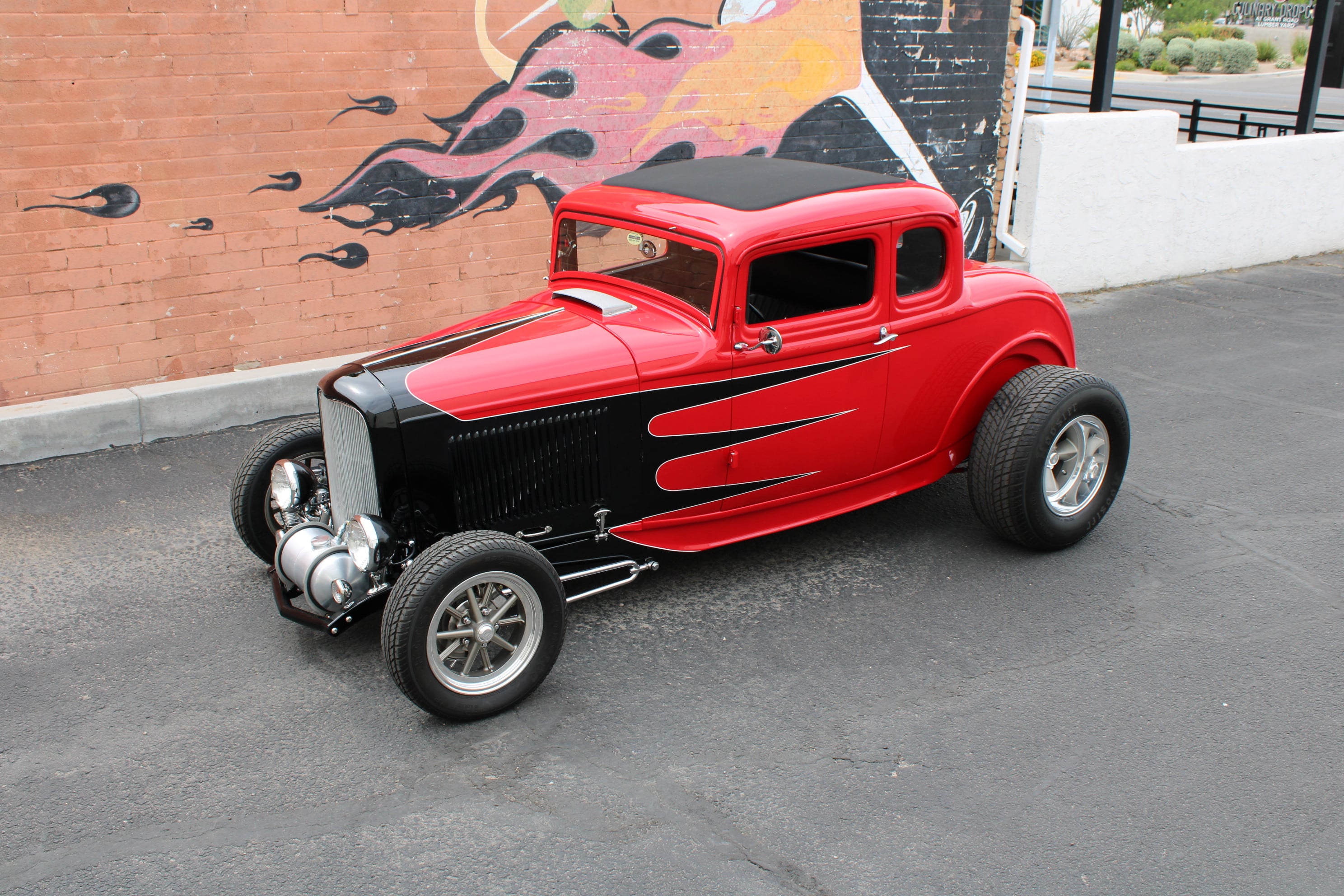
Values
Read this market as several markets wearing one name, because a 5 Window Coupe is priced less by its year than by which of those markets the individual car belongs to. A stock, correctly restored car trades among pre-war Ford people who pay for originality, documentation and the right details. A well-built street rod trades among hot rodders who pay for the build — the quality of the chassis work, the engine and driveline specification, the finish — and who discount a famous body style wrapped around mediocre fabrication without mercy. A project trades on the value of its bones: a sound original steel body and a correct frame are worth money in any company, while a rotten or reproduction body on a tired chassis is a starting point, not a bargain. Keep those three conversations separate in your head and asking prices start to make sense; mix them, and everything looks expensive or cheap for the wrong reason.
Within any one of those markets, the condition spread is wide and it is driven by the expensive, invisible things this guide has concentrated on. Two cars that photograph identically diverge the moment you price a flathead rebuild, a babbitt job, a body-off wood repair or a frame replacement into one of them. That is why the honest project-versus-driver gap on these cars is so large: a running, driving, structurally sound car carries the value of all the work you do not have to commission, and on a ninety-year-old Ford that work is measured in years of a specialist's time, not in parts bills alone. Cars in the middle — shiny, running, but with undocumented engines and unexamined undersides — are where buyers overpay, because the discount for the unknown should be real and sellers of shiny cars rarely volunteer it.
Variant premiums follow identity. The 1932 cars sit at the top of the range because the Deuce is the hobby's icon, and within 1932 a genuine V8 car with its correct frame commands more than a four-cylinder car or a conversion, however charming. Original steel outranks reproduction steel, which outranks fibreglass, and that ranking holds even when the reproduction car is objectively the nicer object — you are buying provenance as well as transport. The 1933–34 cars appeal to buyers who prefer the longer, sleeker look and are often the connoisseur's choice rather than the crowd's; the 1935–36 cars are the value route into a stock flathead coupe, easier to live with and less fought over. A documented racing history moves a cut-down car out of the "damaged coupe" conversation entirely and into the vintage-racing one, but only documentation does that — lettering alone is paint. On rods, a recognised builder's name and a build file function the way a matching-numbers drivetrain does on a stock car: they are the proof that the specification on paper is the car in front of you.
Negotiation reality is simple. Sellers price the car they remember building or restoring; you should price the car you can verify. Asking prices assume the engine is sound, the body is steel and the frame number is right, so every one of those assumptions you cannot confirm is a legitimate, itemised deduction — not an insult, a list. The computed market summary that accompanies this guide shows you what is actually listed and what has actually sold; use it to place the specific car in its specific market, then let the inspection, not the photographs, decide how far from the shiny end of that market your offer belongs.
Parts and ownership
Ownership is this car's great strength: you are buying into the best-supported pre-war hobby in the world. The early Ford V8 world has its own dedicated suppliers, clubs and swap-meet culture, and between them they reproduce or stock an astonishing share of what these cars need — mechanical brake components, kingpin and spring hardware, wiring harnesses in the original pattern, interior kits, glass, rubber, gaskets, water pumps, carburettor parts and sheet metal including repair panels for the usual rust zones. Stromberg carburation is supported by a specialist trade of its own. Model B four-cylinder owners lean on the even larger Model A parts world for much of their engine and service needs. Flathead machine work is the one genuinely scarce resource: find the specialist who magnafluxes, seats, sleeves and — on early engines — pours babbitt, and expect to join a queue, because that queue is the hobby's bottleneck. Budget accordingly: a carburettor rebuild in the hundreds, a kingpin job under four figures, a full interior kit in the low thousands before fitting, a thorough engine rebuild well into five figures if the block fights back.
Living with the car is a matter of rhythm rather than hardship. These are simple machines that reward regular, small attention: grease and oil on a period schedule rather than a modern one, brake adjustment checked as part of life with mechanical brakes, coolant kept clean in an unpressurised system, and a battery maintained on a six-volt car that sits. They are slow by modern measure and honest about it — plan journeys at the car's pace, leave the braking distance the drums ask for, and a stock coupe is a relaxing, characterful way to cover ground. A rodded car trades some of that simplicity for modern pace and its own service world of small-block parts and automatic gearboxes, which any general shop can support. Insurance through the classic trade, club membership — the Early Ford V8 Club world for stock cars, the rod runs and traditional events for the rest — and dry storage matter more to value than any accessory. Store one damp and the roof insert, wood and lower panels begin the next owner's rust map; store one dry and drive it monthly, and a 5-window mostly asks for consumables and attention.
Which one to buy
- The icon hunter: a 1932 Model 18 — genuine V8, correct one-year frame with a legible serial, original steel body. You pay the Deuce premium once, for the car every other coupe in this guide is measured against, and you verify the frame and body harder than any other purchase here.
- The connoisseur: a 1933–34 Model 40. The longest, sleekest lines of the run, the mature 85 hp flathead by 1934, and a car the crowd walks past on its way to the Deuces — which is precisely why a good one is the smart buy.
- The traditional rodder: an older hot rod built on a real steel body and frame, with a later flathead or a period-style small-block, a manual gearbox and a build you can trace. Buy the fabrication quality and the history, not the stance in the photographs.
- The driver: a 1936 Model 68, ideally a late car with the insert-bearing engine, hydraulic-brake conversion done properly and cooling sorted. The most developed stock coupe of the run, and the easiest to use every week.
- The value buy: a 1935 Model 48 in honest driver condition. Roomier and more civilised than the early cars, priced below them, and every bit as well supported — the discount is for fashion, not for substance.
- The project buyer: a structurally sound car with a tired engine, never the reverse. Blocks, gearboxes and trim can be rebuilt or replaced on a schedule; a rotten body over rotten wood on a bent frame is three projects wearing one title.
- The racer: a documented vintage oval-track car like the yellow 1934 pattern — bought for its history file and its eligibility, judged on the cage, the chassis and the story, and never "restored back" into a road coupe it stopped being decades ago.
The overriding rule: on a 5 Window Coupe you buy identity and structure — a legible frame number, an honest body, sound wood and straight rails — because engines, brakes, interiors and paint can all be bought later, but a car that is not what its title and seller claim it is can never be fixed at any price.
See the 3 5 Window Coupe cars currently listed.
For sale now
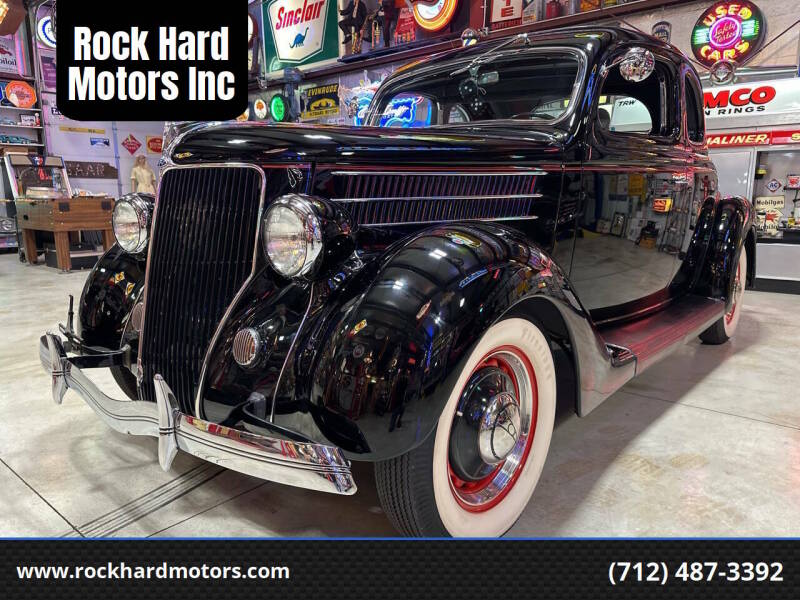 $44,995 · 11% below typical
Expand
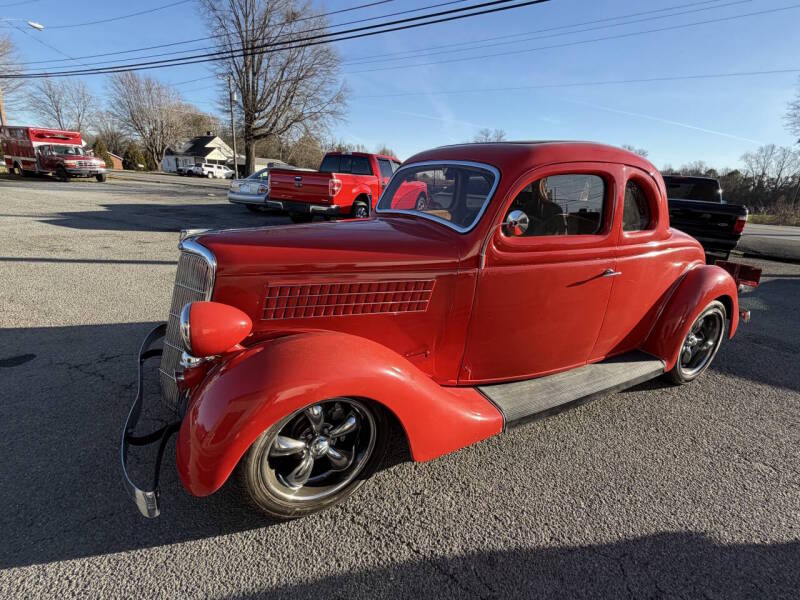 $29,500 · 42% below typical
Expand
What they sell for: 5 Window Coupe sale prices.