
Ford Cabriolet buyer's guide
Ford Cabriolet -- the model's own buyer's guide: variants, values and what to check.
Years listed: 1933-1937 · Series: Full Size
Overview and history
The Ford Cabriolet is not a model in the way a Mustang or a Thunderbird is a model. It is a body style — Ford's name, through the 1930s, for its most civilised open car — and that single fact governs everything else in this guide. When you go to look at one, you are not really shopping for a nameplate. You are shopping for a year, an engine and a body, in that order, and the Cabriolet part of the description tells you only what happens above the beltline: a folding top on fixed windshield posts, glass windows that wind up and down in the doors, a lined and padded roof, and weather equipment good enough to use the car in winter. Set that against the Roadster, Ford's other open two-door of the same years, and the difference is the whole point. A Roadster has a windshield that folds, no glass in its doors at all, and side curtains you clip on when the weather turns. A Cabriolet is a convertible in the modern sense — a closed car that opens — and period buyers paid a clear premium for it over the Roadster sitting next to it on the same chassis.
That premium is also why so few survive in original form. The Cabriolet was never the volume open Ford. The Roadster was cheaper and sportier, the coupes and sedans cheaper still and far more practical, and the Cabriolet sat in the awkward, expensive middle: the car you bought because you wanted open-air driving without open-car misery. It sold steadily from its Model A beginnings through the flathead V8 years, and it is those V8 years — 1932 to 1937 in the listings this guide is built around — that define the car today. The pool behind this page is tiny and honest about it: three cars, a 1932, a 1933 and a 1937, every one a dealer car, and every one modified. Hold that thought, because it is the second governing fact of Cabriolet buying in this century. The stock, numbers-correct Cabriolet exists, but the cars that actually change hands in the open market are overwhelmingly street rods and resto-mods: early Ford bodies, original or reproduction, over later engines, automatic or five-speed gearboxes, modern brakes and modern interiors. The two transmissions recorded in this pool tell the story without commentary — a 700R4 overdrive automatic and a manual five-speed. No 1930s Ford ever left Dearborn with either. You are therefore buying two cars at once in almost every Cabriolet transaction: a 1930s Ford body and identity, and a later build of someone else's choosing underneath it. This guide treats both halves with equal seriousness.
The years break into three clear chapters. The first is 1932, the Deuce year: a one-year body on a 106-inch wheelbase, offered as the four-cylinder Model B or the V8 Model 18, and already so desirable as a hot rod base that original Cabriolets were being cut, channelled and engine-swapped within a generation. The second chapter is 1933–36, the Model 40 and its successors on a longer 112-inch wheelbase: sleeker, skirted-fender cars, V8-only in practice by 1935, and the years in which the Club Cabriolet — a Cabriolet with a proper rear seat under the top instead of a rumble seat — joined and then overshadowed the original formula. The third chapter is 1937, when Ford restyled the car around a V-shaped grille and headlamps faired into the fenders, widened the engine choice to include the small economy V8-60 alongside the 85 hp 221, and built what many consider the prettiest of the pre-war open Fords — the year of the orange-and-silver car photographed in this guide, itself a full custom build wearing the 1937 shape.
A word on names, because sellers use them loosely and money follows the looseness. "Cabriolet" on a 1930s Ford should mean the winding-window convertible described above. It is routinely applied in listings to Roadsters, to convertible sedans (a different, four-door body), and — as one car in this very pool demonstrates — to hi-boy roadster builds with no top, no door glass and no windshield frame worth the name. The word is worth money, the Roadster word is worth less, and the gap between them is exactly why you verify the body in front of you rather than the word in the advert. The checks are simple: a true Cabriolet has a fixed, upright windshield frame that is part of the cowl structure, window frames and winding mechanisms inside the doors, and a top that folds on a substantial iron frame. A car with none of those things may be a fine hot rod, but it is not the car this guide is about, and it should not be priced as one.
Finally, set your expectations for what these cars are to drive. A stock 1932–37 Cabriolet is a pre-war car in every system: transverse leaf springs, mechanical brakes, a three-speed gearbox with synchromesh only on the upper gears, six-volt electrics, and steering that asks for planning. A well-built street-rod Cabriolet keeps the silhouette and replaces almost every one of those experiences. They are different purchases, for different owners, at different money — and the worst Cabriolet buy is the one where you pay for one and take home the other.
The models
Ford offered a Cabriolet in every year covered here, but changed the car underneath the name almost annually, and the year matters more than the badge. Read the table as a map of what you will actually meet for sale. Production figures for individual 1930s Ford body styles survive only patchily, so the "built" column gives you an honest scale rather than a spuriously precise count. What is not in doubt is the ranking: in every one of these years the Cabriolet was a low-volume, premium body, built in far smaller numbers than the coupes and sedans on the same chassis.
| model | years | engine | output | built | character |
|---|---|---|---|---|---|
| Cabriolet (Model B / Model 18) | 1932 | 200.5 cu in four / 221 cu in flathead V8 | 50 hp / 65 hp | Scarce — one-year body, small share of Deuce output | The Deuce. One-year styling, 106 in wheelbase, rumble seat, the hot rod world's favourite open body |
| Cabriolet (Model 40) | 1933–34 | 221 cu in flathead V8 (four to 1934, rare) | 75 hp (1933), 85 hp (1934) | Low volume | Longer, sleeker skirted-fender car on 112 in; 1934 the more powerful and more sought-after |
| Cabriolet (Models 48 / 68) | 1935–36 | 221 cu in flathead V8 | 85 hp | Low volume | Rounder, more integrated styling; 1936 adds the Club Cabriolet with a real rear seat |
| Club Cabriolet | 1936–37 | 221 cu in flathead V8 | 85 hp | Low volume | The usable one: four seats under the top, no rumble seat, the family man's open Ford |
| Cabriolet (Model 78 / 74) | 1937 | 221 cu in V8 / 136 cu in V8-60 | 85 hp / 60 hp | Low volume | V-grille, fender-faired headlamps, all-steel roof era styling; V8-60 cars are economy specials, worth less |
The 1932 car is its own world. Ford built it for one year only, on the new double-drop frame, and styled it as a small Lincoln: upright grille shell, long hood, a rumble seat behind the cabin and a top that folds down behind the seat rather than disappearing into the body. You could order it as a Model B with the improved four-cylinder engine or as a Model 18 with the new flathead V8, and the V8 is what the market remembers — but read the Model B guide on this site before you dismiss a four-cylinder car, because a genuine, unconverted four-cylinder Deuce Cabriolet is now the rarer artefact precisely because so many were V8-swapped or rodded. What almost no 1932 Cabriolet is, any more, is stock. The yellow hi-boy in this site's pool is filed as a 1932 Cabriolet, and its photographs show why you must look for yourself: no fenders, no top, no door glass, a cut-down windshield and an exposed later engine. That is a roadster-style hot rod in configuration, whatever the paperwork calls it, and the inspection section below shows you how to make that call on any car in minutes.
For 1933 the whole car grew up. The wheelbase stretched to 112 inches, the fenders gained skirts, the grille sloped, and the Cabriolet became a genuinely elegant machine — the shape the pale yellow 1933 car in this pool still wears under its modern wheels and smoothed panels. The V8 rose to 75 hp for 1933 and 85 hp for 1934, helped by improved carburation and, for 1934, a better intake and Stromberg two-barrel. The four-cylinder lingered as a catalogue option into 1934 and is vanishingly rare in a Cabriolet; treat any claimed four-cylinder 1933–34 car as a research project, not a discount. Rumble seat standard, winding windows, fixed windshield: the Cabriolet formula was now settled.
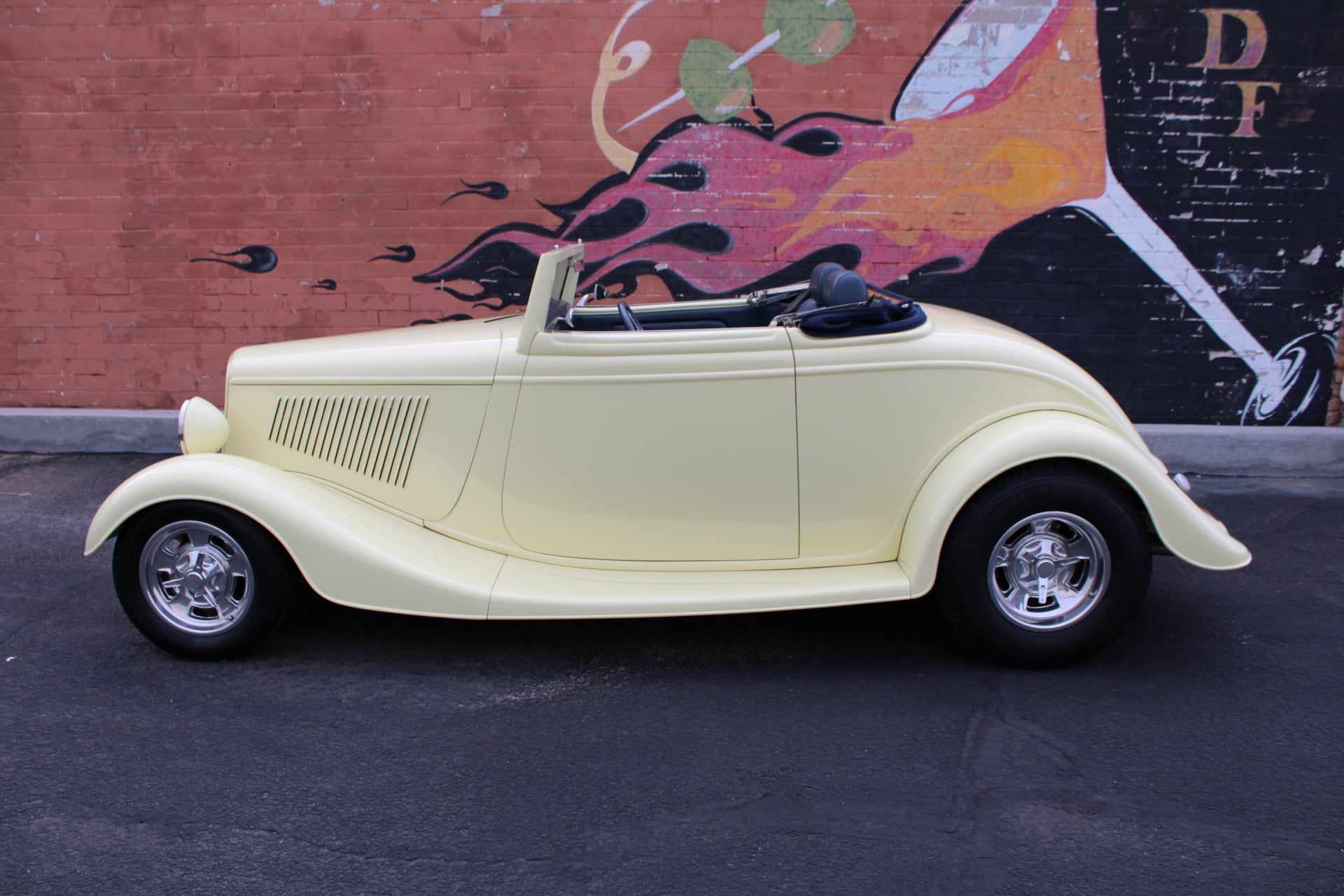
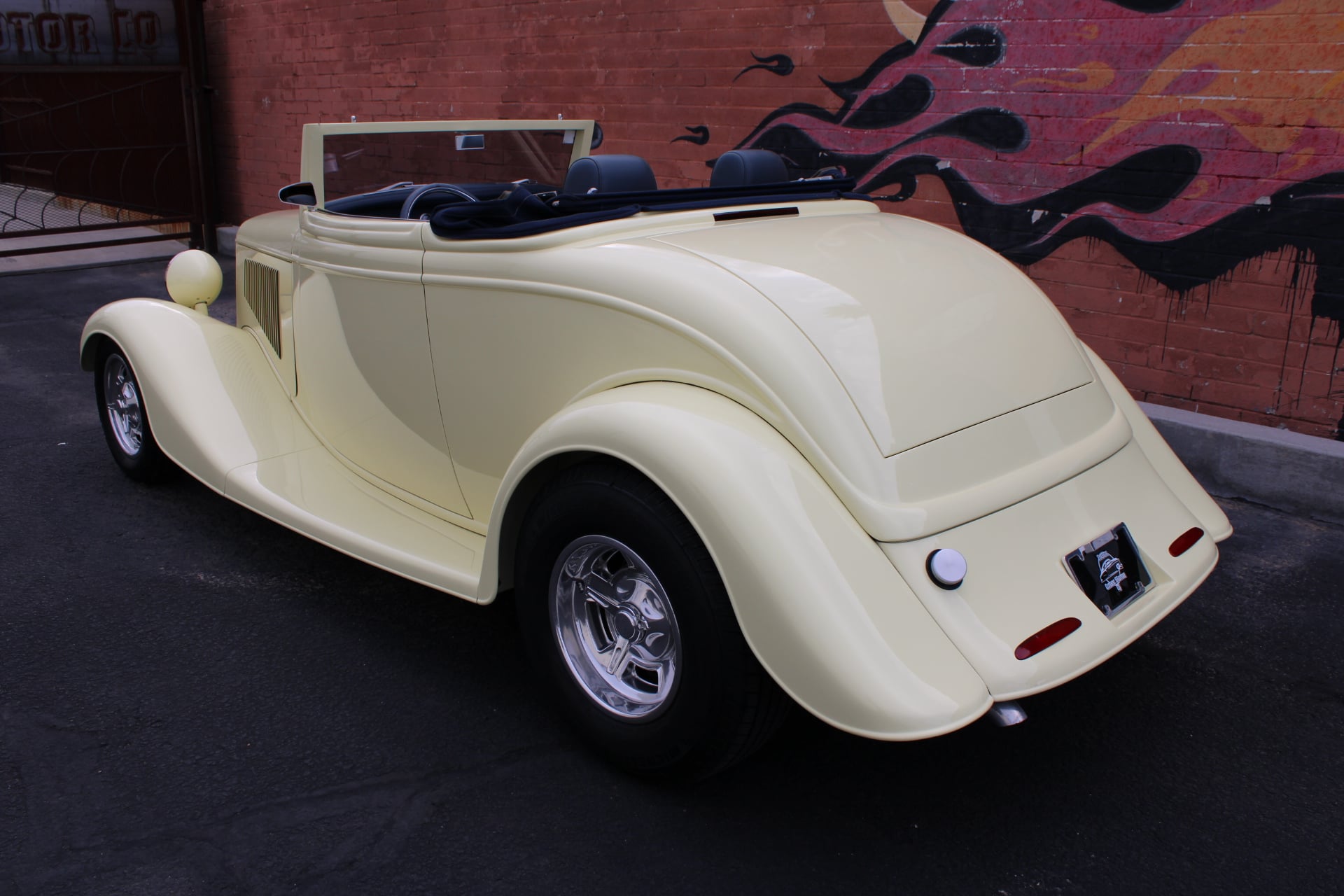
Nineteen thirty-seven closes the run this guide covers, and it is a styling step-change: the grille becomes a split, heart-shaped V, the headlamps move from free-standing pods into the fender tops, and the whole car looks five years younger than a 1936. Underneath, the 85 hp 221 remains the engine you want. The new V8-60 — a 136 cu in miniature flathead making 60 hp, designed for economy and European tax brackets — is a charming engine in a light car, but in a heavy open body it is underpowered, and the market prices V8-60 Cabriolets accordingly. The orange-and-silver 1937 in this pool is at the opposite pole: a full custom, smoothed and lowered, modern inside and out. It demonstrates the final lesson of this section. By 1937 the Cabriolet shape had become a styling icon, and icons get customised. Judge each car as the individual build it is.
Engines and gearboxes
The 221 flathead V8 — design and identity
The engine that made these cars famous is the original Ford flathead V8: 221 cubic inches (3.6 litres), a monobloc L-head V8 with the exhaust passages cast through the block, three main bearings, a single downdraught carburettor, and 65 hp in its 1932 form. Its architecture explains both its charm and nearly every problem in the next section. Because the exhaust ports route through the water jacket on their way out of the block, a flathead runs its coolant hotter than a comparable overhead-valve engine doing the same work — cooling is not a flathead accessory system, it is the engine's central design compromise, and everything about owning one flows from that. The valves sit beside the bores in the block, adjusted (on the early engines) by grinding stems and fitting lifters rather than by any screw you can turn at the roadside, and the ignition is a Ford-specific distributor driven from the front of the camshaft, sitting low at the front of the engine where road water and its own condenser conspire against it.
Identity first, because swaps began in period and never stopped. A 1932–36 engine is a 21-stud engine: count the head studs or nuts — 21 per head on the early 221, against 24 on the later 1939-onward 221 and 239 engines that are the most common period-correct replacements. The water pumps on the early engines mount on the cylinder heads, one per bank, driven by the fan belt; later engines moved the pumps to the block. A genuine 1932 engine is rarer still: the earliest V8s differ in detail (including the first, short-lived aluminium-head and Detroit Lubricator carburettor fitments), and most 1932 cars that still run a flathead run a later one. None of this is a condemnation — a healthy 24-stud 239 from the 1940s is a stronger, better-supported engine than a tired original 21-stud — but it changes what the car is and what it is worth, so establish which flathead you are looking at before you discuss price. The engine number on an early Ford is stamped on the gearbox casing bell and matches the frame number, not stamped on the block itself in the modern fashion; the full identity procedure is in the inspection section.
The 221 flathead V8 — carburation, cooling and character
A stock Cabriolet flathead breathes through a single two-barrel downdraught carburettor — a Ford/Holley-built unit or a Stromberg 48 or 97 depending on year and market — fed by a cam-driven mechanical fuel pump, with a vacuum-operated distributor advance working alongside centrifugal weights. The system is simple, well understood and reproduced in every particular, but it has three period behaviours you must learn to read rather than "fix". First, hot restart: heat soak after a shutdown vaporises fuel in the pump and lines, and a flathead that cranks without catching on a hot day is usually asking for time, a wide-open throttle and patience, not parts. Second, the vacuum advance depends on a sound carburettor and a leak-free line; a perished vacuum pipe gives you a flat spot that generations of owners have blamed on the carburettor bodies, when the test is a hand vacuum pump on the advance canister before anyone sells you a rebuilt carburettor. Third, the fuel pump's diaphragm and the sediment bowl are service items in modern ethanol fuel, which attacks period rubber and cork — budget for a modern-materials rebuild kit as routine ownership, roughly $150–400 fitted depending on how much of the fuel system you renew while you are there.
In character, the flathead is the reason to buy the stock car at all. It starts eagerly, idles with a soft, uneven lope no later engine imitates, pulls from almost no revs, and makes 45 mph feel like an event. It is not fast. An 85 hp Cabriolet cruises happily at 50–55 mph and will run faster at the cost of noise, heat and conscience. If your intended use is modern highway distances, that is the most important sentence in this section — and exactly the calculation that produced the street-rod half of the market.
The four-cylinder Model B engine — design and identity
The four-cylinder Cabriolet is the connoisseur's footnote. The Model B engine is the Model A engine developed: the same 200.5 cubic inches, but with a counterweighted crankshaft, improved lubrication with a pressurised feed to the main bearings in place of the A's splash-and-gravity system, a water pump and fuel pump where the A had thermosyphon and gravity, and 50 hp against the A's 40. It is a torquey, unburstable, low-revving engine that suits the car's gearing beautifully, and in a 1932 Cabriolet it is the original specification for a Model B-badged car. Identification runs through the engine number stamped on a pad on the left side of the block and the car's frame number, and a four-cylinder car should also carry the four-cylinder's own radiator, gearbox casing and details — a "four-cylinder" car assembled around a V8 chassis is a conversion wearing a story.
The four-cylinder in practice, and the V8-60
Living with the four means accepting its pace — it is slower than the V8 by a margin you feel on every hill — in exchange for simplicity: one head, one carburettor, conventional coil ignition, and a cooling system with half the flathead's drama. Its known weaknesses are age weaknesses rather than design scandals: babbitt main and rod bearings that wear and knock (a bottom-end rebuild with modern insert conversions runs into the $2,500–4,500 range at a specialist), cracked blocks from historic freezing along the water jacket, and tired carburation causing hot-start flooding. The myth to correct is that the four is worthless: in a Cabriolet, where the body is the value, a genuine documented four-cylinder car is a rarity play, not a parts car.
The V8-60, offered in the 1937 cars, is a scaled-down flathead V8 of 136 cubic inches and 60 hp, with the same through-block exhaust architecture in miniature. It was designed for economy and European taxation classes, it is smooth and willing, and it is simply out of its depth in a Cabriolet asked to climb or carry. Its parts situation is thinner than the 221's — fewer were built, fewer specialists stock for it — and the market's discount on V8-60 cars is rational. Buy one for its economy and novelty with your eyes open, and check the same cooling and identity points as the big engine, remembering that a 221 swap into a V8-60 car is common and not always disclosed.
The engines you will actually find: swaps
Now the honest half of this section. A large share of Cabriolets run later engines entirely: small-block Chevrolet V8s above all, small-block Fords, modern crate engines, occasionally a late flathead built to 1950s specification. There is no single "swap engine" to describe, so learn the buyer's framework instead. One: identification — get the engine's actual identity in writing (casting numbers, displacement, builder if known), because "350 Chevy" covers everything from a tired truck engine to a serious build, and the difference is the car. Two: installation quality — mounts, cooling capacity (a swap car that overheats was usually given a radiator sized for the photograph, not the engine), exhaust clearance at the steering box, wiring executed as engineering rather than sculpture. Three: paperwork — receipts and a build sheet convert an unknown into a specification, and they are worth real money. A documented swap by a known shop is a feature. An anonymous swap is a question mark with a V8 attached.
Gearboxes — original and otherwise
The original gearbox is Ford's three-speed sliding-mesh manual: synchromesh on second and top, a floor-mounted lever, a torque-tube driveline behind it to the banjo rear axle. It is stronger than its reputation, pleasant once you learn its pace, and its party trick is that second and top carry most driving — the flathead's torque means you change down far less than the specification suggests. First is unsynchronised, so you select it at a standstill or learn to double-declutch; crashing it at speed chips teeth and fills the oil with glitter, which is one of the inspection checks. Worn synchromesh on second announces itself as a crunch on fast upchanges that disappears when you slow the change down — liveable for years, and a $800–1,800 rebuild if it finally refuses.
Behind swapped engines you will meet the modern gearbox world, and the pool's two examples span it: a GM 700R4 four-speed overdrive automatic — the street rod's default, giving relaxed cruising from its overdrive top, provided its TV (throttle valve) cable is correctly adjusted, because a mis-set TV cable is the classic 700R4 killer, dropping line pressure and burning the box in ordinary driving; ask who set it up and test that the box shifts firmly and kicks down cleanly — and a manual five-speed of the Tremec T5 family type, whose health you judge by synchromesh behaviour on second and third and by noise in fifth. In both cases the gearbox is only as good as its installation — crossmember, mount, speedometer drive, and propshaft (the torque tube is gone on a swapped car, replaced by an open shaft to a later axle, which should be a named unit — Ford 8- or 9-inch, GM 10-bolt — with a known ratio). Ask for the ratio. A seller who cannot tell you what axle and ratio the car runs is telling you something about the whole build.
Problem areas
Rust and structure: the map
Everything else in this section is negotiable; the body is not. A Cabriolet body is a steel skin over a structure that, on the early cars especially, still relies on wood in the floor, the door frames, the top well and the body framing — and open cars live wet lives. Water enters at the top and the windshield, sits in the floors and the sills, and works outward from places you cannot see until the damage is structural. In this site's own photo-note sample the examined Cabriolets are too few to give you a meaningful rust rate — two cars examined, with a leak mentioned in one of the two — so treat the map below as the checklist it is, not a statistic, and work it in full on every car.
Start at the sills and the floor. The rocker panels and the floor pans either side of the transmission tunnel are the first structural casualties, and on a Cabriolet they matter more than on a coupe because the open body has no roof to stiffen it: a Cabriolet with soft sills is a car whose doors will not stay shut over bumps. Press along the sill with your palm, look from underneath with a torch, and treat fresh underseal on a car with no restoration paperwork as a question, not an answer. The door bottoms and the lower door skins follow, then the cowl sides where the front fenders meet the body, the lower windshield frame and header rail — a Cabriolet-specific rot point, because the fixed windshield frame channels water into the cowl for ninety years — and the rear quarters ahead of the rear wheels. The rumble-seat compartment and the deck gutters around it hold water by design; lift the lid, look at the floor of the well and the hinge panel, and expect repair here even on good cars. On a Club Cabriolet the equivalent trap is the rear seat well and the floor beneath it.
The frame is the second structure and the one sellers hope you skip. The 1932 double-drop frame and the 1933-on X-member frames are strong, but they rust at the crossmember junctions, crack around the front crossmember and spring hangers on hard-used cars, and — on rodded cars — carry the evidence of every modification: drilled holes, welded brackets, boxed sections done well or badly. A frame that has been boxed (plates welded inside the rails for stiffness, standard practice for a V8 swap) should show neat, continuous work; bird-droppings welds on a frame are a verdict on the whole build. Straightness matters more than shine: sight down the rails, compare the diagonal measurements if the car pulls or crabs, and walk away from a bent frame on a car priced as finished. Frame repair ranges from a few hundred dollars for localised welding to a full body-off programme at $8,000 and up before paint — which is why this paragraph outranks everything mechanical in the car.
Wood is the third structure, and the one modern buyers forget. Door frames, floor boards, seat and top-well framing on the early cars are timber, and timber rots invisibly behind trim and under paint. A door that flexes when you swing it, a top that will not latch evenly on both sides, a seat that moves under you: suspect the wood before the metal. Replacement wood kits exist for the popular years and cost a few hundred to around $1,500 in parts, but fitting them is skilled, slow work — budget $2,000–5,000 in labour on a car that needs a full re-wood of doors and floor, and understand that a car needing wood usually needs the paint disturbed to do it.
Finally, reproduction bodies. Steel reproduction Cabriolet and roadster bodies (Brookville is the best-known maker) and fibreglass bodies have been available for decades, and a car built on one is not automatically a bad car — a new Brookville steel body is straighter than most survivors. But it is not a 1932 Ford body, it must not be priced as one, and the seller must be able to tell you which it is. The tells: fibreglass shows itself at the inside of panels (mat texture, no spot welds, thickness at edges); reproduction steel lacks the small imperfections, factory seams and age of an original and usually arrives with modern panel fit. Ask directly, in those words: "Is the body original Ford steel?" The answer, and the confidence behind it, are both data.
The flathead: cooling, cracks and bearings
The flathead V8's problem list is short, specific and dominated by heat. The through-block exhaust design means a neglected cooling system does not just overheat the engine, it cooks it: scaled water passages (decades of hard water and no antifreeze discipline) narrow until the rear cylinders run hot, head gaskets begin to weep, and eventually a head or the block cracks — classically between a valve seat and the bore, or along the exhaust side of the block, sometimes visible only on a pressure test or with the head off. A flathead that uses water with no visible leak is guilty until proven innocent: pressure-test the cooling system, look for bubbles in the header tank with the engine running (combustion gas entering the water), and check the oil for emulsion. A cracked block is not always fatal — pinning and sleeving are established repairs — but a cracked block discovered after purchase converts a driver into a $4,000–8,000 engine programme, so the test happens before the money, not after.
Bearings and oil: worn main and rod bearings announce themselves as a deep knock under load that fades as you lift off, with oil pressure (where a gauge is fitted) sagging hot at idle. The flathead's oil pump and its drive are reliable; its oil leaks are not a fault so much as a factory finish — expect weeping at the rear main and the timing cover, and distinguish a weep (a film, a drip on the card after a week) from a leak (a puddle, a quart between drives). The site's photo notes for this pool mention a leak in one of the two examined cars, which matches the breed: budget for seals and gaskets as routine, and investigate only when the rate is high or the source is the cooling system rather than the oil system.
Ignition and charging are six-volt period systems with period failure modes. The front-mounted distributor's condenser and coil are heat-cycled every drive; a flathead that dies when hot and restarts when cool is describing its condenser or coil until proven otherwise, and the test is substitution with known-good parts, not a carburettor rebuild. Six-volt starting is adequate with fat, clean cables and a healthy battery, and marginal with the thin modern cables and corroded earths most cars actually have — slow cranking on a six-volt car is a cabling diagnosis first and a starter diagnosis last. Many cars have been converted to 12 volts, with or without an alternator; a conversion done completely (bulbs, gauges protected, starter accounted for) is a usability gift, and one done halfway is an electrical fault with a fuse box.
Chassis, steering and brakes: the pre-war systems
A stock Cabriolet rides on beam axles and transverse leaf springs at both ends, located at the rear by the torque tube, with lever-arm or early tubular shock absorbers depending on year. The wear points are mechanical and honest: kingpins and bushes at the front axle (jack the front up, grasp the wheel top and bottom, and rock — play you can feel is play you must price, at $400–900 a side fitted for pins and bushes), spring shackles and their bushes, worn spring leaves that let the car sit down on one corner, and shock absorbers that have been empty ornaments for fifty years. The steering box is a worm-and-roller or worm-and-sector unit that wears in the straight-ahead position, giving you a dead band at the wheel centre that adjustment takes up only until the box binds at full lock; the correct test is play at centre versus tightness at the locks, and a box that is both loose in the middle and tight at the ends is worn, not maladjusted — a rebuild or exchange box runs $600–1,400.
The brakes are the section's safety headline. Every Cabriolet in the years this guide covers left the factory with mechanically operated drum brakes — rods and cables, no hydraulics. In perfect order, correctly adjusted, they stop the car adequately for period speeds. In typical order — stretched cables, worn clevis pins, oval drums, oil-contaminated linings from leaking axle seals — they stop it eventually, and unevenly: a mechanical-brake car that pulls under braking is telling you one side's linkage is doing more work than the other, and the fix is methodical adjustment and renewal of the linkage, $500–1,500 at a specialist for a full recommission, not a bigger push on the pedal. Many cars have been converted to the 1939-onward Ford hydraulic system or to later brakes entirely, and on a driver this is the single most valuable modification a Cabriolet can carry. Establish what is fitted before the test drive, and drive accordingly: your first stop in an unfamiliar mechanical-brake car is a gentle one, in a straight line, with room.
On street rods the chassis questions change from wear to specification: a Mustang II-type independent front end and a four-bar rear are the standard recipe and a good one when executed well, so hunt execution faults — bump steer, cracking coilover mounts, propshaft angles that drum at speed. Drive the car over a broken surface and through a fast sweeper; a well-built rod is calm at both, and a badly built one tells you within a mile.
Top, glass and interior: the Cabriolet's own systems
The top is the Cabriolet's defining mechanism and its most neglected one. The frame is a scissor of steel irons that must fold symmetrically; bent or worn irons give you a top that latches on one side and strains on the other, and straining a top shut is how header rails crack and windshield frames twist. Operate it yourself, twice, up and down, and watch both sides move together. The fabric — originally a rubberised canvas — perishes, shrinks and tears at the folds; a new top fitted properly is a $1,500–3,500 job depending on material and whether the pads, straps and tack strips are renewed with it, and a car "with a new top" should show you the invoice, because a new skin over rotten pads looks right for exactly one summer. The rear window, the headlining and the landau bars are the details that separate a restored top from a recovered one.
Door glass is the Cabriolet's other signature system and a genuinely expensive one to put right. The winding mechanisms wear, the glass channels rot, the glass itself delaminates at the edges on laminated panes, and the division bars and seals that keep weather out are consumables that most cars have consumed. Wind both windows up and down through their full travel: they should rise evenly without tipping, meet the top frame without a gap you can post a coin through, and stay where you leave them. A window that drops is a regulator; a window that tips is channels and guides; both together, plus glass, is a $600–1,500 per-door programme at a trim shop. This is also your identity cross-check from the overview: a car with no winding glass, no regulators and no window frames in the doors is not a Cabriolet, whatever its title says.
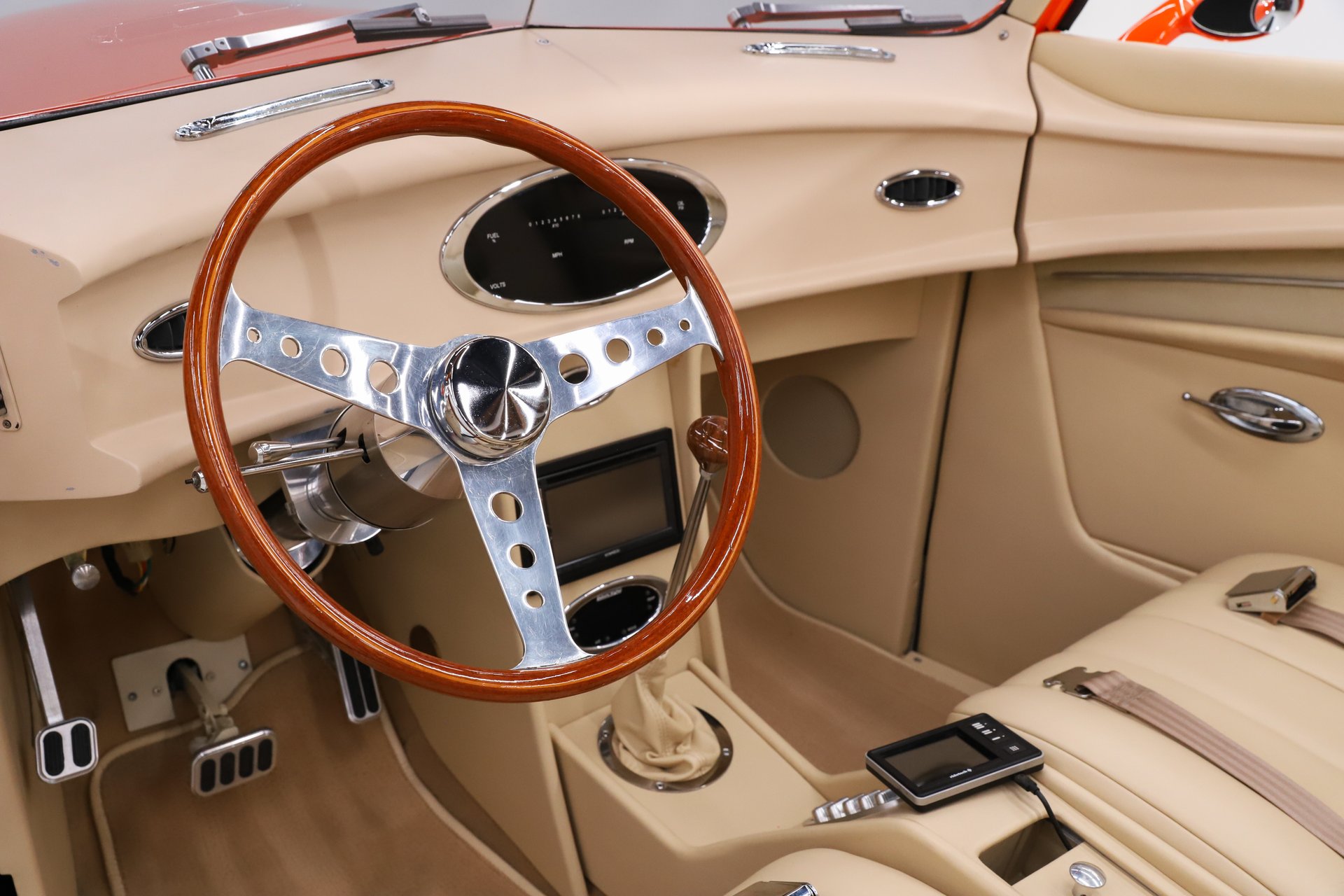
Interiors on original cars are leather or leather-and-cloth to period patterns, and most surviving interiors are replacements of varying fidelity — which matters for value only when the seller claims otherwise. On street rods the interior is a custom build, and the car in this pool shows the full modern form: sculpted door cards, a digital instrument cluster, a centre console, modern seats and belts, air conditioning vents. Judge a custom interior as furniture and wiring at once: everything electrical in it is a one-off installation, so work every switch, and ask who wired it.
The street-rod layer: build quality as a problem area
Because so many Cabriolets are builds, the build itself is a problem area, with its own failure modes. Cooling leads: a small-block V8 in a narrow 1930s engine bay needs a serious radiator, a shrouded fan and an escape route for hot air, and a rod that runs hot in traffic was built to a budget at exactly this point. Wiring is second: look behind the dash and under the car for twisted-and-taped joins, unprotected runs through metal holes and a fuse box that matches the car's actual equipment. Third is heat in the cabin — uninsulated floors and firewalls above side-exit exhausts cook feet and perish carpet, so a long test drive tells you what a short one hides. Fourth is documentation drift: builds change hands, specifications get retold, and engines shrink or grow in the telling. The antidote to all four is the same: receipts, a build sheet, a known shop's name, and a long, hot, varied test drive.
How to inspect one
Work this list in order: the checks that can kill the deal — identity, structure, engine health — come before the road test, and the road test answers specific questions the static checks raise. Bring a torch, a magnet in a cloth, a tyre gauge, a friend, and a piece of clean card to leave under the car.

- Identity before everything. Find the frame number — on early Fords it is stamped on the left frame rail, typically visible near the front crossmember and again further back — and compare it with the title. On a V8 car the number's prefix and sequence place the car by year and original engine type; the gearbox casing carries the matching engine-side number on an original driveline. A number that does not match the title, a rail that has been ground or re-stamped, or a "1932" whose number sequence belongs to another year stops the inspection until the seller explains it in documents, not adjectives.
- Cabriolet or not. Confirm the body is what the car is sold as: fixed windshield frame integral with the cowl, winding glass in both doors with regulators you can feel working, a folding top on a full iron frame. No door glass and a folding windshield means Roadster; four doors means a different body entirely. Price the car in front of you, not the word in the advert — this is the check the hi-boy in this site's pool fails, and it takes ninety seconds.
- Steel, glass or reproduction. Run the cloth-wrapped magnet over the quarters, doors and deck: it should hold everywhere on an original or reproduction steel body and fall off fibreglass and filler. A few low spots are ninety years of life; a whole quarter that will not hold a magnet is a material fact. Ask the direct question — original Ford steel, reproduction steel, or fibreglass — and note the answer verbatim.
- The structure walk. Torch underneath: sills, floor edges, crossmember junctions, frame rails, spring hangers. Press the sills, look into the rumble-seat well or under the Club Cabriolet's rear seat, and open and shut both doors twice — a structurally sound open car shuts its doors the same way on the flat and with one front wheel raised on a kerb; a car whose door gaps change with the kerb test has the sill and wood problems of the rust section, priced accordingly.
- Wood and top. Swing each door gently and feel for flex; sit in the seat and bounce once; then raise and lower the top twice, watching both sides travel together, and latch it. Check the header rail fit against the windshield frame and the state of the fabric at the folds. A top that fights you is a frame, wood or fabric bill — get it acknowledged while the seller is watching it happen.
- Cold start, from cold. Insist the engine is cold when you arrive — a warmed-up car at a viewing is a choice the seller made. Watch the exhaust at first fire (blue, white or clean), listen for bearing knock in the first seconds before oil pressure builds, and note how it cranks: a six-volt car that spins eagerly has good cables and a good battery, and one that labours is giving you the electrics section's diagnosis for free.
- The full warm-up. Idle the car and then drive it gently until it is fully hot, watching temperature the whole time. You are running the flathead cooling test from the problem areas: temperature that climbs at idle, climbs at speed, or climbs on hills are three different faults with three different bills, and a car that will not complete a twenty-minute warm-up and drive without distress is not a driver at any price. Check for bubbles in the header tank and water loss as it cools.
- Compression and plugs, if the seller allows. On an original-engine car this is the single most informative half-hour available: even readings, healthy engine; one low cylinder, a valve or gasket; two adjacent low, the gasket between them. Read the plugs as they come out — oil fouling, soot and one clean steam-washed plug each tell their own story. A seller who refuses a compression test on a car priced as a good engine has answered it.
- Gearbox and driveline on the road. In an original three-speed, feel second-gear synchromesh on a brisk upchange, listen for first-gear whine, and check for axle tramp and torque-tube rumble on a trailing throttle. In an automatic street rod, demand the 700R4 checks: firm shifts, clean kickdown, no flare between gears, and ask who set the TV cable. In a five-speed car, work every gear and listen in fifth. Any box: put the clean card under the car for ten minutes after the drive and read the drips — engine oil, gearbox oil, coolant and brake fluid each land in their own place.
- Brakes, tested progressively. Establish first whether the brakes are mechanical or hydraulic — the pedal feel and a look at the backing plates tell you. Then brake gently, then firmly, then hard from moderate speed in a straight line with hands light on the wheel. Pulling, grabbing, a pedal that creeps or a car that needs two applications are all findings, and on mechanical brakes they are linkage findings from the problem areas, to be priced as a recommission, not waved away as character.
- Steering and suspension on a bad road. Find broken tarmac. Kingpin play shows as shimmy and clonk; worn shackles knock; a worn steering box gives you the dead band at centre that tightens at the locks. On a rod, this is also the bump-steer and build-quality test: a car that darts over ridges or steers itself under power has geometry to fix, and geometry is fabrication money.
- Paperwork and the build file. Finish where the money is. Title matching the frame number, registration history, and — on any modified car — the build sheet, receipts, engine and axle identification, and the name of the builder. Score the car in the two layers from the overview: body and identity in one column, mechanical specification and condition in the other. A Cabriolet that is honest in both columns is the car to buy. One that is vague in either is a negotiation, and one that is evasive in both is a walk.
Values
The Cabriolet market is really two markets sharing a silhouette, and the first skill in reading it is refusing to average them. On one side sit the original cars: factory bodies, flathead or four-cylinder power, mechanical brakes, documented identity. On the other sit the builds: street rods and resto-mods whose value is the sum of a body (original or reproduction), a specification and a builder's reputation. A price that looks absurd for one market can be unremarkable in the other, so every comparison you make must be within a layer first — year, body authenticity and specification — before it is between individual cars. The computed market block beneath this guide gives you the current numbers for cars actually listed and sold; use it with that layering in mind, because a median drawn across both markets describes neither.
Within the original-car market, the condition spread is wide and it is driven by structure, not shine. A Cabriolet's value lives in its body: original steel, sound sills and wood, a working top and winding glass. A mechanically tired car with a sound, original body is a better buy at the same money than a gleaming car whose beauty is filler and fresh paint, because engines are rebuilt every day and original Cabriolet bodies are not made any more — the reproduction exists, and the market prices an original body above it for exactly that reason. Year premiums follow the familiar early-Ford order: 1932 carries the Deuce premium in every body style; 1933–34 cars are close behind on looks; the Club Cabriolet earns a premium over the rumble-seat car for usability and rarity; and V8-60 versions of the 1937 car sit at a discount to their 85 hp sisters that no amount of charm has yet closed. Four-cylinder cars break the pattern in an interesting way — a genuinely documented four-cylinder Cabriolet trades on rarity to a small, knowledgeable audience, which means it can be both slow to sell and surprisingly firm in price.
In the build market, asking prices are set by build cost and achieved prices are set by taste, documentation and drivability, and the gap between the two is where Cabriolet negotiations live. A professional build with a full receipt file, a named engine and axle, working air conditioning and sorted cooling can hold a strong price for years. The same silhouette with anonymous mechanicals and no paperwork is worth what the next buyer can verify, which is much less — build cost is not value, and the seller's total spend is the least persuasive number in the room. Projects price on the project-versus-driver gap in its purest form: an unfinished Cabriolet build is worth its body, its title and its verifiable parts, minus the cost of finishing someone else's vision, which is why unfinished projects routinely change hands for a fraction of the money already in them.
Parts and ownership
Ownership splits along the same two layers as everything else about these cars. For the original car, the parts situation is one of the great strengths of the early-Ford world. The flathead V8 is supported by a deep specialist trade: gaskets, bearings, water pumps, carburettor kits, ignition parts and complete rebuilt components are available off the shelf from long-established early-Ford suppliers, and the four-cylinder shares much of the Model A/B trade's depth. Body and trim are the thinner end — Cabriolet-specific items such as top irons, window regulators, rumble-seat hardware and correct small trim are reproduced selectively or not at all, and the hunt for them runs through the Early Ford V8 Club's network, swap meets and the marque's specialist breakers. Join the club before you buy the car; its technical advisers have forgotten more about these bodies than most sellers ever knew, and its classifieds are where the unobtanium actually surfaces. Routine running costs on a stock car are modest — oils, grease, points, plugs, tyres in period sizes — and the discipline that matters is cadence: grease the chassis points every thousand miles or so, keep the cooling system on a two-year flush-and-antifreeze rhythm, exercise the top and the window regulators rather than letting them seize in place, and store the car dry with the top up, because a folded top creases, shrinks and mildews in exactly the places you cannot repair invisibly.
For the build, ownership is a documentation discipline. Your car's real parts catalogue is its build sheet: the engine is whatever the casting numbers say, the front suspension is a named kit or a named donor, the axle is a named unit with a ratio, the instruments are a named maker's. Keep the file, add every receipt, and photograph the hidden installations (wiring runs, brake line routing, fan shrouding) while they are accessible, because the next fault will be diagnosed by whoever holds that file — quite possibly you, at the roadside. Consumables on a rod are modern and easy; the costs concentrate in the custom layer, where a failed one-off component is a fabrication job rather than a parts order. Insurance and registration deserve a sentence on both layers: agree the car's description with your insurer in writing (original, modified, or reproduction-bodied cars are rated differently, and a fibreglass or reproduction body discovered after a claim is a miserable conversation), and keep the frame-number evidence with the title, because on a ninety-year-old car the paper trail is part of the machine.
Which one to buy
- The originality buy: a documented 1933–34 V8 Cabriolet in original steel with a sound body and a tired engine. The body is the irreplaceable asset, the flathead is the rebuildable one, and these are the prettiest of the rumble-seat cars.
- The icon buy: a 1932 Cabriolet — but only with the frame number verified and the body material established in writing. The Deuce premium is real, and so is everything that gets passed off under its name.
- The family buy: a 1936–37 Club Cabriolet. Four seats under a proper top, the same flathead virtues, and a rarity premium you pay once and enjoy every time you carry passengers in the dry.
- The driver buy: a well-documented street rod on an original or reproduction steel body, with hydraulic brakes, a named modern drivetrain and cooling that survives traffic. This is the Cabriolet you can actually tour, and the build file is worth more than the chrome.
- The value buy: a 1937 V8-60 car or a four-cylinder car, bought knowingly. Both are discounted for their engines by buyers who want speed the cars were never built for; if your use is gentle, the discount is your friend.
- The brave buy: an unfinished project with a sound original body, a clean title and a parts inventory you have counted yourself. Price it as body, title and parts only — never as a nearly-finished car.
The overriding rule: buy the body and the paperwork, and let the engine be the negotiable part — a Cabriolet's steel, wood, top and title are what you can never replace, and every mechanical fault on these cars has a known fix at a known price.
See the 2 Cabriolet cars currently listed.
For sale now
 $81,998 · 36% above typical
Expand
What they sell for: Cabriolet sale prices.