
Honda Acty buyer's guide
Honda Acty (1988–2001) — Acty: what's listed, and what they sell for.
Years: 1988–2001 · Models: Acty
Overview and history
The Honda Acty is the smallest useful vehicle Honda has ever sold: a cab-over kei truck — and, in van form, a cab-over kei van — built to a Japanese legal formula that fixes its maximum length, width and engine size, and then engineers everything else around carrying a load inside those limits. The engine sits amidships, under the bed. The cab sits over the front wheels. Almost the entire length behind your back is flat load bed. Nothing is wasted, because in the kei class nothing can be.
Honda launched the Acty in July 1977, replacing the earlier TN series of kei trucks, and took the name from the word "activity." The brief was exactly that: a working tool for Japanese farmers, builders, shopkeepers and delivery firms, cheap to buy, cheap to tax and insure under Japan's kei regime, and small enough for lanes a full-size truck cannot use. Production ran, through successive generations, until 2021 — a 44-year life that tells you how completely the formula worked at home. Honda kept its kei truck distinctly its own while rivals converged: an unusually willing engine for the class, a proper five-speed gearbox on later cars, and Real Time 4WD.
None of these trucks and vans was ever sold new in the United States. Every Acty you will see here is a Japanese-market vehicle imported used, almost all under the federal 25-year exemption described later in this guide. That origin shapes everything about buying one: the car will be right-hand drive, its odometer will read in kilometres, its service history, if it exists at all, will be in Japanese, and its specification reflects Japanese domestic buyers, not American ones.
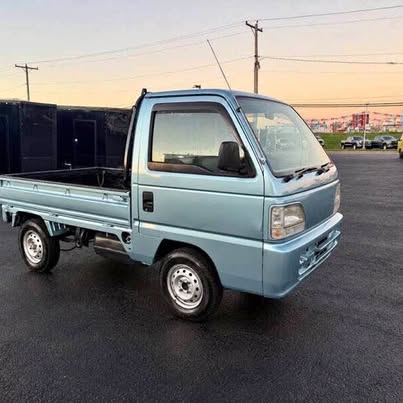
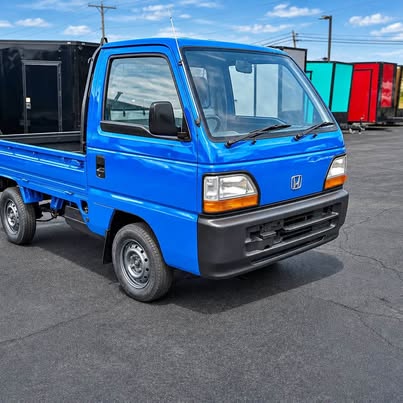
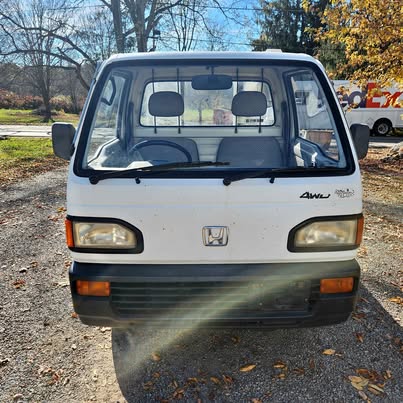
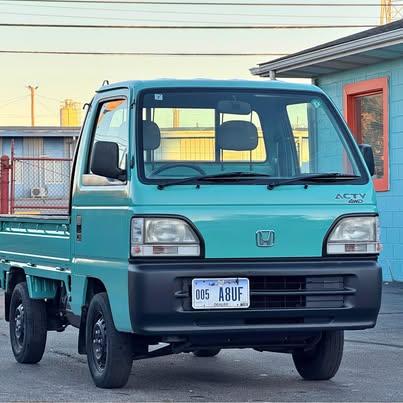
Our own pool is small, and it is worth stating plainly because it is the sample behind the market block below this guide: 10 Actys listed for sale, all 10 sourced from Facebook Marketplace sellers, spanning the 1991 and 1998 model years in the store's year fields, with 8 manual gearboxes and 2 automatics in the sample of 10. Colours in that sample run to 5 white, 2 turquoise, 2 blue and 1 grey, and the sample sits in Ohio (6 cars), New York (2), North Carolina (1) and New Jersey (1). Treat the pool as a snapshot of the importer trade, not as the whole American Acty population.
Why do people buy them here? In three distinct ways, and you should know which buyer you are before you start, because the right car differs for each. The first wants a working tool: a farm, estate, nursery or smallholding vehicle that carries 350 kilograms — the kei truck's standard rated payload, unchanged across the Acty's life — in a bed roughly six and a half feet long, sips fuel, fits down paths a utility side-by-side costs more to buy than, and can in many states be registered for the road as well. The second wants a novelty that turns out to be genuinely useful: a right-hand-drive miniature truck that does tip runs with a smile. The third wants the van — the Acty Van, and its passenger twin the Acty Street — as a micro-camper base or a market trader's wagon.
All three are legitimate. What none of them should buy is a full-size truck substitute. An Acty cruises happily at 50–60 mph, will reach around 65–70 mph in the right conditions, and is working hard — and you are working hard — at sustained American freeway speeds. It has the crash structure of a Japanese domestic design of its era, which is to say very little by modern standards, and you sit directly above the front axle. Bought with open eyes, it is one of the most charming and capable small vehicles ever made; bought as a cheap full-size pickup, it will disappoint you within a week.
The models
Every Acty is one of two shapes — truck or van — in one of two drive layouts, from one of four broad generations. The generation matters more than the badge, because it decides the engine, the size limits the car was built to, and whether the car can be imported at all under the 25-year rule. Honda did not publish tidy per-variant production totals, and any source that gives you a precise build figure for an individual trim is guessing — so the table declines to invent them.
| Model | Years | Engine | Output | Built | Character |
|---|---|---|---|---|---|
| Acty Truck 550 (HA1/HA2) / Van (HH1/HH2) | 1988–1990 | 547cc E05A three-cylinder, carburettor | about 34 hp | Not separately published | Second-generation shape, smaller 550-era engine |
| Acty Truck 660, 2WD (HA3) | 1990–1999 | 656cc E07A three-cylinder, carburettor or injection | about 38–44 hp | Not separately published | The core US import; rear-wheel drive, five-speed manual |
| Acty Truck 660, 4WD (HA4) | 1990–1999 | 656cc E07A three-cylinder | about 38–44 hp | Not separately published | Real Time four-wheel drive; the farm and snow-belt pick |
| Acty Van / Street (HH3/HH4) | 1990–1999 | 656cc E07A three-cylinder | about 38–46 hp | Not separately published | Commercial van and its passenger-trimmed twin; 2WD and 4WD |
| Acty Truck / Van, third generation (HA6/HA7, HH5/HH6) | 1999–2009 | 656cc E07Z three-cylinder, injection | about 45 hp | Not separately published | Bigger, stronger cab; reaching US eligibility in numbers |
| Acty Truck, fourth generation (HA8/HA9) | 2009–2021 | 656cc E07Z three-cylinder, injection | about 46 hp | Not separately published | The final Acty; not yet eligible for US import |
The chassis codes are the real model names. They appear on the Japanese export documents and the maker's plate, so learn to read them before you learn the trim names. HA is the truck, HH is the van. In each pair the first code is rear-wheel drive and the second is four-wheel drive: HA3 is a two-wheel-drive 1990s truck, HA4 the four-wheel-drive version; HH3 and HH4 are the equivalent vans. The 550 cars are HA1/HA2 and HH1/HH2; the 1999-on cars are HA6/HA7 and HH5/HH6; the final trucks are HA8/HA9.
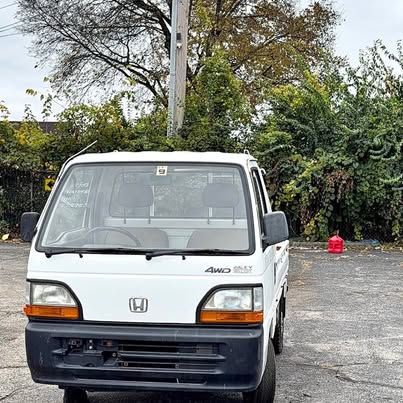
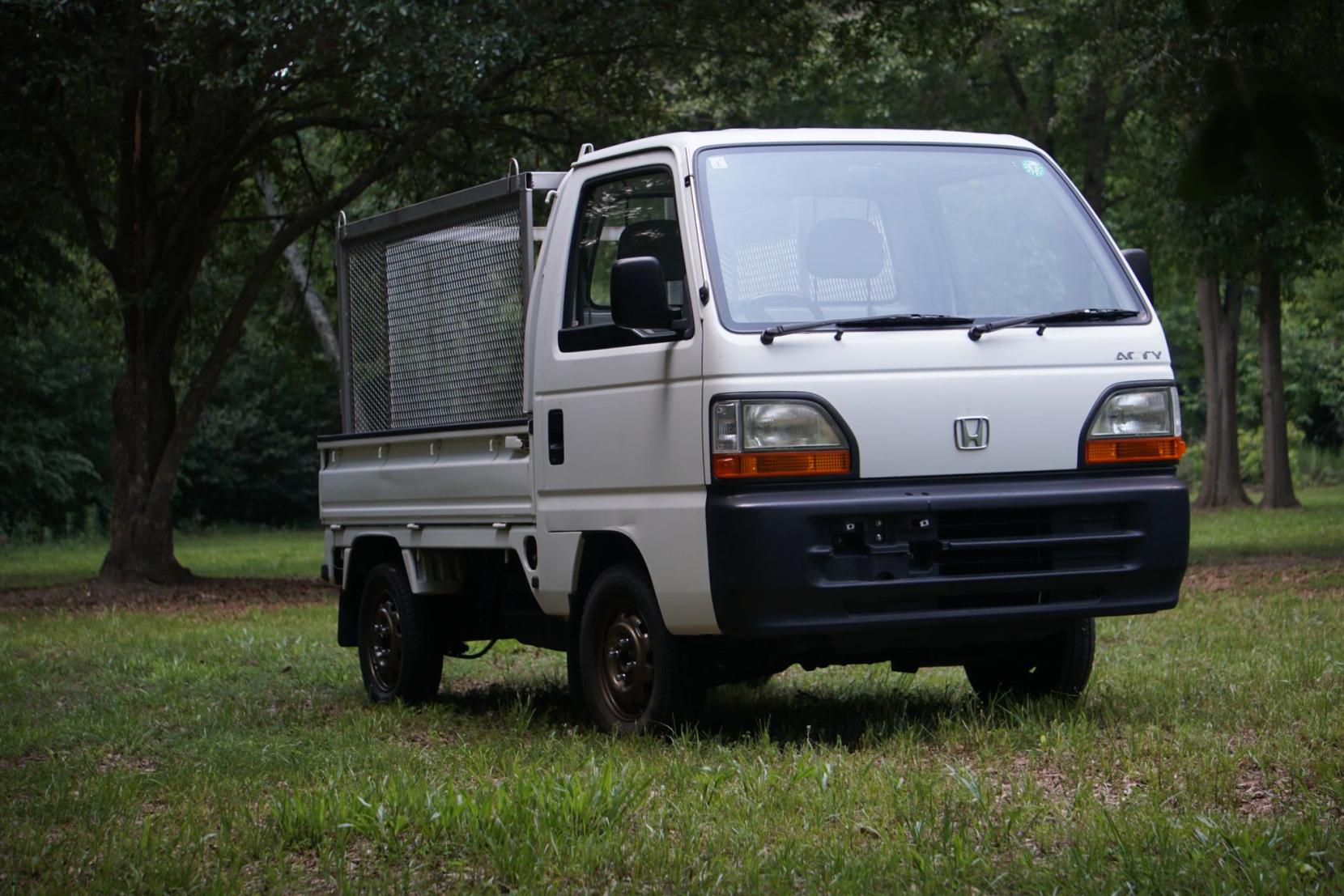
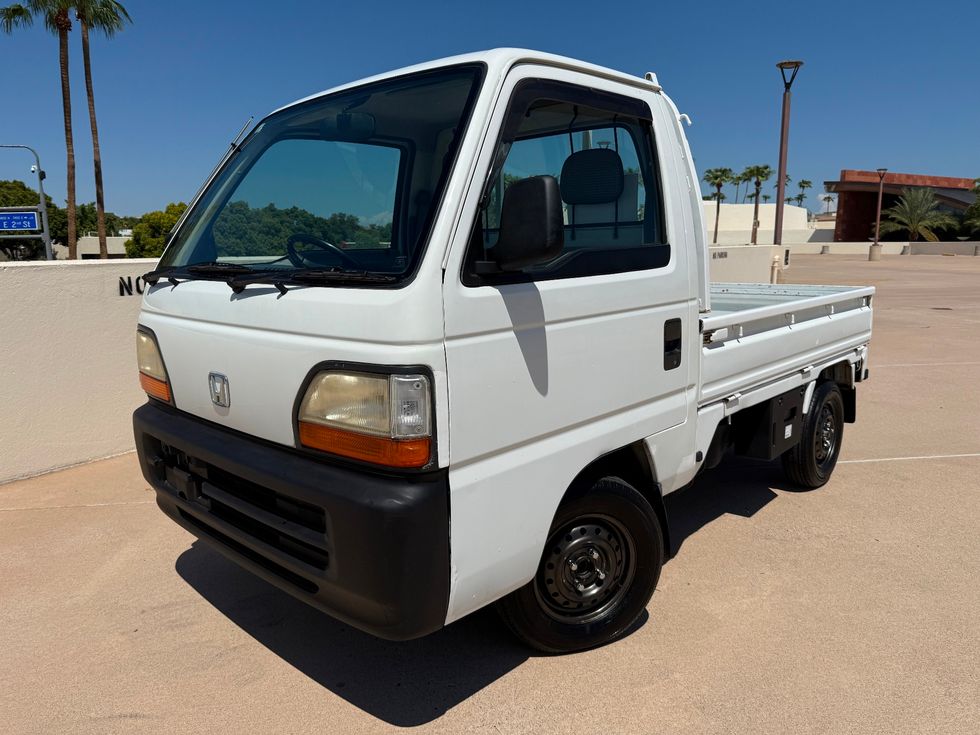
The trucks. The truck is the default Acty and the right default for most buyers. The bed measures roughly 1.94 metres long by 1.38 metres wide on the 1990s cars — long enough for bales, feed sacks, sheet material cut down, or a quad bike with the tailgate down — and the deck sits low because the engine lives underneath it, so loading is a lift to knee height rather than chest height. The sides and tailgate fold down on most versions to give a completely flat platform, the single most useful feature in daily work and the first thing to test on a viewing, because bent hinges, seized latches and rusted lower rails are common. Specialist bodies — dump beds and scissor lifts — exist, are rare, and command premiums. Two-wheel-drive trucks are lighter, simpler and slightly livelier; four-wheel-drive HA4 trucks are worth a real premium anywhere the truck will work in mud, snow or steep wet grass.
The Attack. The Attack is the connoisseur's work truck: a four-wheel-drive HA4 variant with ultra-low gearing in first and reverse — crawler ratios for climbing out of fields and up loading ramps at walking pace without slipping the clutch to death — and, on most versions, a locking rear differential. Verify it from the chassis plate and the extra-low gears' behaviour on the test drive, because Attack badges and descriptions travel.
The vans and the Street. The Acty Van is a true commercial van in miniature: a flat floor behind the front seats, sliding doors on both sides, a tailgate that opens to a low load lip, and trim chosen to be hosed out. The Street is the same shell trimmed as a passenger wagon — plusher seats, more sound deadening, often a three-speed automatic, often Real Time four-wheel drive, and generally the stronger injected tune — and Streets tend to have lived gentler Japanese lives than working vans. Buy the van to work, the Street to enjoy, and either only after the sliding-door and tailgate checks in the problem areas section.
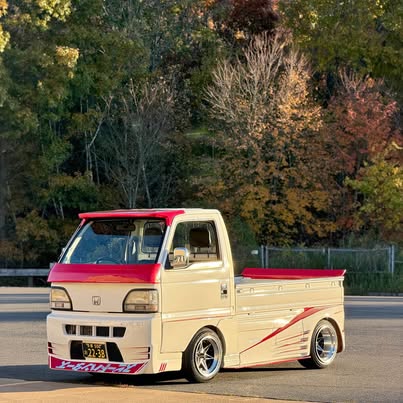
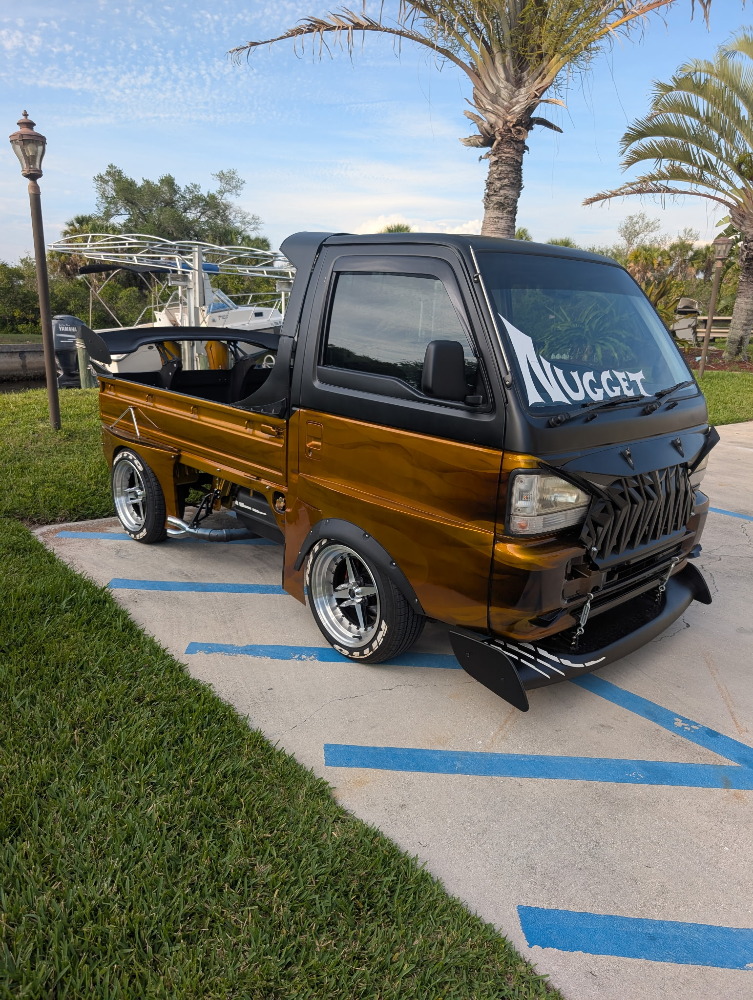
Trim: SDX and the rest. Japanese kei trucks were sold in a ladder of trims — base cars with vinyl and steel wheels, top versions with air conditioning, power steering and better seats. In our pool of 10 cars the store's display model is the Honda Acty SDX. SDX is a trim level, not a model and not an engine: an SDX truck and a basic truck share the same engine, gearbox and bed; the SDX simply left the factory with more equipment — typically a better seat, intermittent wipers, more cab trim and, on many cars, air conditioning. Pay a small premium for a tidy SDX if the equipment matters to you; pay nothing for the letters alone. The same applies to special editions such as the Hello Special widebody car in our photo pool: wider arches can hide exactly the rust this guide tells you to look for. Price the car underneath the kit, not the kit.
The kei rules, and what they mean for the car in front of you. The Acty's size is not a styling choice. Japanese kei regulations cap length, width, height and engine displacement, and each generation was built to the cap of its day: cars to 1990 were built to a 550cc limit and dimensions of about 3.2 metres long by 1.4 metres wide; the March 1990 revision raised the engine limit to 660cc and length to about 3.3 metres, the rule set the HA3/HA4 generation was designed around; the October 1998 revision raised length to about 3.4 metres and width to about 1.48 metres, which the 1999-on cars use. This is why a 1991 car and a 1998 car — the span of our pool — are the same basic vehicle, while a 1999 car feels perceptibly larger in the cab. It is also why no Acty has a bigger engine: 660cc is the law the car was built under.
The import path. First-generation cars are effectively absent from the US market. The American Acty story is regulatory: a vehicle 25 years old or older is exempt from the Federal Motor Vehicle Safety Standards administered by NHTSA — the importer declares the exemption on the HS-7 form at entry — and vehicles 21 years old or older in original, unmodified configuration are exempt from EPA import requirements, declared on form 3520-1. The 25-year rule is the binding one, so a car becomes freely importable on its 25th birthday, dated from its build date, not its model year alone. Customs entry also requires the Japanese export certificate — the deregistration document issued when the car left Japan's register — with an English translation; that document is the root of the car's American paper trail. Third-generation cars began reaching eligibility from 2024 onward; for a buyer shopping today, the realistic choice is a 1990s 660, and the rest of this guide is written for that car.
Federal eligibility is only half the question, because titling and registration are state law, and state treatment of kei trucks varies and changes. Some states title an imported Acty like any other 25-year-old vehicle; some register kei trucks with restrictions; some have moved in recent years to limit or refuse on-road titles for mini-trucks, occasionally reaching cars already titled. Check your own state's current position before you buy: a car already titled in your state, in the seller's name, is worth a premium for exactly that reason.
Engines and gearboxes
The three-cylinders: E05A, E07A and E07Z
Every Acty you are likely to buy is powered by a three-cylinder, single-overhead-cam, 12-valve Honda engine mounted behind the cab, under the bed or the van floor. Access is through a hatch in the bed floor on trucks and through panels in the van floor on vans. The layout gives the Acty its low bed and its balanced handling, and it also means the engine lives in a warm, dusty box that owners forget to open. The radiator sits at the front, connected by long coolant pipes that run the length of the floor — a layout whose consequences run through the whole problem areas section.
The E05A (1988–1990) is the 547cc original three-cylinder, sized for the old 550cc limit, with about 34 hp. The 550 cars are slower and harder to feed — its parts are the scarcest of the three engines — so buy one only if the car itself is exceptional. The E07A (1990–1999) is the engine that matters. Capacity rose to 656cc with the 1990 rule change, and output rose to roughly 38 hp in the carburettor trucks that make up most early-1990s imports, with fuel-injected versions — Honda's PGM-FI — appearing through the 1990s and lifting output into the low-to-mid 40s. The E07A shares its basic architecture with the engine in the Honda Beat sports car and the Today kei hatchback, which is genuinely useful: the Beat community has mapped this family's parts and failure modes in English. Do not let a seller inflate that connection — the Acty's version is tuned for low-speed torque, with none of the Beat's individual-throttle MTREC system. It is the same family wearing overalls.
The E07Z (1999 onward) is the developed version: still 656cc, still a 12-valve single-cam three, but fuel injection only, with about 45–46 hp. Everything in the problem areas section applies to it unchanged.
All three engines share the ownership facts that decide Acty happiness. The camshaft is driven by a timing belt, and the belt is the single most important service item on the car. Honda's interval is 100,000 kilometres — about 62,000 miles — and Japanese odometers read in kilometres, a fact American buyers repeatedly miss: a car showing 110,000 kilometres with no belt record is overdue right now, whatever the seller says about its low mileage. Belts also age: a low-kilometre car that sat in Japan for a decade can carry a belt inside its kilometre interval and far outside any sane age limit. Treat the E07 family as an interference design: if the belt lets go, valves meet pistons and a cheap truck becomes an engine-out job. A documented recent belt is worth paying for; no record means you change the belt immediately after purchase and price the car accordingly. A belt change with water pump, tensioner and seals runs roughly $600–$1,100 in the US — cheap insurance. And "the importer said it looked fine" is not a record: a belt's condition cannot be judged by looking at it.
Valve clearances are set by screw-and-locknut adjusters: they announce neglect as a top-end tick, and a quiet top end at a cold start is one of the best signs a car has been serviced at all. Oil capacity is small — roughly two and a half to three litres with a filter — so pull the dipstick and judge the oil's colour and level as evidence. A healthy E07 starts promptly, idles evenly, pulls cleanly, and shows no blue smoke on a trailing throttle. Blue smoke under load is rings or bores; smoke at start-up that clears is valve stem seals, a known and fixable job. Oil weeping from the cam cover is normal ageing; oil everywhere is a biography of skipped services.
Carburettor versus injection is the E07A's dividing line. Carburettor cars use a single downdraft carburettor with an automatic choke and a dense network of vacuum hoses controlling idle-up for the air conditioning, cold running and emissions functions. When the hoses are sound, these cars run sweetly. When they perish — and after 30 years in a hot engine box, they perish — the symptoms are a hunting idle, a stall at junctions, a flat spot pulling away, or an idle that sits at 2,000 rpm and will not come down. None of that is expensive in parts: a few metres of vacuum hose and a methodical afternoon cures most of it, working one hose at a time so the routing stays correct. What is expensive is misdiagnosis — paying for a carburettor rebuild, realistically $400–$800 done properly in the US, for a fault that lived in a split hose. Injected cars delete most of this and add a fuel pump that tires, injectors that gum up after storage, and sensors that are Japanese-market specific when they fail. For a truck that will sit for months between uses, injection is the safer bet.
Four-wheel drive: Real Time and the Attack system
Two-wheel-drive Actys are rear-wheel drive, and for road and dry-farm use they are entirely adequate — the mid-engine layout puts weight over the driven wheels. The four-wheel-drive cars use Honda's Real Time system: normally the vehicle runs as a rear-wheel-drive car, and a viscous coupling senses a speed difference between the axles and progressively brings the front wheels in when the rears slip. There is no lever and no switch, which makes its health check behavioural: on a loose surface, a Real Time car digs in and goes, while a car with a failed coupling spins its rear wheels like a two-wheel-drive car wearing a four-wheel-drive price tag. The coupling is sealed and not a service item, but the front differential and transfer components take oil that owners forget — ask when the driveline oils were changed, and budget $200–$400 for a full fluids service on any car without records. Tyres matter out of proportion: the coupling reads wheel-speed differences, so mismatched sizes front to rear make the system work when it should be resting.
Gearboxes
The standard gearbox across the range is a five-speed manual, and it is the gearbox to have: light, precise in the Honda manner, and geared short enough that the little engine stays in its working band. Judge the box on second-gear synchromesh, which wears first, on a clean selection of reverse, and on clutch behaviour. The clutch is a small unit doing tractor work in Attack service, and a clutch change is an engine-access job that runs roughly $700–$1,200 fitted in the US, so a slipping clutch on the test drive is a priced deduction, not a shrug. Clutch judder from rest usually means oil contamination or a tired pressure plate, and on a mid-engined car you cannot inspect your way to certainty — the drive decides. Some early and base cars carry fewer forward gears; confirm which box a car actually has rather than assuming it from the year.
The alternative is a three-speed automatic, fitted to a minority of trucks and a larger share of Streets and vans — 2 of the 10 cars in our pool are automatic. It is a simple, sturdy period automatic that suits the Street's passenger role and the van's stop-start delivery work. On the drive, an automatic should engage drive and reverse promptly without a thump, change up cleanly under light throttle, and hold its gear on a steady grade rather than cycling. Flaring, delayed engagement or dark, burnt-smelling fluid means a rebuild conversation — and specialists willing to open a Japanese-market Honda box are scarcer than manual ones, so condition matters more, not less, on the automatic cars. An automatic also blunts a 38 hp truck's modest performance; buy one for the use it suits, not as a default.
Right-hand drive deserves a note of its own. The pedals and gear pattern are exactly where your hands and feet expect them — the pattern is not mirrored — but the shifter is worked with the left hand, and indicators and wipers are commonly on the opposite stalks from American convention. Most drivers adapt within a few hundred miles; the honest cautions are overtaking on two-lane roads, where you sit on the kerb side with the worst view, and toll booths and drive-through windows, which are all on the wrong side.
Problem areas
An Acty fails in a predictable order: rust takes the structure, cooling neglect takes the engine, and perished rubber takes everything else. Work through this section in that order — on a vehicle whose total value is modest, one structural repair can consume the entire margin between a fair price and a mistake.
Rust: the map
Japanese domestic vehicles of this era were not rustproofed to European or American standards, because Japan's shaken inspection system retired most cars before rust became the owner's problem, and much of Japan uses little road salt. An Acty imported at 25 years old and kept outdoors in Ohio or New York — the states where most of the cars in our sample of 10 are listed — is meeting road salt for the first sustained time in its life. Assume rust until the car proves otherwise, in these places, in this order.
Cab floor, steps and cab corners. The cab is the structure everything else hangs from, and it rots where water and mud are thrown and held: the floor edges where the floor meets the sills, the step wells you climb through to reach the seats, the bottoms of the A-pillars, and the cab corners behind the front wheels, where road spray packs in and stays. Lift the cab mats and press the floor along its edges with your thumb and then a screwdriver, with the seller's permission. Surface scale is treatable; softness, holes or a floor that flexes is structural welding, and cab-floor welding on a vehicle this small is disproportionately awkward because seats, controls and wiring all live within inches of the repair — and the repair panels are not a catalogue order, the fabricator is making them. Budget $800–$2,000 per side for proper cut-out-and-weld repairs.
Wheel arches, door bottoms and the panel below the windscreen. Front arches rot from the inside lip outward, where mud sits on the return edge; rear arches on trucks rot where the bed side meets the arch, and on vans the rear arch and the panel below the sliding-door rail form a single rust trap. Door bottoms fill with water when their drain holes block — run a fingertip along the bottom edge of each door and feel for bubbling, then check the drain slots are clear. The scuttle and screen surround deserve a slow look: water past a perished screen seal runs down inside the cab front panel and emerges as floor rust that owners misdiagnose as a floor problem. The same neglect showing in arches, doors and cab floor together is a biography of the car's storage, and you should believe it.
The bed. A truck bed is a working surface and honest wear is expected — dents, scratches, worn paint. Rust is different: look for perforation along the bed floor seams, at the corners where the floor meets the side panels, around the engine hatch frame — a rusted hatch frame also lets water straight onto the engine — and on the undersides of the folding side panels, whose lower rails trap water and whose hinges seize. A bed floor holed at its seams is a fabrication job; one with surface rust and sound seams is a clean, treat and paint job you can do yourself. Vans substitute their own traps: the load floor rots at its rear edge by the tailgate seal, the tailgate rots along its bottom edge, and the sliding-door rails collect water and dirt into a paste that eats the rail and the sill below it. Work every sliding door through its full travel: a door that grinds, drops or needs a shoulder to close is often a rusted rail or a collapsed roller, and rail repair is panel work, not adjustment.
Chassis and underneath. The Acty's underbody is a pressed-steel floor structure with subframes rather than a separate ladder chassis, and its enemies are the seams and box sections: sill outers, floor crossmembers, the front subframe and its mounting points, spring hangers and the rear suspension mounting areas. This is why the inspection insists on getting under the car, ideally on a lift. Fresh black underseal blown uniformly over everything shortly before sale is a cover-up until proven otherwise: nobody re-underseals a sound underside as a favour to the next owner. Honest undersides look patchy — factory coating thin at the edges, stone chips, surface rust on brackets, dirt in the seams. After purchase, wash the underside, treat what you find, and consider proper rustproofing before its first American winter: the car's next decade of salt is the threat, not its last one in Japan.
The cooling-system metalwork. File this under rust even though it presents as overheating: the radiator sits at the front and the engine in the middle, connected by long steel coolant pipes that run the length of the floor. Those pipes corrode inside and out, weep at their joints, and eventually perforate — and a slow weep empties the system over weeks of short trips without leaving a dramatic puddle. Any Acty with a history of topping up the coolant has a leak, and on this vehicle the leak is pipes and hoses until proven otherwise. Replacement pipes are a fabrication or Japan-order job, realistically $300–$700 fitted.
Cooling, head gaskets and the overheating cascade
The mid-engine layout gives the Acty its characteristic engine failure. The cooling system is long, low and hard to bleed; the radiator is small; the engine works hard because 38 to 45 hp moving a loaded truck is always working hard; and the margin for neglect is thin. The cascade runs like this: a perished hose or corroded pipe weeps, the level falls, an air lock forms in the long pipe runs, the gauge climbs, and the alloy head on the iron block warps or the head gasket fails. An E07 with a blown head gasket presents as overheating that no thermostat cures, bubbles in the header tank, coolant loss with no visible leak, mayonnaise under the oil filler cap, or a misfire from cold that clears as the engine warms. A head gasket job is engine-access labour in a confined box — realistically $1,200–$2,200 in the US with a head skim and gasket set — and it should always trigger the question the seller hopes you will not ask: what overheated it, and has that cause been fixed, or are you buying the same failure on a timer?
Prevention is cheap and knowable at a viewing. The coolant should be clean, coloured and at the correct level in the header tank — rusty water, an oily film or sealant crystals each tell their own story, and sealant crystals mean someone has already managed a leak chemically rather than mechanically. Hoses should squeeze with resilience rather than crunch, and the electric fan should cut in as the engine idles up to temperature: let any Acty idle for ten minutes, watch the gauge settle and stay, and listen for the fan. A missing thermostat is a classic masking trick: the car runs cool on a test drive and overheats in summer traffic with a load aboard. An engine that takes forever to reach temperature has no thermostat or a stuck-open one — someone has been managing a symptom. Bleeding matters after any cooling work, too: the long system traps air, and a car refilled carelessly will overheat with a full header tank.
Belts, ignition and fuel system
Beyond the belt — the highest-value question in Acty buying, covered in the engines section — the ignition system is period Honda: a distributor whose cap, rotor and seals age, plug leads that perish in the hot engine box, and components that fail with heat, typically presenting as a car that cuts out hot and restarts when cool, a fault sellers describe as character. A car that dies at operating temperature and restarts twenty minutes later has an ignition or fuel-pump fault until proven otherwise; both are fixable, neither is free.
Fuel systems fail by storage: American Actys sit on modern ethanol-blended fuel that attacks 1990s Japanese rubber and leaves varnish in tanks, pumps and carburettor jets. A carburettor car that has sat needs its tank drained, its filter changed and its carburettor cleaned before any running fault is diagnosed as anything else.
Suspension, brakes, steering and tyres
The front suspension is a MacPherson strut layout and the rear is a leaf-sprung axle designed for load work. Strut top mounts perish and knock over bumps; dampers tire; leaf springs sag, crack leaves and lose their arch, showing first as a truck that sits low or unevenly at the rear. Steering is light, unassisted on most cars, and should be smooth and free of play at the straight-ahead. Play plus a knock over bumps is a front-end refresh: the parts are individually cheap, but a full tidy with alignment runs $500–$1,000 fitted. Power steering, where fitted, adds a pump and rack to the leak list — check for weeping seals, because Japanese-market steering parts are order-ahead items.
Brakes are front discs and rear drums, adequate for the vehicle's weight and speed when maintained — and routinely neglected, because a slow truck masks tired brakes until the day it is loaded. Seized rear drum mechanisms and a handbrake that barely holds are the standard findings; perished flexible hoses and corroded steel lines underneath are the dangerous ones, and the steel lines share the floor with the coolant pipes and corrode in the same places. A full brake refresh runs roughly $600–$1,400 depending on how much line work is hiding underneath. Judge the handbrake on a slope: one that will not hold the truck is a failed drum mechanism, not an adjustment, until a mechanic proves otherwise.
Tyres are the Acty's most commonly botched consumable. The standard fitment is a 145R12 light-truck tyre, a commercial rating with stiff sidewalls chosen for load work. American owners fit passenger-car 12-inch tyres because they are cheap and available, and the truck then wanders, rolls and overloads its tyres at rated payload. Check the sidewalls: size, load rating and age code all matter, and a mixed set of aged passenger tyres is a $400–$600 replacement bill and, on a Real Time car, a driveline concern as set out in the engines section.
Cab, electrics and the small systems
Inside the cab, the Acty is vinyl, painted metal and simple switchgear, and it ages accordingly. Seat vinyl splits along its seams and the foam beneath collapses on the driver's cushion first — sit in the driver's seat, because the passenger seat lies about the car's life. Cab leaks present as wet carpets and misted glass and connect straight back to the rust map: find the water's path at the windscreen and door seals before you treat the floor it is rotting. Heater performance matters more than its simplicity suggests: a car with a weak heater and a sweet smell in the cab has a leaking matrix — a dashboard-out job in a small cab, $600–$1,200 fitted, and a classic masking candidate when a seller has looped the heater hoses together in the engine box to hide the leak. Check that both heater hoses run to the bulkhead and get hot. Air conditioning, where fitted, is a genuine asset in American summers and a genuine load on a 38 hp engine — and a leaking condenser or tired compressor is a $500–$1,500 conversation.
Electrics are simple and fail simply: earth points corrode, alternator brushes wear, starter motors tire, and the small Japanese battery is asked to work in a vehicle that sits for weeks. A slow crank on a car with a new battery is a starter or earth diagnosis, not a battery one. Work every switch on your viewing: lights, indicators, wipers on every speed, washers, horn, blower on every speed, and every window. Collectively, a cab where half the electrics are dead is a car that has been stored damp — and damp storage connects the gremlins straight back to the rust map.
How to inspect one
Allow a full hour, bring a torch, a magnet wrapped in cloth and a screwdriver for prodding with the seller's permission. If the car passes you, pay for a lift inspection before money changes hands. Most Actys in America are bought from importers or at a distance, so this checklist works twice: once as photo and video requests when the car is three states away, and once in person when you — or a mechanic you pay — stand in front of it.
- Start with the paperwork, not the truck. Match the chassis code and serial across the maker's plate, the Japanese export certificate and the American title documents. Decode the code as you go: HA3 is a two-wheel-drive 660 truck, HA4 the four-wheel-drive truck, HH3 and HH4 the vans and Streets. Confirm the title is in the seller's name, confirm your state will register the car, and confirm the odometer reads in kilometres, converting before you judge mileage. Ask the timing-belt question now: when, at what kilometre reading, and where is the record? A car bought sight-unseen needs this step completed from photographs of the actual documents, not from the listing text.
- For a distance purchase, demand the evidence set before any deposit. An uncut cold-start video, in one take from a cold engine, showing the dash, the exhaust and the engine hatch opened afterwards. Flash photographs of the underside — cab floor edges, sills, crossmembers, spring hangers, coolant pipes — not a beauty shot of the bed. Photographs of the maker's plate and the export certificate, and a walk-around video that works every door and drops every bed side. A seller who refuses the underside photographs has answered the rust question. Where the car came through a Japanese auction, ask for the auction sheet and have it translated: the grade and the inspector's diagram are the most honest documents in the car's life.
- Cold start, insisted upon. The engine must be cold when you arrive — or, on video, demonstrably cold. A warmed-up Acty at a viewing is a seller managing a symptom. A healthy E07 starts promptly, settles to an even idle and shows no blue smoke beyond the faintest puff. A hunting idle, a stall, or an idle that sits high and will not fall points to the carburettor and vacuum-hose network in the problem areas — fixable, but priced.
- Lift the bed hatch or the van floor panels. This is the Acty's engine-room inspection and most buyers skip it. Read the engine as evidence: oil weeping from the cam cover is normal ageing; oil everywhere is neglect. Squeeze the coolant hoses — resilient is good, crunchy is perished. Check the header tank for clean, coloured coolant; rusty water, an oily film or sealant crystals each start the overheating conversation. On a carburettor car, look for split or perished vacuum hoses and hoses blanked off with screws — a fault managed rather than fixed. Look for both heater hoses running to the bulkhead: the looped-hose trick hides a leaking heater matrix.
- Underneath, before anything else is decided. Torch along the cab floor edges, the step wells, the sills, the floor crossmembers, the front subframe and its mounts, and the spring hangers. Prod seams and listen for the change in sound. Perforation in the cab floor, sills or crossmembers is structural, and structural rust decides whether you continue at all — the rust map in the problem areas section is the checklist for this step. Read the underseal as you go: patchy and honest is factory; a fresh uniform black coat over everything is a question, not an answer.
- Follow the coolant pipes and brake lines. Run your torch along the long pipes from the front radiator to the mid-mounted engine, and the steel brake lines that share their route. Weeping joints and heavy corrosion mean the pipe job in the problem areas is already due.
- The bed, or the van box. On a truck, check the bed floor seams, the corners, the hatch frame and the undersides of the folding side panels; drop all three sides and confirm they hinge freely and latch honestly. On a van, work both sliding doors through their full travel, check the rails and steps beneath them for rust, and inspect the tailgate's bottom edge and the load floor's rear seam. A van door that grinds or drops is panel work, not adjustment, until proven otherwise.
- Body and gaps with the magnet. Run the magnet over the cab corners, arch lips, door bottoms and bed sides — filler announces itself by letting go. Feel along every door's bottom edge for bubbling and check the drain slots are clear.
- Tyres, wheels and stance. Stand back and sight the car's stance: level and even, or listing and sagging. Then read every sidewall: correct 145R12 light-truck fitment, matched sizes front and rear — essential on a Real Time car — and age codes you are willing to drive on.
- The test drive, loaded with questions. Twenty minutes minimum, including a hill, a stretch at 50–55 mph and a loose or wet surface if the car is four-wheel drive. Note the right-hand-drive adaptation honestly — you are also testing whether you like living with it. A manual should select every gear cleanly, with second-gear synchromesh the first thing to judge; an automatic should engage promptly, change cleanly and hold its gear on a grade. On a Real Time car, the loose-surface pull-away settles whether the front axle joins in or the coupling has failed. In an Attack, select first and reverse and confirm the ultra-low creep is really there. Brake firmly from speed: straight, no pull, no judder. Test the handbrake on the hill, and run the air conditioning if fitted — a noticeable performance cost is normal, a crippling one is a fault.
- Heat, idle and the long pause. Back at base, let the engine idle for ten minutes. Watch the temperature gauge settle and stay, listen for the electric fan cutting in, and confirm the heater blows hot. A car that cuts out hot and is explained away as character has an ignition or fuel fault priced into your offer.
- Every switch, every door, every seat — then price the car you actually inspected. Work the lights, indicators, wipers on all speeds, washers, horn, blower on all speeds and every window. Sit in the driver's seat and feel for a collapsed cushion. Then list what the car needs in the order this guide ranks them — structure, cooling, belt, brakes, tyres, then cosmetics — and total the job costs from the problem areas section before you discuss the asking figure. An Acty with a documented belt, a clean cooling system, sound cab floors and correct tyres is a genuinely scarce car in the American market and worth stretching for. An Acty that fails on structure is not a cheap Acty at any price, because the welding costs the same as it does on the good car and the finished vehicle is worth no more.
Values
The figures that matter for this series are computed from this site's own listings and recorded sales, and they sit below this guide — the listed-now summary and the market block are refreshed every time the site rebuilds, so use them rather than any number quoted elsewhere. What follows is how to read them. No listing prices are quoted here, deliberately: with a pool as small as ours — 10 cars, all from one source — any figure printed here would be stale before it was useful.
The first driver is specification, and the market prices it in a clear order. Four-wheel drive carries a real and durable premium over two-wheel drive, because the buyers who work these trucks in mud, snow and wet grass have no substitute for it, and a genuine Attack — verified from the chassis plate and the ultra-low gears, not from a title line — sits above even the standard four-wheel-drive cars. Injected cars carry a smaller premium over carburettor cars, earned in cold starting and in freedom from the vacuum-hose network. The Street's passenger trim prices above the working van, whose buyers are the most price-disciplined of all. Trim letters, including the SDX badge, move value least of all: they describe equipment, not capability. Novelty cuts both ways, too: in its first American year an Acty is a curiosity, but by the third year its value rests entirely on whether it works, carries and starts.
The second driver is condition, and on an Acty condition means the three things this guide has ranked throughout: structure, cooling history and belt history. The gap between a project and a driver is wide precisely because the work is indivisible — a truck that needs cab-floor welding, a cooling-system overhaul and a timing belt needs all three before it is a vehicle at all, and the sum of those jobs approaches the value of a sorted car. That is why the cheapest listings are rarely bargains, and why the honest, documented, slightly scruffy driver in the middle of the market is usually the best value in it. Fresh paint inverts the signal: on a vehicle whose Japanese working life left it white and worn, a recent repaint should move a car down your list until the underside and cab floors have proved the work was cosmetic rather than cosmetic surgery.
The third driver is paperwork, and it is the one American buyers undervalue most. An Acty's value rests on the chain of documents that makes it legally ownable in its state: the export certificate and its translation, the customs records, and a clean state title in the seller's name. Cars with gaps — a title in another name, missing import documents, a chassis number that does not match across the set — are discounted for a reason, and the discount should be yours, not the next buyer's problem. State rules on titling kei trucks keep changing; the same truck can be straightforwardly road-legal in one state and restricted in the next, and that patchwork widens the buyer pool, and the price, for cars already titled in friendly states.
Finally, read asking figures against achieved figures with scepticism. Supply is thin — we track 10 cars as this guide is written, all 10 from Facebook Marketplace sellers — so a single optimistic listing can distort any average built from it, while the cars that actually sell tend to be the honestly described ones in the middle. Where recorded-sale results exist, they are the better guide to what the market pays. Negotiate from the inspection list, not from the advertisement.
Parts and ownership
The Acty rewards the owner who plans ahead. Nothing about the vehicle is exotic — it is a mass-produced Honda built over four decades — but the supply chain runs through Japan, and the skill is knowing which parts are on the shelf in America and which are a two-week order away.
Easy, because America stocks them: service consumables and wear items. Oil filters, air filters, spark plugs, brake pads and shoes, and many belts and hoses cross over to other Hondas or are stocked by the US mini-truck specialists. Tyres in the correct 145R12 light-truck size are a commercial-tyre order rather than a shelf item, but they are obtainable without drama, and a set fitted runs roughly $400–$600. A routine service is a few hundred dollars at a specialist and well within home-mechanic territory for an owner with the Japanese service data, which circulates in translated form in the mini-truck community.
Order-ahead, because Japan stocks them: the model-specific middle ground. Timing belt kits with the correct tensioner and water pump, carburettor rebuild kits, vacuum hose sets, coolant pipes, clutch kits, distributor components, suspension bushes, leaf springs and brake cylinders are all available through the Japanese parts networks — the online catalogues that sell by chassis code and frame number, shipping worldwide — and through US specialists, typically in one to three weeks. Order by chassis code and serial from the parts diagrams, not by model name and year, because mid-year changes punish guesswork. Keep a small shelf: a belt kit, hoses, filters and plugs bought before you need them convert most Acty emergencies into weekend jobs.
Genuinely scarce, and priced into buying decisions: body and trim. Cab panels, doors, bed panels, sliding-door hardware, glass, lamps and interior trim exist only as Japanese stock, used imports and the occasional dismantled car. A cracked windscreen is an order-and-wait event rather than a next-day fitting. This is why the inspection weights structure and glass so heavily: the mechanical car can almost always be kept alive, while the body it lives in cannot be re-ordered from a catalogue.
Running the thing. The fuel tank is small, so range rather than economy shapes trip planning. Servicing is simple enough for any competent independent mechanic willing to work from the translated data, but choose the mechanic before you need him, because mid-engine access and Japanese-market parts numbers are unfamiliar in a general shop. Insurance is the item to arrange before purchase: some mainstream insurers will write a right-hand-drive Japanese import on a standard policy, others route it to specialist or agreed-value cover, and a minority decline it outright, so get the quote from the chassis number before you buy. The first-year budget rule applies with force: catching up deferred maintenance — belt, fluids, hoses, brakes, tyres — honestly runs into the low thousands of dollars before you improve anything. Budget, too, for rustproofing before the car's first salted winter.
Which one to buy
- The all-rounder: Acty Truck 660, four-wheel drive (HA4), five-speed manual. The specification most American owners actually need: Real Time four-wheel drive for mud, snow and wet fields, the bigger 660 engine, a bed that folds flat on three sides, and the deepest parts base of any Acty in the country.
- The value buy: Acty Truck 660, two-wheel drive (HA3). The same truck without the front driveline — cheaper to buy, simpler to keep, and entirely adequate on roads, tracks and dry ground.
- The work specialist: Acty Attack. Ultra-low first and reverse gears and a locking rear differential make it the most capable Acty off pavement. Verify the specification from the plate and the test drive, because the badge travels and the premium is real.
- The enclosed workhorse: Acty Van (HH3/HH4). A flat floor, sliding doors on both sides and weatherproof volume in a vehicle that fits through a barn door — bought on sliding-door rails, tailgate edges and load-floor seams rather than on mileage.
- The comfortable one: Acty Street. The passenger van, with the better seats, the quieter cab and often the automatic gearbox and the stronger injected tune. Streets lived gentler Japanese lives and make the best Acty for regular road use and micro-camper conversion.
And the rule that overrides all of the above: buy the Acty with the soundest cab floors and the most honest paperwork, in the specification you can live with. Engines, belts, clutches, brakes and cooling pipes are all fixable at prices you can plan for. A rotten cab structure costs more to put right than the finished truck will be worth, and paperwork gaps can strand an owner in a way no mechanic can fix.
Listed now
On Classic Listings today: 31 cars are listed here; 10 for sale and 20 marked sold; average asking price $8,416; asking range $7,500 to $9,750; sold cars average $6,741.
See the 31 Acty cars currently listed.
The market — recorded sales
Acty Classic Listings Index: $6,125 — based on 20 recorded sales, Oct 2024 – Oct 2026.
Change vs the prior 24 months: — not enough earlier sales to compute a change.
Recorded sales: 20 · Total recorded sale value: $134,827 · Lowest sale: $4,455 · Top sale: $10,750 · Most recent sale: $10,000 (Oct 12, 2026)
| Date | Car | Sale price | Source |
|---|---|---|---|
| Oct 12, 2026 | 1997 Acty | $10,000 | Cars & Bids |
| Sep 28, 2026 | 1999 Acty | $6,000 | Cars & Bids |
| Sep 9, 2026 | 1998 Acty | $5,322 | Cars & Bids |
| Jul 20, 2026 | 1997 Acty | $10,750 | Cars & Bids |
| Jun 1, 2026 | 1991 Acty | $6,200 | Cars & Bids |
| Apr 29, 2026 | 1996 Acty | $5,750 | Cars & Bids |
| Apr 21, 2026 | 1996 Acty | $6,300 | Cars & Bids |
| Apr 17, 2026 | 1999 Acty | $8,600 | Cars & Bids |
| Mar 31, 2026 | 1990 Acty | $9,600 | Cars & Bids |
| Feb 27, 2026 | 1999 Acty | $5,800 | Cars & Bids |
| Feb 10, 2026 | 1991 Acty | $6,250 | Cars & Bids |
| Jan 29, 2026 | 1993 Acty | $5,600 | Cars & Bids |
| Dec 11, 2025 | 1996 Acty | $5,500 | Cars & Bids |
| Oct 23, 2025 | 1995 Acty | $6,900 | Cars & Bids |
| Oct 20, 2025 | 1994 Acty | $5,100 | Cars & Bids |
| Oct 16, 2025 | 1993 Acty | $4,600 | Cars & Bids |
| Oct 13, 2025 | 1992 Acty | $6,050 | Cars & Bids |
| Oct 9, 2025 | 1995 Acty | $9,000 | Cars & Bids |
| Sep 23, 2025 | 1993 Acty | $7,050 | Cars & Bids |
| Sep 22, 2025 | 1992 Acty | $4,455 | Cars & Bids |
Dates are the sale date where the source states one; otherwise the date the sale was recorded here.
For sale now
Expand
Expand
Expand
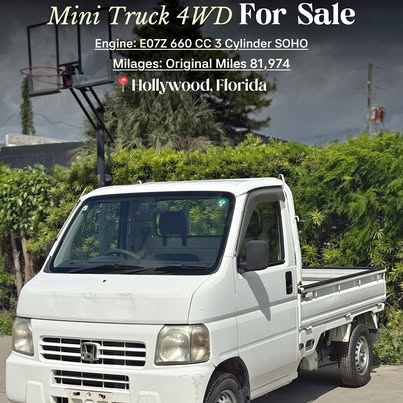 $7,999
Expand
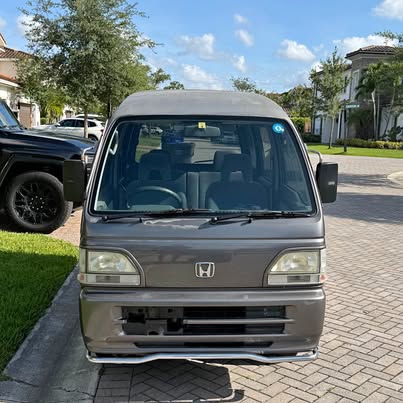 $9,750
Expand
Expand
Expand
$7,500