
Nissan Pathfinder buyer's guide
Nissan Pathfinder (1987–2001) — Pathfinder: what's listed, and what they sell for.
Years: 1987–2001 · Models: Pathfinder
Overview and history
The Nissan Pathfinder is the family SUV that learned its manners from a pickup truck — and, in its classic-era forms, never quite forgot them, which is exactly why buyers look for one now. It is tough, square, honest transport: a wagon body on proper four-wheel-drive hardware, with engines shared across Nissan's truck line, an interior you can hose out in spirit if not quite in fact, and a reputation earned in the years before SUVs became crossovers.
Scoping needs saying plainly at the start, because the Pathfinder name has run for a long time and across very different machines. This site's classics age line runs to about 2001, and this guide covers the two generations that belong on a classics site: the first-generation WD21 of 1986½–1995, and the second-generation R50 of 1996–2004. The WD21 is a body-on-frame truck. The R50 kept the name and the brief but switched to unibody construction. The third-generation R51 that arrived for 2005 went back to a frame, grew considerably, and added a third row; the still-later Pathfinder became a front-drive-based crossover. Those later trucks are a different buying proposition and a different inspection, and they are outside this guide except where a failure mode that belongs to them — the radiator transmission-cooler failure discussed in the problem-areas section — is so often misattributed to the R50 that it needs untangling here. If you are looking at a 2005 truck, you are looking at an R51, not a late R50, and you should inspect it as one.
The Pathfinder arrived in North America in mid-1986 as a 1987 model, Nissan's answer to the Toyota 4Runner, the Ford Bronco II, the Jeep Cherokee and the Chevrolet S-10 Blazer — rivals that had all found the same market: pickup toughness with a covered, carpeted load bay. Nissan's starting point was its new D21 pickup, the truck North America knew as the Hardbody. The Pathfinder took the D21's frame, front suspension, engines and much of its front sheet metal, and put a steel wagon body on top. That Hardbody kinship is the single most useful fact about a WD21: it explains how the truck feels, why so many mechanical parts are cheap and findable, and why the frame — not the body, not the engine — decides whether an example is worth saving.
At launch the WD21 was a two-door only. That matters now, because the two-door is the rarest and most characterful Pathfinder of all, and the one most often misdescribed in adverts. A four-door joined for 1990, after rivals had shown that most buyers wanted the extra doors, and from then on the four-door did the volume while the two-door faded. The facelift that came with the four-door softened the styling slightly, tidied the interior and marked the point where the Pathfinder settled from sporty two-door off-roader into family truck — without losing the low-range transfer case, the skid plates or the upright driving position that made it good at both jobs.
The R50 that replaced it for 1996 was Nissan following the market: Ford's Explorer had shown how large the family-SUV prize was, and buyers wanted car-like refinement without giving up four-wheel drive or the high seat. So the R50 was built as a unibody — frame rails formed into the body shell rather than a separate ladder frame — with strut front suspension in place of the WD21's torsion bars. It was rounder, quieter, roomier and more civilised, yet it still offered low range, still towed usefully, and in later VQ35 form went noticeably harder than any WD21. It ran, with updates, through 2004 — a long life that makes it, today, the Pathfinder you are most likely to find in usable condition.
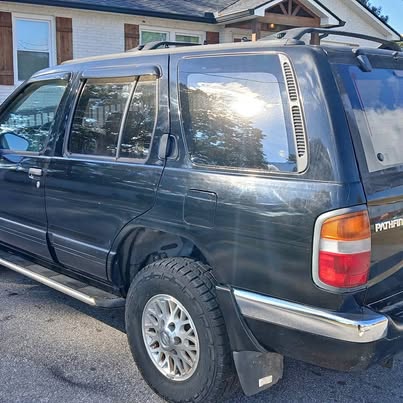
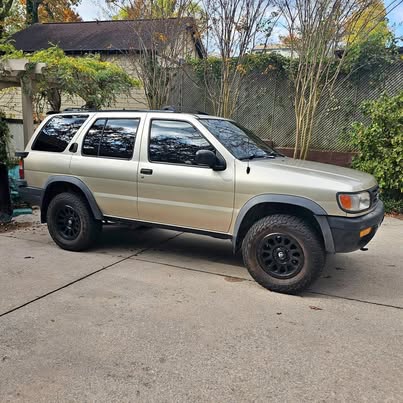
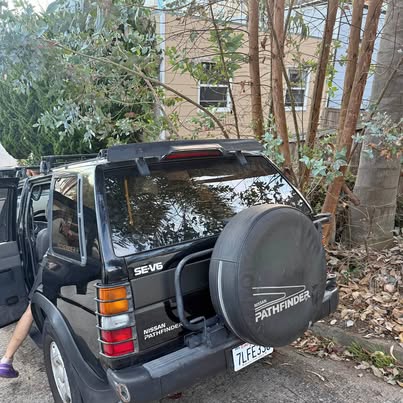
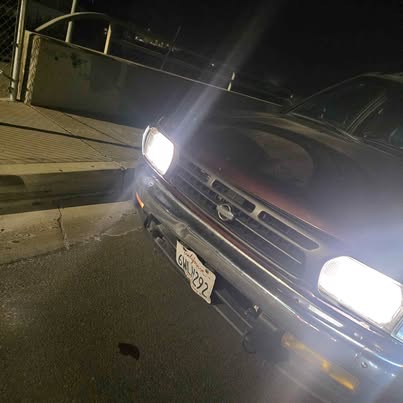
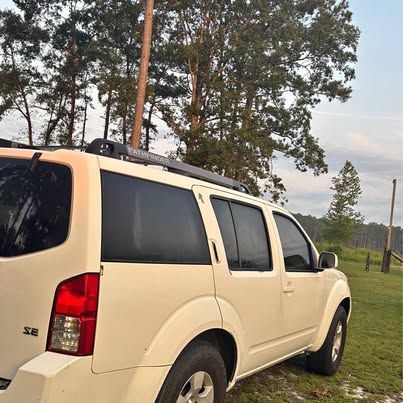
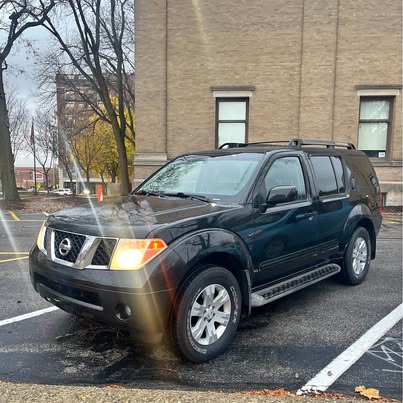
That long life is visible even in a small sample. In this site's current pool of 7 Pathfinders, the years run from 1995 to 2005, which is to say from the last year of the WD21 to the first year of the R51, with R50s in between — a neat cross-section of the nameplate changing underneath the badge. All 7 cars in that pool of 7 are automatics, all 7 came through Facebook Marketplace, and the colours in the pool of 7 are black (3 cars), gold (2 cars), white (1 car) and green (1 car). Treat that as a snapshot of what surfaces cheaply on Marketplace in the Southeast and California, not as a census of what was built: manuals exist, two-doors exist, and neither shows up often in that channel. The sections that follow are written for the buyer standing in front of one specific truck, Marketplace find or otherwise, deciding whether it is a sound old Nissan or a rusty frame with a wagon body resting on it.
Why buy one, against a 4Runner of the same age? Value and character. The Toyota tax is real: a comparable 4Runner usually costs more and is no less rusty underneath. The Pathfinder counters with durable VG and VQ V6s, a more car-like interior in R50 form, and, in the WD21 two-door, a silhouette nothing else matches. What it does not counter with is rust protection: both generations were used as winter trucks, ski trucks and boat launchers, and both are now old enough that corrosion, not mileage, writes the verdict. On a Pathfinder, you buy the structure first and everything else second.
The models
Every classic-era Pathfinder is a four-wheel-drive (or, in some markets and trims, rear-wheel-drive) mid-size wagon sharing its mechanicals with Nissan's pickups. The badge stayed the same across two very different constructions, so the first job in reading any advert is to fix the generation, not the trim. A 1995 truck is a WD21 on a separate frame. A 1996 truck is an R50 unibody. They share a name, a general shape and almost nothing underneath that matters to an inspection.
This site's taxonomy roster for the series is deliberately simple — one model line, Pathfinder, with the pool of 7 cars spanning 1995 to 2005 — so the table below breaks the line down the way a buyer actually meets it: by generation, body and trim, with the engines that define each version.
| Model | Years | Engine | Output | Built | Character |
|---|---|---|---|---|---|
| Pathfinder two-door (WD21) | 1986½–1995 | 2.4 four (Z24i/KA24E) or 3.0 V6 (VG30) | 106 hp (four) / 153 hp (V6) | Not published as a separate audited total | The original; rarest body, most character |
| Pathfinder four-door (WD21) | 1990–1995 | 2.4 four (KA24E) or 3.0 V6 (VG30E) | 106 hp / 153 hp | Not published as a separate audited total | The family WD21; the volume classic truck |
| Pathfinder XE (R50) | 1996–2004 | 3.3 V6 (VG33E), later 3.5 V6 (VQ35DE) | 168 hp / 240 hp | Not published as a separate audited total | The working trim; cloth, steel wheels, fewer electrics to fail |
| Pathfinder SE (R50) | 1996–2004 | 3.3 V6 (VG33E), later 3.5 V6 (VQ35DE) | 168 hp / 240 hp | Not published as a separate audited total | The off-road trim; limited-slip, bigger tyres, skid plates |
| Pathfinder LE (R50) | 1996–2004 | 3.3 V6 (VG33E), later 3.5 V6 (VQ35DE) | 168 hp / 240 hp | 240 hp in VQ35 form | The luxury trim; leather, sunroof, All-Mode 4WD on many cars |
(Outputs are period US-market figures: the VG30 in its later multi-point form at 153 hp, the VG33E at 168–170 hp depending on year, and the VQ35DE at 240 hp in automatic form — manual VQ35 cars were rated higher, at 250 hp, a quirk explained in the engines section. Production was in the hundreds of thousands across both generations, but Nissan did not publish a clean trim-by-trim audited split that a guide can quote honestly, so the table does not invent one.)
The WD21 two-door (1986½–1995). The launch body, and the one to picture when someone says "first Pathfinder." Short, upright, with a steeply raked tailgate and, on early cars, a spare wheel that could be carried inside, on the tailgate or on a swing-away carrier depending on market and trim. Early two-doors came as XE and SE, with the SE carrying the sport equipment: larger tyres, a limited-slip rear differential on many cars, skid plates and the distinctive graphics that have usually been polished off or repainted over by now. The two-door's rarity today is not a marketing story: most were bought as lifestyle trucks and used hard, modified and crashed at higher rates than the family four-doors. A straight, unmodified two-door with a sound frame is genuinely scarce — and count the doors in the listing photographs before you travel, because sellers do mix them up.
The WD21 four-door (1990–1995). The four-door kept the frame, engines and running gear and added the practicality the market demanded; what changed was the buyer. Four-doors were family, tow and winter cars, which cuts both ways: maintained as transport rather than modified as toys, but also salted, loaded and left outside through fifteen winters. Trim ran XE to SE and LE, with leather on late LEs. If you want a WD21 to use, the four-door V6 is the sensible classic Pathfinder — and the one where your money should go on frame condition rather than trim.
The R50 XE (1996–2004). The base R50, and in some ways the connoisseur's choice now, for a negative reason: there is less on it to break. Cloth seats, simpler climate controls, fewer motors and switches, and — on early cars — the possibility of the five-speed manual that the higher trims steadily dropped. XE does not mean rear-wheel drive by definition, but rear-drive Pathfinders do exist in Sun Belt markets, so check for the transfer-case lever or selector and a front differential before assuming any Pathfinder is a 4WD; a two-wheel-drive R50 is a perfectly good wagon and a poor off-roader, and it should be priced as the former.
The R50 SE (1996–2004). The sporting and off-road trim: firmer suspension tuning, larger tyres, fender flares, skid plates, and a limited-slip rear differential as part of the package in most years. The SE is the R50 that still feels related to the WD21 — it sits a little more purposefully, rides a little more firmly, and is the one the aftermarket supported. It is also the trim most likely to have been used as intended, so inspect an SE's underside for trail damage — bent skid plates are honest, bent crossmembers are a negotiation — rather than assuming a tidy cabin means a tidy truck.
The R50 LE (1996–2004). The luxury trim: leather, wood-effect trim, automatic climate control, sunroof on many cars, and, most significantly, Nissan's All-Mode 4WD on many examples in place of the part-time system. LEs were the most expensive Pathfinders new and are often the best maintained now, but they are also the most electrically laden, so the LE inspection adds sunroof drains, seat motors and the All-Mode system's behaviour to the standard list. A late LE with the VQ35 is the most civilised classic-era Pathfinder there is.
Two naming traps catch buyers out. The first is the model-year trap: 1995 is WD21 and 1996 is R50, with no overlap in construction despite the shared badge, and 2004 is R50 while 2005 is R51 — adverts calling a 2005 truck a "late R50 shape" are wrong about the thing that matters most, its structure. The second is trim inflation: badges are cheap and LE leather can be swapped into an XE. Read the equipment and the VIN plate, not the tailgate: trim moves price at the margins; generation, engine and frame move everything.
Engines and gearboxes
Four engine families cover the classic Pathfinder, and they divide cleanly by generation and by the one service question that decides their survival: belt or chain. The WD21 offered Nissan's Z/KA four and the VG30 V6. The R50 started with the VG33, a bored-out development of the same VG V6, and finished with the VQ35, a completely different, chain-driven V6. Learn which engine is in front of you before you discuss price, because the maintenance conversation, the failure modes and the performance are different in each case.
The fours: Z24i and KA24E
The entry WD21 engine was the 2.4-litre four from the Hardbody line: first the Z24i, a twin-spark, throttle-body-injected development of Nissan's old Z engine, and then, from 1990, the KA24E — a single-overhead-cam, three-valve-per-cylinder four with multi-point injection, rated at 106 hp in the truck tune that most Pathfinders carry. Neither is a performance engine in a wagon of this weight. A four-cylinder WD21 accelerates adequately around town, works hard on a freeway grade, and lets you know it is working. What it offers in return is simplicity: fewer parts, more room in the engine bay, a timing chain instead of the V6's belt, and fuel consumption a V6 owner would envy — though "envy" is relative in a shaped-brick truck of this era.
The KA24E's known habits are manageable ones. The timing chain itself lasts well, but the plastic chain guides wear and the tensioner tires with age and mileage; the tell is a rattle from the front cover for a second or two on a cold start that, on a worn engine, stops fading and starts staying. Listen for it on the cold start in the inspection — rattle that persists is a front-cover job priced into the offer. The Z24i cars add gummed idle-air valves and dozens of aged vacuum hoses, any one of which can produce a fault that looks electronic and is a split rubber elbow. Neither four suffers a catastrophic failure mode: they leak a little oil and run on if the oil has been changed. A four-cylinder truck with a sound frame is a slow, honest purchase. Just do not buy one expecting V6 pace with a load aboard or a trailer behind: the four's towing ability is modest, and a seller who quotes V6 tow figures for a four-cylinder truck is quoting the wrong page.
The VG V6s: VG30 and VG33E
The engine most classic Pathfinders carry is the VG — Nissan's 60-degree V6, cast-iron block, alloy single-overhead-cam heads, two valves per cylinder, and a timing belt driving both cams. In the WD21 it appeared first as the VG30i with throttle-body injection and then as the VG30E with multi-point injection, at 153 hp in its later form. In the early R50 it grew to 3.3 litres as the VG33E, at 168–170 hp, with more torque delivered lower down — the right change for a heavier unibody truck, even if the headline power gain looks small.
The VG's reputation is deserved: it is one of the durable truck engines of its period. The bottom end is strong, the heads rarely give trouble if the engine has never been overheated, and a VG that has had oil changes will run quietly and pull cleanly at mileages that end lesser engines. Its demands are specific, and there are three.
The first is timing-belt discipline, and it is the closest thing the VG has to a survival rule. The belt is a service item, not a lifetime component: period schedules put replacement at 60,000 miles on earlier VG30s, and the VG33's schedule stretched the interval to 105,000 miles. Treat any undocumented belt as overdue, whatever the seller says about the previous owner. The reason for strictness is not just that a failed belt strands the truck — it is that on the VG30 in particular a snapped belt risks bent valves, turning a few-hundred-dollar service into a heads-off repair. Owners argue online about exactly which VG variants are interference designs; the buyer's position is simpler and safer: never run a VG on an unknown belt to find out. The correct job replaces the belt, the tensioner and idlers, the water pump (which lives behind the belt and is cheap insurance while access is open), and the front seals if they weep: budget roughly $700–1,200 at an independent shop. Documented, recent belt work is therefore worth real money — ask for the invoice and look for the service sticker on the timing cover or radiator support. No sticker, no invoice, no belt: price the job into the offer and do it immediately.
The second demand is cooling-system honesty. A VG that has overheated is a VG whose head gaskets need questioning. Check the coolant's colour and level, look for staining around the water pump and thermostat housing, and on the test drive watch the temperature gauge through a climb and a long idle, not just at a cruise. Exhaust manifold studs are the other familiar nuisance: manifolds warp slightly and studs snap with heat cycles, giving a ticking leak on a cold start that quietens as the manifold expands. It is repairable, but stud extraction on an old truck can escalate, so budget roughly $500–1,000 and treat "they all do that" as half true: they do, and it still costs money.
The third is neglect arithmetic. Spark plugs on the VG33's rear bank are awkward enough to be skipped, leads age, distributor caps wear, and idle-air valves carbon up into a lumpy idle owners blame on "the computer." All of it is diagnostic noise: a VG that idles unevenly on old plugs may be a fine engine wearing cheap faults, while one that still does so after a proper service is telling you something else. Cheap faults first, verdict second.
The VQ35DE: the R50 grows up
For 2001 the R50 received the engine that transformed it: the VQ35DE, Nissan's all-alloy, double-overhead-cam, 24-valve V6 from the VQ family that powered everything from Maximas to 350Zs in various tunes. In the Pathfinder it made 240 hp with the automatic and 250 hp with the manual — the manual's higher figure reflecting a less restrictive rating and exhaust arrangement in period — and, more importantly, it made its torque in a way the VG never could: smooth, willing and quiet at a cruise, with genuine overtaking pace that makes a VQ R50 feel a generation newer than a VG R50, because mechanically it nearly is.
The VQ's service story is the mirror image of the VG's. There is no timing belt. The VQ drives its cams by chain, and the chain system is designed for the life of the engine provided the oil has been changed. That proviso is the whole inspection. VQ chains, guides and variable-valve-timing hardware tolerate clean oil and punish neglected oil: a VQ run on stretched intervals can develop chain rattle on start-up, guide wear, and cam-timing faults that present as a check-engine light, a rough idle and a seller explaining that "it just needs a sensor." Sometimes it does — camshaft and crankshaft position sensors are a known, cheap VQ service item — and sometimes the sensor is reporting a genuinely mistimed engine. History distinguishes them: a thick file of regular oil changes on a VQ is the equivalent of the belt invoice on a VG, and worth the same premium. Check oil consumption directly too: a quart between changes on a high-mile truck is a monitoring item, while heavy consumption with blue smoke under load is ring wear and an engine-out conversation. Ask the seller plainly how much it uses, and check whether the dipstick agrees.
Cooling and ancillaries follow the pattern of any modern alloy V6: thermostats, hoses, the radiator's plastic tanks and the water pump are all twenty-year items now, and any of them is expensive in consequence if a failure overheats the alloy heads. A VQ truck with a recent radiator, hoses and thermostat documented is a truck whose owner understood the assignment.
Gearboxes and four-wheel drive
Most classic Pathfinders you will meet are automatics — in this site's pool of 7 cars, all 7 are automatics — and the automatic in both generations is Nissan's RE4R01A four-speed (also coded RL4R01A in some applications), an electronically controlled overdrive box with a long service record across Nissan's trucks and rear-drive cars. Shifts should be clean and reasonably prompt, overdrive should engage without a shudder, and reverse should take up without a long pause. Its enemies are heat and old fluid: a truck that has towed without an auxiliary cooler, or simply never had a fluid change, announces itself with dark, burnt-smelling fluid, flaring on the 2–3 change and delayed cold engagement. Pull the transmission dipstick where one is fitted and read it as you would engine oil: bright red and sweet is health, brown and burnt is a rebuild negotiation. A rebuild runs roughly $2,500–4,000; a fluid-and-filter service on a healthy box is a few hundred dollars and the best money in Pathfinder ownership. The cold test drive in the inspection section distinguishes the two.
The five-speed manual — FS5W71C behind the fours and early V6s, the stronger FS5R30A behind later V6s — is the enthusiast's gearbox and the rarest. Judge it on second-gear synchromesh (tested on a brisk 1–2 change and a 3–2 downchange), clutch bite and judder, and transfer-case engagement, which on a stiff, unused lever can feel broken when it is merely dry. A manual is usually cheaper to buy and harder to sell than the automatic. Buy it because you want it.
Four-wheel drive divides by generation and trim. WD21s and most R50s use a part-time system (the TX10 transfer-case family) offering 2WD, 4-High and 4-Low: 4-High is for slippery surfaces only, because there is no centre differential, so binding and hopping in a tight turn on tarmac is the system working as designed — though a truck run for miles like that may have wound its transfer case and U-joints into premature wear, which is a fault. WD21 front hubs are automatic-locking on most cars; hubs that fail to engage, or engage with a bang and a delay, are a known age item, and a proper conversion to manual hubs is an acceptable modification. Many R50 LEs instead carry All-Mode 4WD, an electronic system with an Auto mode plus locked 4-High and 4-Low: its test is seamless Auto engagement, dash indicators that agree with the selector, and no warning light staying lit. Whichever system a truck has, low range must engage and disengage cleanly at a crawl. A system the seller says "probably works, never tried it" is a system you must try, in front of them.
Problem areas
Everything in this section follows one ordering principle: structure first, then the systems that strand you, then the systems that merely cost you. On a Pathfinder that order is not a stylistic choice. The engines are durable, the automatic is durable, the electrics are simple by modern standards — and the frames and underbodies rot with an enthusiasm that has ended far more of these trucks than every mechanical failure combined. Assume the underside needs a forensic examination, and be pleasantly surprised when a truck passes.
Frame and underbody rust: the central subject
The WD21 frame. The WD21's separate ladder frame is both its strength and its death certificate. Nissan's rust protection on the D21/WD21 frame was thin, the boxed sections trap mud, road salt and moisture inside where no wash reaches, and the frame rusts from the inside out — which means the outside paint can look presentable over metal that has lost most of its thickness. The map is consistent. Start at the rear: the rails from the rear axle backwards, the rear spring and shackle mounts, and the crossmembers near the fuel tank perforate first, because they live in the spray zone and hold mud longest. Work forwards through the rails under the load bay and cab, prod around every body mount (the mounts trap moisture against the rail), and finish at the front crossmember and the steering mounts. The screwdriver test, with the seller's permission, is the honest instrument: sound metal rings and resists; rotten metal crunches, flakes in layers and lets the tip through at the seams and lower rail faces, which go first. Surface rust with full metal thickness beneath is a clean-and-protect job. Laminated, swelling rust, daylight holes and soft spots at mounts are structural, and structural repair means cutting out and fabricating sections, not patching with plate for the photograph. Professional frame-section repair runs from roughly $1,500 for a localised section to figures exceeding the truck's value when both rear rails are involved — which is why a California or high-desert WD21 with a scruffy body is worth more than a shiny salt-belt truck with a thin frame. Walk away from perforation at spring, steering or body mounts without regret: there is always another Pathfinder, and never another frame under that one at sensible money.
The R50 unibody. Do not let anyone tell you the unibody R50 solved the rust problem. It changed its address: on the R50 the structure is the body, so the sills, the integrated rails in the floor, the subframe mounting points and the rear arches all carry structural load. The known pattern is rust in the front strut towers and inner front wings — open the hood and examine the towers for bubbling, lifting seam sealer and previous patching, because a perforated tower is a structural repair, not a cosmetic one — rust along the sills, worst at the jacking points; and rust in the rear arches and floor edges above the rear subframe mounts. Subframes rot too, and a rear subframe perforated around its mounts is a replacement-and-alignment job at roughly $1,200–2,500. The R50 therefore needs the same lift, torch and screwdriver as the WD21, applied to different metal. A seller who says "it's a unibody, they don't rust" has told you they have not looked. Look anyway.
Body rust above the structure. Both generations rust cosmetically in the predictable water traps: door bottoms where the drain holes block, tailgate and hatch lower edges, wheel-arch lips, the bottom of the front wings, windshield surrounds, and the roof around sunroof apertures on LEs. None alone kills a truck; together they date and price it. The useful reading is diagnostic: honest arch bubbles over a sound frame mean a truck that lived outside; perfect arches over fresh underseal and a soft frame mean a truck prepared for you. Buy the first kind.
Underseal, read correctly. A fresh, uniform coat of black stone-chip blown over the whole underside the week before sale — over rust, over brake lines, over everything — is the oldest trick in the old-truck trade. Factory protection was never that uniform. Honest undersides are patchy: coating worn at the edges, road rash, dirt in the crevices. Treat a cosmetically perfect black underside as a question the seller must answer with photographs from before it went on.
Engines: the failures that strand you
The VG and VQ failure modes are covered mechanically in the engines section; here they are as buying risks, in the order they should affect your offer.
On the VG, the overdue timing belt is the standing risk on every truck without paperwork — price the full belt, tensioner and water-pump service ($700–1,200) into any undocumented car and do it at once. Head-gasket failure is usually the consequence of an overheating event rather than a spontaneous fault, so hunt the overheating itself: a recently replaced radiator with no explanation, coolant stains baked down the block, a temperature gauge that climbs at idle. Milky residue under the oil filler cap can be mere condensation on a short-trip truck; the same residue with coolant loss, bubbles in the expansion tank and a sweet exhaust smell is a head-gasket conversation at $1,500–2,500. Exhaust-manifold ticking is the VG's most common noise and its least dangerous — but confirm it by its behaviour (loudest cold, fading as it warms) rather than accepting the diagnosis for a noise that stays.
On the VQ, the strand-you failures are cooling-system age failures — a split plastic radiator tank or a burst hose overheating an alloy engine quickly — and the slow failure of neglected oil: chain rattle, guide wear and cam-timing faults. Add the VQ's appetite for position sensors: a VQ that stalls at junctions, cuts out hot and restarts when cool, or throws cam/crank correlation codes very often needs camshaft and crankshaft position sensors, a few hundred dollars in parts and labour, and the fix is well documented. Do not let a seller turn that cheap fix into a mystery discount in their favour, and do not let them turn a rattling chain into "just a sensor" in yours. The cold-start rattle test separates them: sensors do not rattle.
The fours strand you least of all. A KA24E's chain-guide rattle, an idle valve's hunting and a Z24i's vacuum leaks are drivability faults, not terminal ones. The four-cylinder truck's real problem area is the same as the V6's: the frame it sits on.
Transmissions and four-wheel drive: wear, heat and one famous failure that belongs to another truck
The RE4R01A automatic fails slowly and legibly. The progression runs from tired fluid and a flare on one change, through delayed cold engagement, to slip under load and finally a box that drives in one gear. Because the progression is legible, the dipstick and the cold test drive settle most trucks: burnt fluid plus a flare is a rebuild priced in ($2,500–4,000); clean fluid plus clean changes is a service and a cooler away from a long life. Heat is the accelerant, so look for evidence of towing — a hitch receiver, a trailer-wiring socket, brake-controller screw holes under the dash — and ask whether an auxiliary cooler was fitted. A truck that towed within its rating on a cooler with fluid changes is a better buy than a lower-mileage truck that never towed but never changed its fluid either.
Now the failure this guide is most often asked about, scoped to the trucks it actually belongs to. The "strawberry milkshake" — automatic transmission fluid and coolant cross-contaminating when the transmission cooler inside the radiator fails, producing a pink, milky fluid that destroys the transmission — is famous on the Pathfinder because it is a genuine, well-documented defect of the R51 Pathfinder of 2005–2010 (and its Frontier and Xterra relatives) with the five-speed RE5R05A automatic, where the radiator's internal cooler can crack and mix the circuits, often ruining the box within miles. It is not a defining defect of the classic-era R50 covered here, whose RE4R01A and radiator arrangement do not carry the same pattern failure, and you should correct any advert, forum post or seller who prices an R50 down — or talks one up as "the last year before the milkshake problem" — on that basis. Two qualifications complete the picture. First, any old automatic with an in-radiator cooler can suffer a cooler failure if the radiator is neglected and original at twenty-five years, so checking the transmission fluid for pink milkiness and the coolant for an oily film belongs in every Pathfinder inspection, R50 included — as routine hygiene, not a known-defect hunt. Second, if you are looking at a 2005 truck — and this site's pool of 7 cars includes 2005 examples, which are R51s — the check moves from hygiene to headline: examine both fluids first, ask whether the radiator has been replaced or the cooler bypassed with an external unit (the standard preventative fix), and treat pink fluid as a walk-away unless the price assumes a transmission. Scoping a famous failure to its correct years stops you discounting a sound R50 for another truck's disease — and buying an early R51 blind to its own.
Transfer cases wear by use and by misuse. Sustained dry-pavement running in 4-High shows as driveline shunt, clunks on take-up and a case reluctant to leave 4WD. Worn front CV joints on R50s click on full lock; worn WD21 U-joints clunk and vibrate at speed. Automatic hubs that will not engage leave you with a two-wheel-drive truck and a dashboard that says otherwise, so the inspection's loose-surface test is not optional theatre: engage 4-High and 4-Low, drive, disengage, and confirm the truck agrees with the lever at each step. A case that jumps out of low on a slope is rebuild territory. Rear limited-slip differentials wear their clutch packs out silently — the truck simply becomes an open-diff truck — which matters only if you are paying an SE premium for off-road ability. Test it if you are paying for it.
Suspension, steering and brakes
WD21 front suspension is the Hardbody's double-wishbone layout on torsion bars; the R50 uses MacPherson struts. Both are simple, and every rubber component is now a calendar item. The wear list: ball joints and tie-rod ends developing play (rock the front wheels at 9-and-3 and at 12-and-6), idler and centre-link wear giving vague steering and tyre shoulder wear, tired dampers, and sagging torsion bars or springs dropping the nose. All of it is priced in hundreds per corner, and a truck that steers straight, sits level and wears its front tyres evenly has usually been maintained by someone who cared — a proxy for the rest of its life. WD21 steering boxes weep and develop centre wear; a box vague in the straight-ahead and tight on lock is worn, not misaligned.
Brakes are conventional discs at the front and discs or drums at the rear depending on trim, with ABS on later R50s. The verdict is rarely about design and always about sitting: seized calipers, perished flex hoses, corroded hard lines — inspect the lines along the rails while you are underneath, because a rusty brake line is a safety item, not a negotiation chip — and a master cylinder tired from old fluid. A full hydraulic refresh runs roughly $800–1,800. Budget as if no money has been spent until the invoices prove otherwise.
Interior, electrics and the water that gets in
Pathfinder interiors are hard-wearing: durable cloth on XEs, leather on LEs that cracks on the driver's bolster first, plastics that fade and go brittle in sun-state trucks and survive remarkably in northern ones — the opposite trade to the frame. Seat foams collapse on the driver's side; sit in the driver's seat and feel for the frame through the cushion. LE sunroofs add tired motors and blocked drain tubes that deliver water to the headlining and A-pillars — damp headlining corners are the tell, and that water ends its journey in the sills and floor.
Electrics are the Pathfinder's quiet strength: neither generation is heavily electronic by later standards, and most faults are earth points, tired switches and twenty-year-old connectors rather than modules. Window regulators and switches fail individually; R50 climate controls and blower resistors give the usual symptoms (a blower that works only on high has usually lost its resistor, a cheap part); instrument clusters develop intermittent gauges from dry joints. Test everything, price what is dead individually, and do not let a handful of dead accessories talk you out of a structurally sound truck — nor let "everything works" talk you into a rotten one. The hierarchy of this section is the hierarchy of the whole guide: electrics are hundreds, structure is thousands, and only one of them ends the truck.
How to inspect one
Allow an hour, bring a torch, a screwdriver for prodding (with the seller's permission) and a magnet wrapped in cloth. If the truck passes you, pay for a lift inspection before money moves — it buys the underside view that decides everything.
- Paperwork and identity first. Match the VIN on the title to the plate and the stamping. Fix the generation from the year: 1995 and earlier is a WD21 on a frame, 1996–2004 is an R50 unibody, 2005 is an R51 and outside this guide's scope. Count the doors, check the engine matches the advert, and ask for the service file. On a VG the timing-belt invoice is the most valuable piece of paper; on a VQ it is the run of oil-change receipts.
- Cold start. Insist the engine is cold. A VG should start cleanly and idle evenly; listen for the manifold tick that fades as it warms against any rattle that stays. A VQ or KA four with a chain rattle persisting past the first seconds is showing you guide and tensioner wear. Watch for blue smoke.
- Fluids, all of them. Engine oil: level, colour, petrol smell, and the seller's answer on consumption. Coolant: level, rust, oily film. Transmission fluid on the dipstick where fitted: bright red is health, brown and burnt is a rebuild negotiation, and pink and milky is cross-contamination — routine hygiene on an R50, a headline walk-away check on a 2005 R51, for the reasons set out in the transmission section above.
- Underneath: the decision step. Torch and screwdriver along the structure. On a WD21, work the frame map from the rust section: rear rails, spring and body mounts, crossmembers. Crunching, laminated metal or daylight at a mount ends the inspection. On an R50, the same tools go to the sills, floor edges, rear subframe mounts and — hood open — the front strut towers. Read the underseal as you go: patchy and honest is factory; a fresh uniform black coat is a question.
- Body and water. Magnet over arches, sills and lower doors. Check door bottoms and drain slots, the tailgate's lower edge, the windshield surround, and, on sunroof LEs, the headlining corners and A-pillar trims for the damp that means blocked drains. Lift the load-bay carpet and look in the spare-wheel area for staining and standing water.
- Engine bay. On a VG, look for the belt-service sticker and check for coolant staining at the pump and thermostat housing. On a VQ, a documented recent radiator, hoses and thermostat are a plus; a brand-new radiator with no explanation is a question about an overheating event. Perished vacuum hoses and oil baked onto manifolds price the recommissioning.
- Suspension and steering. Rock each front wheel at 9-and-3 and at 12-and-6 for play. Bounce each corner and watch it settle. Check front tyre shoulders for uneven wear, and note the stance: nose-down is sagging torsion bars or springs, and a truck sitting unevenly is telling you to look underneath again.
- The test drive, from cold. Fifteen minutes minimum, including a grade and a freeway stretch. The automatic should engage drive and reverse promptly from cold, change cleanly without flaring on the 2–3 shift, and hold overdrive without shudder. A manual should take second gear cleanly up and down. Watch the temperature gauge on the climb and at a long idle afterwards, not just at a cruise.
- Four-wheel drive, actually tested. On a loose surface, engage 4-High, drive, engage 4-Low at a crawl, drive, disengage. Part-time trucks should track without clunks; do not judge dry-tarmac binding as a fault. On All-Mode LEs, cycle the modes and confirm the dash indicators agree. Listen for CV clicking on full lock.
- Brakes and lines. Brake firmly from speed: straight stop, firm pedal, no judder, no pull. Then trace the brake hard lines along the rails — corroded lines are a safety replacement, not a bargaining chip.
- Interior and electrics last. Sit in the driver's seat and feel for collapsed foam. Work every window, the blower on all speeds, the sunroof and the LE seat motors. Price dead items individually, in hundreds; never let them outweigh steps 4 and 8.
- Decide on structure, then history. A Pathfinder with a sound structure and a thick file is the buy, even at the top of its band. A Pathfinder with perforation at a mount is a parts truck at a parts price, whatever the paint says. There is no third category.
Values
The figures that matter for this series are computed from this site's own listings and recorded sales, and they sit below this guide — the listed-now summary and the market block are refreshed every time the site rebuilds, so use them rather than any number quoted elsewhere. What follows is how to read them. Read the sample size before any figure in that block: this guide was written when the site's pool held 7 cars, all 7 for sale and all 7 from Facebook Marketplace, spanning 1995 to 2005. A pool that small describes the cheap, quick-sale end of the market, and its figures will move sharply as listings come and go. The durable value logic is structural, not numerical.
The Pathfinder market divides first by structure and only then by specification. A dry-state WD21 with a proven frame is a scarce, appreciating-in-its-small-way classic truck, and the two-door premium over the four-door is real because the supply of straight two-doors is genuinely thin. A rusty WD21, by contrast, is worth its engine, its transfer case and its trim, because the frame repair exceeds the finished truck's worth — the spread between the best and worst WD21 is therefore one of the widest condition spreads of any vehicle in this programme, and the headline figure for "a WD21" means almost nothing without the underside photographs. R50s price more conventionally: the VQ35 cars of 2001–2004 carry a premium over the VG33 cars for performance and for escaping belt discipline, LEs carry a smaller premium for equipment, and the SE's off-road equipment matters only to buyers who will use it. Manuals are cheaper to buy and slower to sell in both generations.
Asking prices are optimistic in a specific way: sellers price the badge and the photograph, and the market pays for the frame and the file. Expect the achieved figure on a sound, documented truck to sit close to asking — good ones are not common — and an undocumented, freshly undersealed truck to sit unsold until the price reaches parts money. The project-versus-driver gap is the frame gap wearing another name: a running project with a sound frame is a rational buy, because every other system is fixable in hundreds and low thousands; a shiny driver with a thin frame is not a driver at all. Negotiate from the inspection, in its order: structure, belt or chain history, transmission fluid, then cosmetics. That file is the value.
Parts and ownership
The Pathfinder's Hardbody kinship pays its second dividend here: both classic generations share heavily with Nissan's pickup and SUV lines, were built in large numbers, and sit in the part of the aftermarket where working trucks are kept alive rather than restored. This is one of the easier classics of its era to own.
Easy: service items across all four engines — filters, plugs, leads, belts and hoses — brake discs, pads, calipers and flex hoses, suspension wear parts (ball joints, tie-rod ends, dampers, bushes), water pumps, radiators, exhaust systems in standard form, clutch kits for the manuals, and the VG's full timing-belt kit. Most of it orders today at ordinary truck prices, and any competent independent shop already knows the VG and VQ families from the wider Nissan range.
Harder and dearer: sound WD21 frame sections (fabrication, not a catalogue part — which is why the frame verdict precedes purchase), R50 rear subframes in uncorroded condition, automatic-hub assemblies in good order, All-Mode transfer-case electronics on the LE, VQ timing-chain and guide work (an engine-front strip, roughly $1,500–2,500 in parts and labour when it is needed), trim and interior pieces in the right colours, two-door-specific body panels and tailgates, and crack-free dashboards on sun-state trucks. None of it is unobtainable; all of it rewards buying the truck that does not need it.
Running costs. Fuel consumption is truck consumption: expect mid-teens mpg from a V6 in mixed use. The budget that catches new buyers is the first-year catch-up, and it has a predictable shape: the timing-belt service on an undocumented VG ($700–1,200), a transmission fluid and filter service plus an auxiliary cooler if the truck will tow (a few hundred dollars, and the cheapest transmission insurance there is), a brake hydraulic refresh if the truck has sat ($800–1,800), and rust protection for a sound underside — clean, treat and cavity-wax a good frame or unibody and it stays good, the highest-return spending in Pathfinder ownership. Budget roughly $2,000–4,000 to bring a running, sound truck up to date in its first year, more if it has slept for years. A sorted Pathfinder is a realistic daily classic. What it will not forgive is the one purchase error this guide keeps returning to — because no parts catalogue sells you a frame.
Which one to buy
- The all-rounder: R50 with the VQ35 (2001–2004). The fastest, quietest, most usable classic-era Pathfinder, with chain timing and modern pace. Buy the oil-change file as much as the truck, and check the cooling system has had its twenty-year renewal.
- The classic truck: WD21 four-door V6 (1990–1995). The Hardbody wagon in its most practical form: frame, low range, VG torque and room for a family. The frame inspection decides everything; a dry-state car is worth travelling for.
- The collector's pick: WD21 two-door. The original silhouette and the scarcest body. Buy the straightest, least modified example with a proven frame, in SE trim if you can find it, and expect to pay for the scarcity — it is real.
- The value buy: R50 XE or SE with the VG33. Less equipment to fail, the durable VG, and prices that lag the VQ cars. The condition is the belt: documented and recent, or priced as overdue and done on day one.
- The luxury buy: R50 LE. Leather, climate and All-Mode for road-biased use, often the best-maintained trucks of all. Add the sunroof drains, seat motors and All-Mode checks to the standard inspection, and do not pay the LE premium for a part-time truck wearing LE badges.
And the rule that overrides all of the above: buy the soundest structure you can find, in the generation you can live with. Belts, chains, brakes and hubs are all fixable at prices you can plan for. A rotten WD21 frame or a perforated R50 sill is the one thing money cannot make original again — and it is the first thing to check.
Listed now
On Classic Listings today: 7 cars are listed here; 1 for sale and 6 marked sold; average asking price $11,000; asking range $11,000 to $11,000; sold cars average $12,987.
See the 7 Pathfinder cars currently listed.
The market — recorded sales
Recorded-sale figures: 6 recorded sales · median $9,950 · range $6,300 to $29,150 (Sep 2024 – Sep 2026)
Based on 6 recorded sales — too few for a benchmark value.
| Date | Car | Sale price | Source |
|---|---|---|---|
| Sep 17, 2026 | 2001 Pathfinder | $6,300 | Cars & Bids |
| Aug 20, 2026 | 1994 Pathfinder | $8,800 | Cars & Bids |
| Jun 18, 2026 | 1989 Pathfinder | $11,100 | Cars & Bids |
| Mar 12, 2026 | 1989 Pathfinder | $29,150 | Cars & Bids |
| Oct 10, 2025 | 1993 Pathfinder | $8,350 | Cars & Bids |
| Sep 12, 2025 | 1995 Pathfinder | $14,222 | Cars & Bids |
Dates are the sale date where the source states one; otherwise the date the sale was recorded here.
For sale now
$11,000