
Plymouth Barracuda buyer's guide
Plymouth Barracuda -- the model's own buyer's guide: variants, values and what to check.
Years listed: 1970-1971 · Series: Barracuda
# Plymouth 'Cuda — Buyer's Guide
Overview and history
You are not buying a trim level when you buy a 'Cuda. You are buying Plymouth's decision, for five short model years, to put its biggest engines in its smallest serious body and to sell the result without apology. The name starts as shorthand — Barracuda owners shorten it long before Plymouth does — becomes an option package on the 1969 Barracuda, and from 1970 becomes a distinct performance model in its own right, sitting above the ordinary Barracuda and the luxury-trimmed Gran Coupe in the range. That distinction matters every time you look at a car, read an advertisement, or decode a tag, because a Barracuda with 'Cuda badges is not a 'Cuda, and the price, the specification and the car's whole identity turn on paperwork and stampings, not on stickers.
The car you meet in most showrooms and auctions is the E-body car of 1970 and 1971. Plymouth and Dodge design the E-body platform for exactly this moment: a wide, low pony car, wider than the A-body Barracuda it replaces, with an engine bay deliberately sized to take Chrysler's big-block V8s and the 426 Hemi without the shoehorn work the earlier cars need. The wheelbase is 108 inches, the track is wide, the bonnet is long, and the proportions do the selling before the engine starts. For 1970 and 1971 you can have a hardtop coupe or a convertible, a small-block 340, big-block 383 and 440s, or the Hemi, with a four-speed manual or the TorqueFlite automatic. It is the fullest expression of the idea, and it lasts two years.
From 1972 the idea contracts. Emissions rules, insurance premiums and a collapsing performance market take the big-blocks and the Hemi out of the range. The 1972 to 1974 'Cuda is still a distinct model with the twin-scoop bonnet and performance suspension, but its biggest engine is the 340 and, for 1974, the 360. These are good cars — lighter in the nose, cheaper to run — but they live in a different market from a 1970 Hemi car, and no honest guide lumps them together.
On Classic Listings the pool behind this guide is small: seven records filed under the Barracuda series, three offered for sale and four recorded as sold, six from 1970 and one from 1971, six through dealers and one through Bring a Trailer, with cars recorded in Oklahoma, Illinois, Wisconsin, Indiana and Oregon. The cars that surface here are overwhelmingly the 1970–71 E-body performance cars — a Hemi, 440 and AAR-weighted sample of the peak years — not the later small-block cars or the 1969 forerunner.
Between the rarest rung — the Hemi convertible — and the sweetest driver's car — the 340 — sits a ladder of specification so clear that you can place any car on it from its VIN alone. Your job is to place the car in front of you on that ladder accurately, prove it belongs there, and then judge its condition without letting the badge think for you.
The models
Start with the range structure, because sellers blur it constantly and the blur always favours the seller. For 1970 and 1971 the Barracuda family has three tiers. The Barracuda is the base car, sold with a slant-six or small V8s including the 318 and, optionally, the 340 in some years and forms — check the specific year before you argue the point. The Gran Coupe is the luxury tier, with upgraded interior trim, a console, overhead console features on the hardtop, badging and sound deadening aimed at comfort rather than speed. The 'Cuda is the performance tier. It carries the 340 as its standard engine, offers the 383, the 440 in single four-barrel and Six-Pack form, and the 426 Hemi, and it comes with the heavy-duty suspension, brakes and cooling that those engines need. A Gran Coupe with a big engine added later, or a base Barracuda dressed with a 'Cuda bonnet and badges, is a clone or a tribute — call it that, price it as that, and do not let the word “original” drift across the conversation unchallenged.
The 1969 forerunner deserves its own paragraph because it confuses listings. For 1969 Plymouth offers the ’Cuda as a performance option package on the A-body Barracuda fastback and coupe, centred on the 340 and available with the 383 big-block shoehorned into a bay never designed for it. These are real, desirable cars, and the package is documented on the car's paperwork, but they are A-body cars — narrower, lighter, different underneath in almost every panel and component from the E-body that follows. If you cross-shop a 1969 against a 1970, you are cross-shopping two different cars that share a name.
Then come the specials, and the AAR is the one you are most likely to meet. The AAR 'Cuda — for Dan Gurney's All American Racers — is Plymouth's homologation car for the SCCA Trans-Am series, built for 1970 only. It uses a unique 340 Six-Pack engine on an Edelbrock aluminium intake, a side-exit exhaust, a fibreglass fresh-air bonnet, a ducktail spoiler, staggered tyre sizes and AAR stripes. It is not a 340 car with stickers: the block, intake, exhaust, bonnet and suspension tune are specific, and each missing part is expensive to put back. The Dodge Challenger T/A is its sister car; do not let a seller borrow T/A claims for an AAR, or the reverse.
The convertible is the other structural divide. You can have one in 1970 and 1971 across much of the engine range, and production is low across the board and tiny with the biggest engines. It also gives you more to inspect — header rail, quarters around the well, floor strength, the power top and its hydraulics — and the VIN and fender tag settle the body style as surely as the engine, so decode them before you fall for an open top.
From 1972 the range simplifies: the convertible and big-blocks disappear, and the 'Cuda continues as a coupe with the 340 as its top engine for 1972 and 1973, joined and then replaced by the 360 for 1974. Styling changes too — a revised grille, round tail lamps, and year-by-year bumper and marker details — and these are your dating tools. A 1974 with a 440 “from the factory” is a car whose story needs documents, not enthusiasm.
| Model | Years | Engine | Output | Built | Character |
|---|---|---|---|---|---|
| 'Cuda 340 | 1970–73 | 340 cu in LA V8, four-barrel | 275 hp gross (1970) | The volume performance model | Free-revving, balanced, the driver's pick |
| 'Cuda 383 | 1970–71 | 383 cu in B V8, four-barrel | 335 hp gross (1970) | Common in period, often overlooked now | Torquey, durable, the quiet value in big-blocks |
| 'Cuda 440 | 1970–71 | 440 cu in RB V8, four-barrel | 375 hp gross | Limited | Effortless torque, nose-heavy, a cruiser with a temper |
| 'Cuda 440 Six-Pack | 1970–71 | 440 cu in RB V8, three two-barrels | 390 hp gross | Limited | The big-block at full stretch; tuning matters |
| Hemi 'Cuda | 1970–71 | 426 cu in Hemi V8, two four-barrels | 425 hp gross | Very low; convertibles in single figures for 1971 | The icon; identity proof is everything |
| AAR 'Cuda | 1970 only | 340 cu in LA V8, Six-Pack | 290 hp gross | One-year homologation run, a few thousand | Trans-Am special; specific parts decide value |
| 'Cuda 360 | 1974 | 360 cu in LA V8, four-barrel | Net-rated, far below gross-era figures | Final-year model | Usable, simpler, a different and cheaper world |
Treat the output figures as period gross ratings — measured without accessories, under standards that flatter every maker of the era — and never compare them directly with the net ratings that follow. Treat the “built” column as deliberately qualitative: for the Hemi cars especially, published totals vary by source and by what is counted, and a seller quoting a suspiciously precise rarity claim owes you the source.
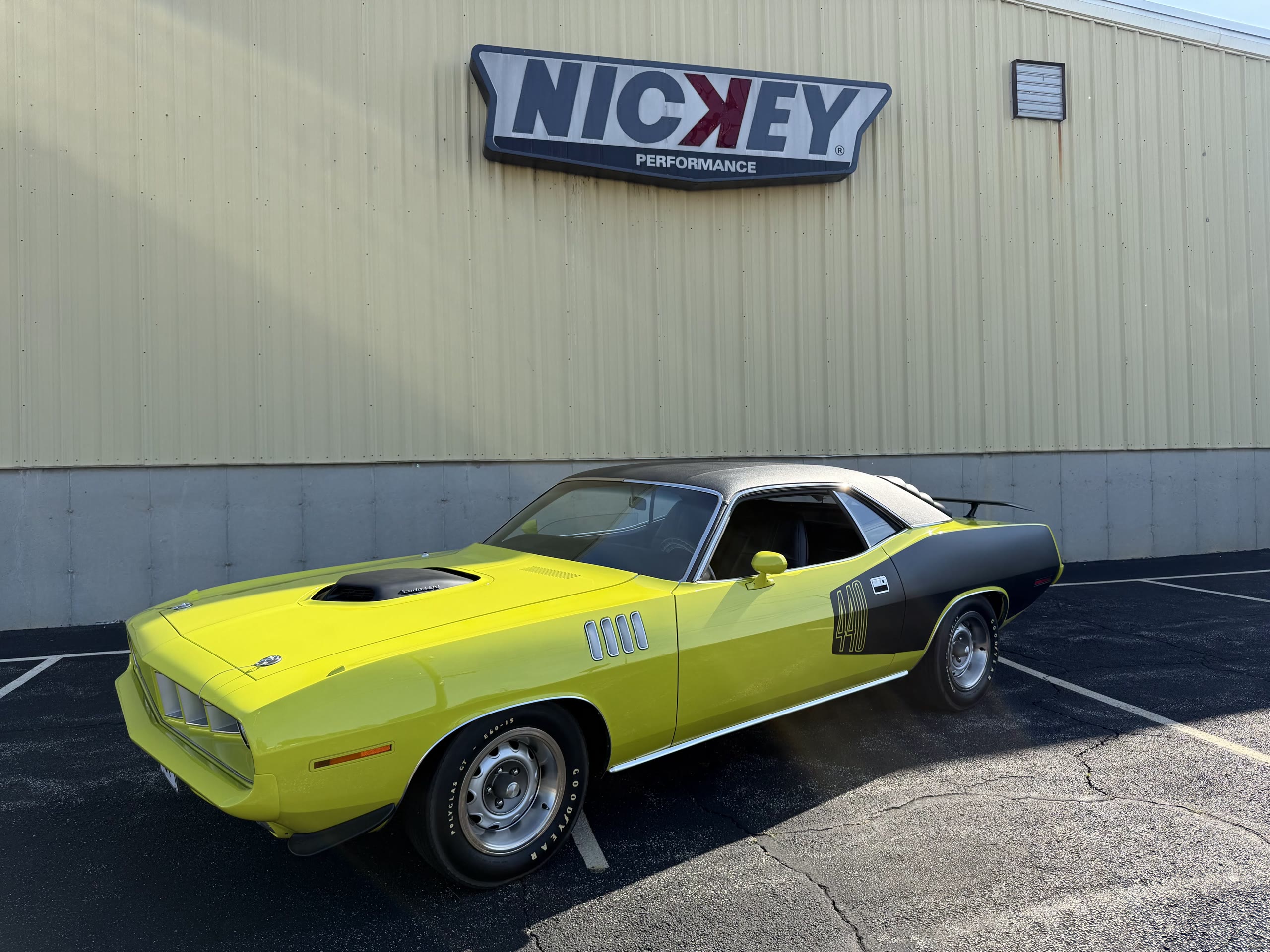
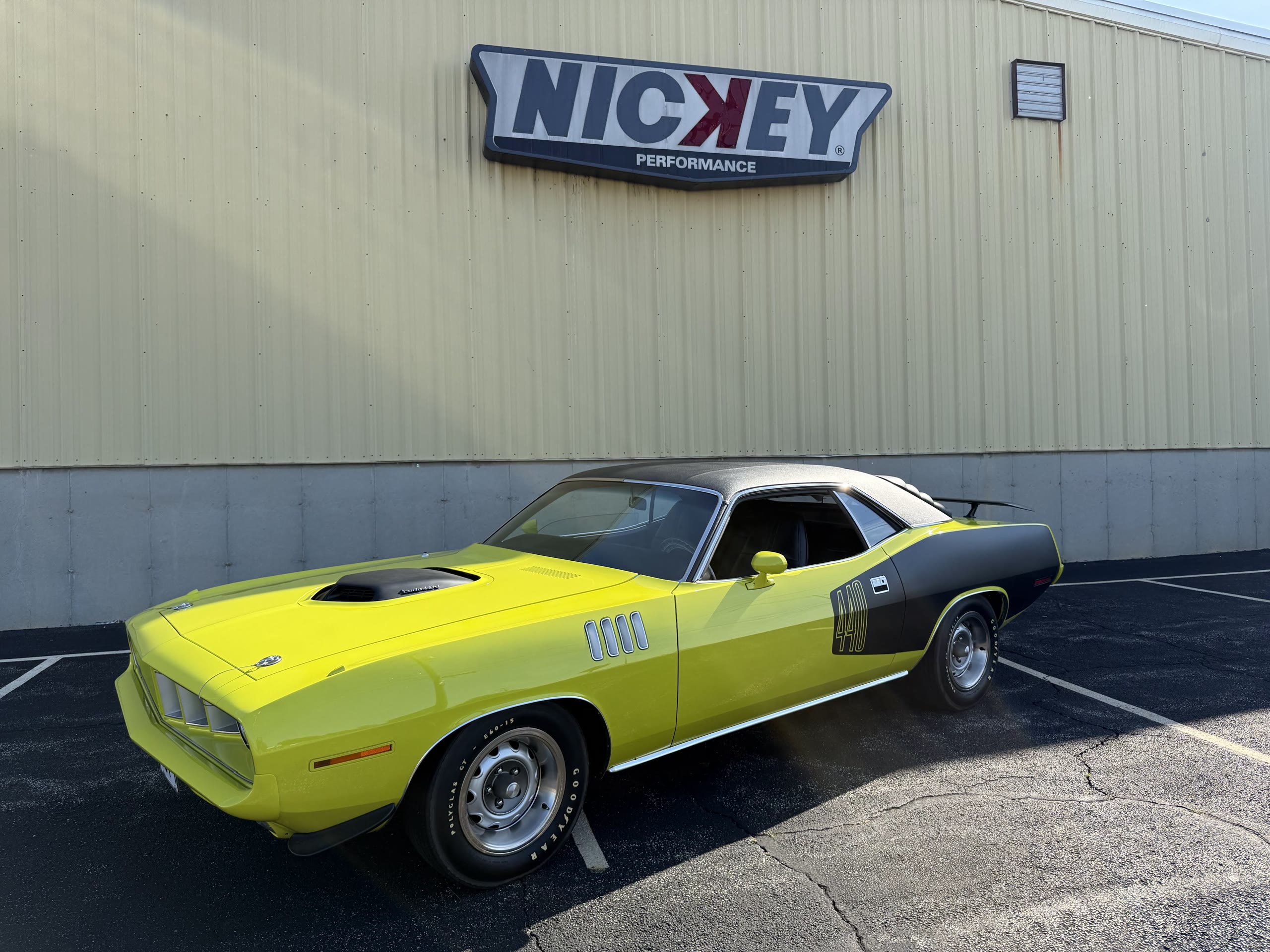
Two traps recur. First, the shaker bonnet — the N96 scoop that mounts to the engine and shakes through a hole in the bonnet — is added to many cars that never had it. The tag and build sheet carry the code, and the correct assembly is costly to source, so a “shaker car” without paperwork is a car with a hole in its bonnet until proved otherwise. Second, colour: Hi-Impact shades such as the Curious Yellow on the 1971 car in the pool, Plum Crazy/In-Violet, Vitamin C Orange and Limelight carry real premiums, and repaints into them are common. The tag carries the paint code. A colour change is not a sin, but you pay for an original Hi-Impact car only when the tag says so.

Engines and gearboxes
The LA small-blocks: 340 and 360
The 340 makes the 'Cuda a driver's car rather than a drag-strip poster, and it deserves more respect than the big-block shadow gives it. Introduced in 1968, it belongs to Chrysler's LA small-block family — LA for “light A”, the lighter, wedge-head evolution of the earlier A engines — with a 4.04-inch bore and 3.31-inch stroke, a forged crankshaft in the early performance years, high-flow heads with 2.02-inch intake valves, a windage tray and a high-lift camshaft in its 1968–71 tune. In the 'Cuda it breathes through a Carter AVS four-barrel and a dual exhaust, and revs with an eagerness no 383 or 440 matches. It makes its 275 hp gross honestly, weighs far less over the front wheels than any big-block, and the car steers, stops and changes direction better for it.
Understand the 340's years, because not all 340s are equal. The 1972 engine adopts a cast crankshaft, lower compression and revised heads as emissions tuning bites, and the 1973 engine continues in that softer tune. None of this makes a late 340 a bad engine, but if you pay early-340 money, confirm the block casting date and cylinder-head castings rather than trusting the air-cleaner decal. The AAR's 340 Six-Pack is separate again: a special block with thicker bulkheads intended to accept four-bolt main caps in race preparation, topped with the Edelbrock manifold and three Holley two-barrels, rated at 290 hp gross. Its centre carburettor does the ordinary work and the outboard pair open under vacuum at full throttle, so a hesitation as they open is a linkage-and-vacuum diagnosis, not a reason to condemn the set-up — and a car converted to a single four-barrel has lost the heart of what makes it an AAR.
The 360, which tops the range in 1974, is a longer-stroke LA (4.00-inch bore, 3.58-inch stroke) designed for torque in the emissions era. It is underrated as a road engine and undervalued as a collectible, which is why a good 1974 car can be the sensible buy. It never carries the 340's cam profile or forged internals here, and you should not pay a seller to pretend otherwise.
Small-block failure modes are knowable and testable. Oil pressure that is healthy cold and fades hot at idle points to bearing wear or a tired pump, and a mechanical gauge in the sender port settles it in ten minutes — never judge these engines by the dashboard gauge. A start-up rattle that clears in two seconds is usually drain-back; one that persists, or a deep knock under load, is bottom-end wear. Hydraulic lifters tick when oil is thin, dirty or low, and when one has collapsed; fresh oil and a pressure reading distinguish housekeeping from surgery. Rear-main and valve-cover leaks are endemic and cheap; oil in the coolant is neither — that is head-gasket or casting trouble until compression and leak-down tests prove otherwise. A flat spot on tip-in is the accelerator pump and vacuum advance far more often than the carburettor body, and heat soak after a hot restart is fuel percolation in the bowl, managed with correct gaskets and fuel-line routing rather than a replacement carburettor bought in frustration.
The B and RB big-blocks: 383, 440 and the Six-Pack
The 383 belongs to Chrysler's B-series low-deck big-blocks: a 4.25-inch bore with a short 3.38-inch stroke, wedge chambers, a single four-barrel in 'Cuda form, and a character unlike the 440's. It revs more freely than its size suggests, it is famously durable, and it gives big-block torque without the 440's full weight and heat, at 335 hp gross in high-performance form. Watch the details: the high-performance 383 carries specific manifolds, camshaft and carburetion, and ordinary two-barrel passenger-car 383s are swapped in over the decades. The stamped pad near the distributor carries the codes that distinguish them. Decode it before you value the car.
The 440 is an RB — “raised B” — engine, with a taller deck height to accommodate its 3.75-inch stroke alongside a 4.32-inch bore. In single four-barrel Magnum/Super Commando form it is rated at 375 hp gross, and its real gift is torque: a broad, lazy wave of it that makes a 'Cuda feel unstoppable in a straight line and heavy in every other direction. The 440 Six-Pack (Super Commando with three Holley two-barrels on an aluminium intake for 1970, rated 390 hp gross) sharpens the top end and complicates the tuning in equal measure. As with the AAR set-up, the centre carburettor runs the car and the vacuum-operated outboards join at full throttle; a Six-Pack that bogs, surges or runs rich at cruise is usually a vacuum-signal, linkage or float-level problem in that system, diagnosed carburettor by carburettor, not a verdict on the engine. Budget real money for a specialist set-up if the car has sat: three carburettors that have dried out together need rebuilding together, typically $900–1,800 for the set properly done, plus the intake-off labour if seals and gaskets have gone hard.
Big-block specifics separate a sorted car from a dressed one. Exhaust manifolds crack, especially around the centre ports, and the high-performance castings are expensive; tubular headers create ground-clearance and heat problems of their own, so ask why they are fitted. These engines run hot in the E-body bay, and the correct heavy-duty radiator, shroud and clutch fan matter more than any electric-fan improvisation — a car that creeps up in traffic but cools on the road has an airflow problem; a car that overheats everywhere has a circulation, head-gasket or timing problem, and a pressure test plus a combustion-gas test in the coolant separates them. Oil consumption on a hard-lived 440 is usually valve guides and seals first, rings second; a leak-down test tells you which, cylinder by cylinder. And check identity physically: the machined pad by the distributor states the cubic inches and year codes, the block casting date should predate the car's build date plausibly, and a “matching-numbers” claim means the partial VIN stamping matches the car's VIN — look at it yourself, with a mirror and a torch, and photograph it.
The 426 Hemi
The 426 Hemi is the reason this guide needs an identity section inside its engine section. The engine is Chrysler's second-generation Hemi: 426 cubic inches (4.25-inch bore, 3.75-inch stroke), hemispherical combustion chambers with opposed valves operated by two rocker shafts per head, a forged crankshaft, 10.25:1 compression in street form, a hydraulic camshaft milder than legend suggests, and two Carter AFB four-barrel carburettors on an aluminium intake. The factory rates it at 425 hp gross, a figure widely understood in period and since as diplomatic rather than maximal. It is heavy, wide — the heads make plug changes and manifold work genuinely awkward — expensive to rebuild properly, and utterly unlike any wedge engine in character: civil at low speed when tuned correctly, and ferocious from the mid-range up.
Because a genuine 1970 or 1971 Hemi 'Cuda sits at the very top of the muscle-car market, the Hemi is also where fraud, honest confusion and forty years of engine swaps concentrate. Settle identity with the system Chrysler built for the purpose, in this order. First, the VIN: on a 1970–71 'Cuda the fifth character of the VIN is the engine code, and a factory Hemi car carries the letter R there; the first characters identify the model line and body style — a 'Cuda hardtop begins with the JS23 pattern (Barracuda 'Cuda, hardtop) and a convertible with JS27 — so a car whose VIN fifth digit is anything other than R was not built with a Hemi, whatever engine sits in it today. Second, the fender tag under the bonnet, screwed to the inner wing: it carries the engine code E74 for the 426 Hemi among its option codes, along with the paint, trim, build date and other options, and it should agree with the VIN. Third, the build sheet — the broadcast sheet, often found tucked in the seat springs, behind the glovebox or under the carpet — which records the car as built, line by line. Fourth, the body itself: factory Hemi E-bodies receive structural reinforcement for the torque, including torque boxes and a skid plate on the front K-member area and heavy-duty components throughout the driveline and suspension, and the K-member and mounting details differ from wedge-engine cars. A Hemi engine dropped into a 318 Barracuda shell lacks the paperwork and usually lacks the reinforcements; a genuine Hemi car that has lost its engine still has the VIN, the tag and the body. Price those two cars as the different things they are.
The myth to correct explicitly: a Hemi in the bay does not make a Hemi car, and — the mirror image — a genuine R-code car with a replacement Hemi block is still a genuine Hemi car, worth less than a numbers-matching one but categorically more than a clone. The second myth: the street Hemi is not a fragile race engine needing constant tuning. In correct tune, with its two AFBs set up properly and its ignition maintained, it starts, idles and cruises reliably. What it does not forgive is neglect: stale fuel in two carburettors, perished hoses, and plug condition ignored because access is awkward. A specialist Hemi rebuild runs well into five figures — $18,000–35,000 is a realistic planning range for a thorough job with machining — which is why compression, leak-down and oil-pressure tests on any Hemi car are the centre of the negotiation, not formalities.

Gearboxes: A833 four-speed and TorqueFlite
You choose between two gearboxes, and the choice changes the car's character, market and inspection list. The manual is Chrysler's A833 four-speed, built by New Process, with a 23-spline output in standard form and the famous 18-spline input “Hemi” version behind the 426 and 440 Six-Pack — itself a collectible component whose presence is part of a big-engine car's correctness. The shifter is by Hurst, with the pistol-grip lever that defines the 1970–71 driving experience. The A833's failure mode is rarely breakage; it is wear — tired synchronisers that crunch on a fast second-gear change, jumping out of gear on overrun from worn engagement teeth or a bent fork, and linkage bushes so worn the gate feels like stirring soup. A rebuild is typically $1,200–2,500, plus $600–1,200 for a clutch kit and flywheel skim while the box is out. Check the reverse-lamp switch, speedometer drive and tailshaft bush underneath: all three are cheap now and annoying later.
The automatic is the 727 TorqueFlite, one of the strongest production automatics ever built, in big-block and small-block bellhousing patterns that do not interchange — a fact that exposes lazy engine swaps. Its part-throttle kickdown (throttle-pressure) linkage must be connected and adjusted: a disconnected linkage makes the box shift early, slip, and burn itself up. It fails, when it fails, through heat, old fluid and worn bands and clutches. Test it hot: delayed engagement is wear announcing itself; a flare on the 2–3 shift is band/clutch wear; dark, burnt-smelling fluid is evidence, and a fluid change that “fixes” a slipping 727 fixes it for weeks, not years. A quality rebuild runs $1,800–3,200 fitted. Behind the gearbox, check the axle: ratios vary widely, the Dana 60 (9.75-inch ring gear) is the heavy-duty fitment behind Hemi and Six-Pack four-speed cars and a significant correctness item, and the Sure Grip limited-slip should load both wheels evenly — a one-wheel spin means worn clutches in the unit.
One driveline warning covers both gearboxes: these are torque-rich cars on 50-year-old universal joints, pinion seals and axle bearings. A vibration that arrives at a specific road speed and vanishes on lift-off is driveline, not wheels; a clunk on taking up drive is accumulated play that you find by rocking the propshaft by hand on a lift, joint by joint, before it finds you on the road.

Problem areas
Rust: the E-body map
Rust is the 'Cuda problem that decides whether every other problem is worth solving, because the E-body shell is a unitary structure: there is no separate chassis to save you, and the panels that rot are the panels that carry the suspension, the steering and the seats. Learn the map in the order water travels, and inspect in that order, with a magnet, a torch, a small hammer or screwdriver handle for tapping, and — with the seller's permission — carpets lifted and a lift under the car. Surface bubbles are the advertisement, not the disease: E-bodies rust from the inside of closed sections outward, so by the time paint blisters, the metal behind it is usually thin or gone.
Start at the front. The torsion bars anchor into a transverse crossmember under the front floor, and that crossmember is the single most structural rust point on the car: it carries the front suspension's spring loads into the shell. Rot here, where the bar sockets and the member meet the floor, is not cosmetic — a weakened crossmember lets the suspension geometry move and, in the limit, lets a bar pull through. Get under the car and look, then tap, then have an assistant bounce the front of the car while you watch for flex or flaking around the sockets. Repairs here mean proper fabricated or reproduction sections welded in with the car's weight correctly supported, typically $1,500–3,500 a side done professionally once floors and access are counted, and a car needing both sides plus floors is a shell-restoration conversation, not a patch conversation. The front frame rails that carry the K-member and engine cradle rot at their rear ends and around the K-member mounts, and accident damage hides in the same area: look for rails that are straight, equally spaced and free of kinks, wrinkles or fresh underseal laid in suspiciously local patches.
The floors themselves go in a predictable pattern: front footwells first, where water from a leaking windscreen seal or cowl sits under carpet and sound deadening, then the rear footwells and the area under the rear seat. The cowl and plenum — the chamber below the windscreen that feeds the heater and ventilation — traps leaves and silt at its drains, rusts through, and then rains into the footwells every time the car is washed, which is why a car can have new carpets and wet floors. Pour water into the cowl intake on your inspection and watch where it emerges: it should leave by the drains behind the front wheels, not by the driver's ankles. The boot floor and the spare-wheel well rot from the other direction — water entering past the rear lamp seals, the boot-lid seal and the rear window — and the well's lowest point holds it against the metal. Lift the spare wheel out entirely; the well tells the truth about the whole rear of the car. The rear frame rails, especially around the rear spring hangers and shackle mounts, carry the leaf springs' loads: rot at a spring hanger is structural in exactly the same way as the torsion-bar crossmember, and you test it the same way, with the car's weight on its wheels and a pry bar's persuasion, looking for movement that should not exist.
Work up the outside next. The lower rear quarters, behind the rear wheels, trap road spray thrown up inside the panel and rust from within, often taking the outer wheel-arch lip and the drop-off panel (the vertical extension down to the boot floor) with them. The front wings rust at their rear lower edges, behind the wheels, where mud packs against the A-pillar area, and at the top around the inner reinforcement. The A-pillars themselves, at the base of the windscreen, and the windscreen surround all the way around — front and rear glass both — are classic E-body rot: the glass sits in a channel that holds water, the seal fails, and the pinch-weld flange dissolves until the glass is effectively retained by habit. Budget $800–2,000 per screen surround for proper metal repair with the glass out, before paint, and treat any car with fresh sealant smeared around its screens as a car whose surrounds you have not yet seen. Sills (rocker panels) rust from inside; tap along their length and listen for the change from a ring to a thud, and check the jacking points and the sill ends where they meet the rear quarters. Doors go at their lower skins and bottom edges where the drain holes block — clear drains are a two-minute job that nobody does for fifty years — and bonnet and boot-lid edges go where the skin folds over the frame and traps moisture in the seam.
Convertibles add their own map: the floor needs to be better, not merely equal, because the open shell relies on it and on the sills for stiffness; the top well behind the rear seat holds water; and the header rail sees weather a hardtop never meets. On any E-body, also check the tag-bearing metal itself: the fender tag's inner wing and the stampings that carry partial VIN numbers should show undisturbed, factory-looking metal. A tag on a replaced inner wing is not automatically fraud — panels get replaced in honest repairs — but it raises the identity questions all over again, and the answers need documents.
Cost the rust honestly. Rear quarter repairs with drop-offs, painted, run $3,000–6,000 at professional rates; a full floor with crossmember work is $4,000–8,000 before retrimming; and a shell needing floors, crossmember, quarters, sills and screen surrounds is a rotisserie restoration at $20,000 and upward in metal and paint alone. A genuine Hemi shell justifies work a converted driver does not — but the price must be set by the shell you verified, not the paint you can see. Fresh, thick underseal is a reason to slow down, not a feature: it hides exactly the members this section names, and a seller who refuses a lift and a tap-test is telling you what the test would find.
Brakes, suspension and steering
The front suspension is Chrysler's torsion-bar system: longitudinal bars anchored at the crossmember behind and at the lower control arms in front, with an anti-roll bar on performance models. Ride height adjusts at the anchor bolts, which is also its trap, because generations of owners have “fixed” a sagging car by winding the bars up instead of asking why it sagged. A car sitting nose-down on one side has a tired or cracked bar, a failing anchor, or rust in the crossmember; a car cranked to the end of its adjustment has the same problems deferred. Check ride height side to side, bounce each corner, and inspect the anchors underneath. Ball joints, idler and pitman arms, tie-rod ends and control-arm bushes are the wear set: with the front supported under the lower arms, so the suspension is loaded as designed, lever each wheel and watch for play joint by joint. Perished bushes are a certainty on an unrestored car and a $500–1,200 front-end refresh, plus an alignment — and insist on the alignment figures afterwards, because a car that will not align is telling you something is bent or rusted.
Steering is a recirculating-ball box, power-assisted on most performance cars, and wear shows as free play at the wheel centre. Distinguish box wear from linkage wear by watching where motion is lost as an assistant rocks the wheel: pitman arm, linkage, then road wheels, in sequence. A box can be rebuilt ($400–900, plus fitting) and the linkage is all available, but play that survives both points back to the structure the box bolts to — return to the rails and crossmember. Pumps whine when low or worn, and hoses perish and leak onto exhaust manifolds. A car that wanders and needs constant correction at speed is the sum of these small wears, not a character trait you must accept.
Brakes divide by year and option, so establish what the car actually wears. Front discs with rear drums are the performance fitment; four-wheel drums survive on converted lesser cars. What matters on inspection is even pad wear, disc thickness and run-out, flexible hoses perished with age (replace them regardless — $80–200 in parts, the cheapest safety money on the car), and hard lines free of rust and of compression fittings, which are never acceptable on brake lines. Rear drums hide their condition: ask for a drum off, or judge by the handbrake and a hard stop. A car that pulls under braking has a sticking caliper, a contaminated shoe, a collapsed hose acting as a one-way valve, or mismatched friction material — each with a different price. Master cylinders weep into the booster; boosters hiss as their diaphragms fail. A full hydraulic recommission on a stored car is $800–1,800 done properly, and it is not optional: test it with two firm stops from speed, in succession, hands light on the wheel.
At the rear, leaf springs carry a live axle — the 8.75-inch Chrysler axle in most applications, the Dana 60 in the heavy-duty ones. Springs sag and crack leaves at the centre bolt; shackle bushes perish and let the axle steer the car from behind; pinion seals fling oil until the axle runs low. A whine on drive that changes pitch with load is ring-and-pinion wear or set-up. Check the axle oil level and condition — nobody does — and budget $600–1,400 for a differential refresh with bearings and a Sure Grip clutch pack if the limited-slip has gone open or the whine is established.
Interior, trim and electrics
The E-body interior is where rarity and expense hide in plain sight, because trim is model-, year- and colour-specific, and reproduction quality ranges from excellent to approximate. Start with identity again: the 'Cuda, Gran Coupe and base Barracuda cabins are different specifications, and a car wearing the wrong door cards, seat pattern or console for its tag is either retrimmed (fine, if priced as retrimmed) or re-bodied in its story (not fine). Seat foams collapse and vinyl splits at the driver's outer bolster; dash pads crack in the sun; the rallye cluster on performance cars is a valuable, specific assembly whose gauges fail one by one. Test every gauge against reality: oil pressure against your mechanical gauge, temperature against an infrared thermometer on the thermostat housing. A specialist cluster refresh is $600–1,500, and a tachometer that reads fantasy makes every other seller claim harder to trust.
The convertible top, where fitted, is a hydraulic-electric system: motor, pump, rams, hoses and a frame that bends if forced. Cycle it fully, twice, watching for even movement and for fluid weeping at the ram seals behind the rear seat. A pump or ram rebuild is $400–1,000; a bent frame is a hunt for a straight used one; and a top that “works but we never put it down” does not work, for valuation purposes, until you have watched it do so. Weather seals on all cars are consumables whose failure is the root cause of half the rust map above: when you find wet carpets, do not price a carpet set — price the seal and the metal the water reached.
Electrics are simple, period Chrysler, with the era's two standard diseases. The first is the bulkhead connector at the firewall: its terminals corrode and overheat — the ammeter's full charging current passes through this area — producing intermittent everything, hot smells and melted insulation. Inspect the block for heat discolouration and compare charging voltage at the battery with voltage at the alternator; a drop of more than half a volt under load is a fault to find, not a quirk. Regard a bypassed ammeter neutrally: done well it is an improvement, done badly it is a fire with a fuse. The second disease is earths: lamps dim, tail lamps glow in sympathy with indicators, and gauges lie through corroded grounds. Renewing ground straps is $0–100 and an afternoon, and it cures faults sellers call “probably the switch.” Test wipers, blower, horn, every lamp and the reverse lamps individually, because “the electrics are fine” dissolves under a checklist. A full reproduction harness is $800–2,000 in parts plus fitting if the original is burnt beyond local repair.
Small trim is the slow bleed: window regulators wear and drop glass, door latches wear until doors need a slam, seat tracks seize, and model-specific bright trim dents, pits and disappears. Price missing brightwork by searching for it before you buy: a reproduced part is an invoice; an unreproduced one is a season of swap meets. The same applies to the AAR's fibreglass bonnet (cracks at the scoop and hinges are normal and repairable, $300–800 before paint), the shaker assembly, stripe kits (fitting them well is a day's skilled labour), and the correct road wheels for the year.
How to inspect one
Work in this order. It moves from identity to structure to machinery, so that you never spend an hour falling for an engine in a car whose paperwork or shell has already ended the conversation.
- Decode the identity before you touch anything. Write down the full VIN from the dashboard plate and decode it character by character: model line and body style first, then the fifth-character engine code — R for a factory Hemi, and the corresponding codes for the 340, 383 and 440 cars. A car whose VIN engine code does not match its story stops here until the price becomes a clone's price.
- Read the fender tag and hunt for the build sheet. Photograph the tag on the inner wing; check its engine code (E74 is the Hemi), paint and trim codes, and scheduled build date against the VIN and the car in front of you. Ask for the build sheet, the window sticker, prior titles and any registry or marque-specialist documentation, and treat original paperwork as part of the car's value, because it is.
- Check the hidden numbers. Find the partial VIN stampings on the body (cowl and radiator support areas on these cars) and, with a mirror and torch, the partial VIN on the engine pad and the gearbox. Numbers that match the VIN plate support the car; ground-off, restamped or freshly painted-over numbers end the premium part of the negotiation on the spot.
- Put it on a lift and walk the rust map. In the order of the rust section: torsion-bar crossmember and its sockets, front rails and K-member mounts, floors front and rear, cowl drains tested with water, sills, rear spring hangers and rails, boot floor and spare-wheel well with the wheel out. Tap, probe where permitted, photograph everything, and price the metal before you price anything else.
- Test the screens, sills and quarters from inside. Carpets up, rear seat out if the seller permits, boot trim aside. Rust works outward from closed sections, so the inside faces of the quarters, sills and screen surrounds — not the shiny outside — are the evidence. Fresh underseal in exactly these places is a finding, not a finish.
- Cold-start the engine — genuinely cold. Arrange it in advance and touch the exhaust manifolds when you arrive. A Hemi or Six-Pack that starts cleanly from cold, settles, and shows no blue smoke on start-up or after a trailing-throttle run has passed a test that a pre-warmed car never sits. Note oil pressure on your own mechanical gauge as it warms, and listen for the start-up rattle that clears versus the knock that stays.
- Run the static engine tests. Compression test all eight cylinders and record the spread — evenness matters more than the absolute figure — and follow with a leak-down test on any cylinder that reads low, listening at the intake, exhaust and oil filler to separate rings, valves and gasket. Pressure-test the cooling system, test the coolant for combustion gas, and inspect every fluid: engine oil, gearbox or transmission fluid (colour and smell on the TorqueFlite dipstick), brake fluid, axle oil.
- Audit the engine bay for correctness. Block casting date against build date, the stamped pad by the distributor on a big-block, carburettor type and count against the model (one AVS, two AFBs, or the correct triple two-barrels), exhaust manifolds against headers, radiator, shroud and fan against the heavy-duty specification. Every incorrect component on a premium car is either a deduction or a question about what else is incorrect.
- Test the gearbox the way the gearbox section describes. A833: every gear up and down, fast and slow changes for synchroniser crunch, jumping out on overrun, clutch bite point and judder, linkage feel. TorqueFlite: engage drive and reverse hot and cold and time the engagement, feel the 2–3 shift for flare, confirm kickdown works and the throttle-pressure linkage is connected and adjusted, then re-check the fluid's colour after the drive.
- Road-test the chassis, not just the engine. Straight-line braking twice from speed, hands light; steering play on centre; wander and tramlining; a full-lock circle each way for joint and differential complaints; trailing-throttle and drive transitions for the Sure Grip and axle whine; and a bounce test at each corner when you return. A 'Cuda should feel taut and slightly thuggish, never vague.
- Work the interior and electrics checklist. Every gauge against an independent reference, every lamp, wipers, blower, horn, reverse lamps, and — on a convertible — the top through two full cycles, watching the rams and listening to the pump. Check the bulkhead connector for heat damage and measure charging voltage at the battery under load.
- Reconcile and price the whole car. Lay your identity findings, rust photographs, test numbers and correctness list against the asking story, and build the price from the cost of the work you actually found, not from a percentage haggled off the ask. If the seller will not permit the lift, the cold start or the numbers check, you have completed the inspection anyway: the answer is no at that price.

Values
Read the market for a 'Cuda as a ladder, not as a single market, because almost nothing that moves the price of one rung moves the price of the next in the same way. At the top sit the factory Hemi cars of 1970 and 1971, with the convertibles above the coupes by a distance that reflects genuine, documented scarcity rather than fashion. Below them come the 440 Six-Pack cars and the best 440 four-barrel cars, then the AAR — which trades in its own world, where the completeness of its specific parts matters as much as its condition — then the 383 cars, then the 340 cars of the peak years, and finally the 1972 to 1974 small-block cars, which are bought more with the heart of a driver than with the calculator of a collector. The computed market block beneath this guide carries the current listings and recorded sales for the cars on this site; use it for the numbers, and use this section for how to interpret them.
Condition spreads here are wider than on almost any comparable car. Identity is the first spread: a documented, numbers-matching car and an identical-looking clone are different goods, and the gap between them dwarfs any gap between good and excellent paint. Originality is the second: original paint, an original interior and an unmodified engine bay carry a premium a fresh restoration works hard to match, because unrestored cars only shrink in supply. Specification is the third: factory Hi-Impact colours, the shaker bonnet and a four-speed all add, but only when the tag and paperwork prove the factory fitted them. A repaint into a fashionable colour adds enjoyment, not the factory premium — pay for the one, not the other.
The asking-versus-achieved gap is widest exactly where identity is softest. Auction results for documented cars are public and discipline the top of the market; the soft middle — undocumented big-block cars, colour-changed cars, replacement engines described in hopeful language — is where asking prices drift furthest from achieved ones, and where patience and paperwork negotiate for you. Project-versus-driver pricing follows the rust map: a mechanically tired car on a sound, verified shell is usually the rational buy, because engines and gearboxes have known costs and known specialists, while a shiny car over a rotten crossmember hides its costs in the one place that cannot be improved without dismantling the car. Buy the shell and the documents; you can always rebuild the machinery later at a predictable price.
Two final disciplines protect you. First, never price a car from photographs of another: the pool reaching public sale is weighted toward the peak years and biggest engines, so its averages flatter a lesser car and insult a greater one — compare like with like, rung with rung, documents with documents. Second, let a car go when the story requires faith. At every rung another car exists; the supply of genuine, documented, sound-shelled examples is small but not zero, and the premium for waiting is almost always smaller than the discount you will need when you sell a car whose identity the next buyer must also take on trust.
Parts and ownership
You can keep a 'Cuda. That separates it from many exotics of its performance: Chrysler built these engines and gearboxes in volume, the design is conventional American practice of its era, and the Mopar parts industry is deep and — for the E-body specifically — remarkably complete. Engine internals for the 340, 383, 440 and 360 are available off the shelf, from gaskets and bearings to complete rotating assemblies; even Hemi components are reproduced by established makers, though at prices that reflect the badge. Carburettor kits, ignition parts, water pumps, radiators, brake hydraulics, bushes, ball joints and torsion bars are all a parcel away, and none of it requires fabrication skills if you can use a torque wrench and a manual.
Body and trim are the honest exception, and you plan around them rather than discovering them. Major sheet metal — floor pans, boot floors, quarters, wings, bonnets, screen surrounds and the crossmember sections named in the rust section — is reproduced for the 1970–71 cars to a standard that ranges from serviceable to very good, and the later cars share much of it. Glass, seals and weatherstripping are available. Interior soft trim, seat covers in the correct grains and patterns, dash pads, headliners and carpet sets are reproduced; hard trim, switchgear, cluster components and the model-specific brightwork discussed earlier are where the trail thins, and where a complete, unmolested interior on a purchase is worth real money because it retires a dozen small hunts at once. AAR-specific parts — the bonnet, the intake and carburettor set, the exhaust — and correct shaker assemblies sit at the far end of the scale: available, sometimes, at prices that make the completeness check in the inspection section the most valuable hour you spend.
Running one is straightforward in the way of all big, simple, carburetted cars, and demanding in two places. The first is fuel and tuning: a Six-Pack or twin-four-barrel Hemi that sits for months starts hard and fouls plugs, and the cure is use, fresh fuel and a specialist's annual attention — budget a few hundred a year for a driven car, and more for recommissioning one that is not. The second is tyres: modern compounds in period sizes transform stopping and steering, so keep the original wheels and fit the best modern rubber that suits them rather than oversize wheels that spoil the geometry and the look. Agree the car's value with your insurer in writing, store it dry — the rust map restarts in a damp building within a winter — and fit security that assumes the car is desirable, because it is.
Ownership support is a strength. The Mopar club and registry world documents these cars seriously, and the fender-tag and broadcast-sheet literature lets you verify almost any claim a seller makes. Join that world before you buy, not after: asking a registry whether a VIN is known costs trivially against learning the same facts as an owner.

Which one to buy
- The all-rounder: a 1970–71 'Cuda 340 four-speed. The sweetest balance of weight, power, sound and running cost in the range, with an engine that rewards use and a market that still prices it as a car rather than as a certificate. Buy the best shell you can find and enjoy the gearbox that suits it best.
- The value buy: a 1970–71 'Cuda 383. Big-block torque and the full E-body experience for the rung's most forgiving money, in the most durable engine Chrysler built in this class. The market overlooks it because two bigger engines exist; your right foot will not overlook it at all.
- The serious collector buy: a documented 440 Six-Pack car. Most of the Hemi's theatre, a fraction of its exposure, and an engine whose tuning you can actually maintain. Documentation and carburettor correctness decide between a good one and a story, so buy the paperwork as carefully as the car.
- The icon buy: a genuine R-code Hemi 'Cuda. Buy this only with the VIN, the fender tag, the build sheet and the body's reinforcements all agreeing, and with specialist verification paid for before completion, not after. In this rung the car is the documents; the metal and the engine are their illustration.
- The character buy: the 1970 AAR 'Cuda. A one-year homologation special with a driving character distinct from every other 'Cuda — lighter, louder, sharper. Completeness of the AAR-specific parts is the whole game: a complete, honest AAR beats a shinier car missing its bonnet, intake and exhaust.
- The driver buy: a 1972–74 'Cuda, 340 or 360. The shape, sound and ownership experience at the most accessible rung, with the simplest running costs in the guide. Buy on shell condition, drive it constantly, and let the peak-year market climb without you.
The overriding rule: buy the identity and the shell, in that order, and let engine and paint come third — a genuine car on sound metal can have its machinery rebuilt to any standard, but no spending turns a clone into a factory car or welds value back into a shell you failed to inspect.
See the 4 Barracuda cars currently listed.
For sale now
 $139,999
Expand
 $365,000 · In line with typical
Expand
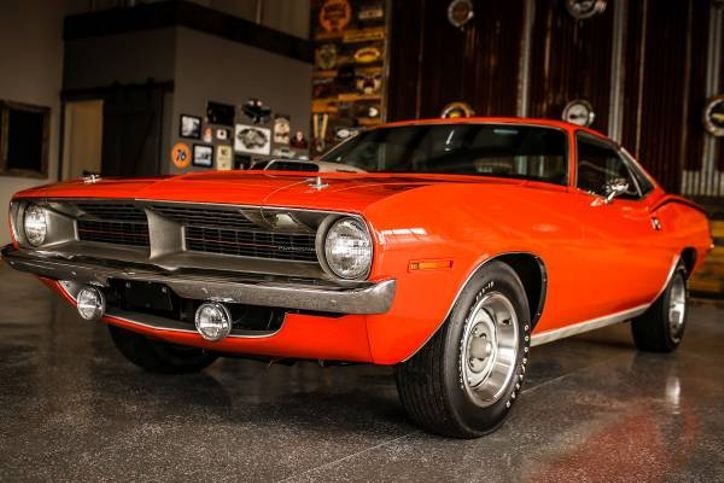 $595,000 · 67% above typical
Expand
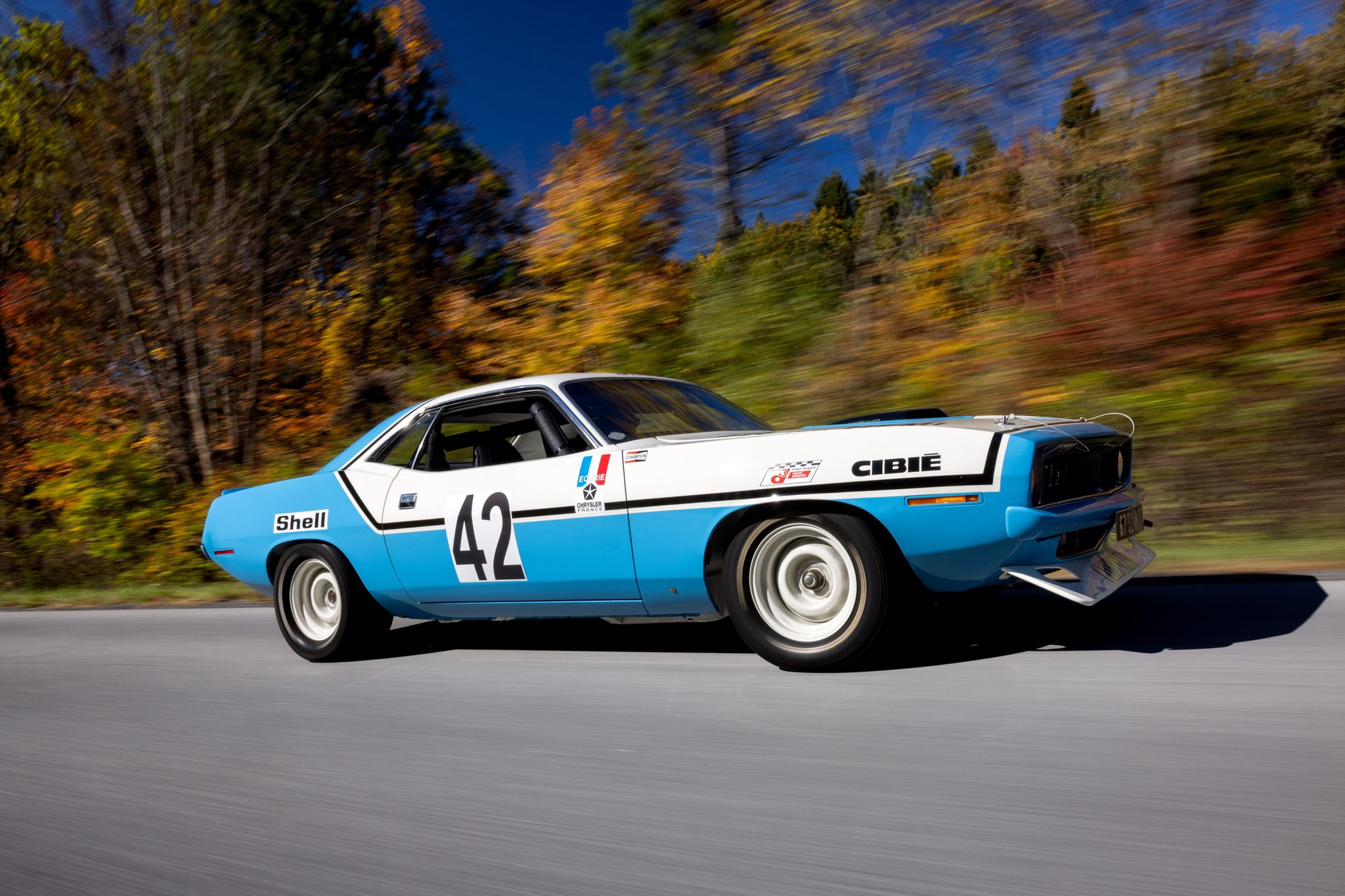 Current bid $110,000
What they sell for: Barracuda sale prices.