
Ford Model 48 buyer's guide
Ford Model 48 -- the model's own buyer's guide: variants, values and what to check.
Years listed: 1935-1936 · Series: Full Size
Overview and history
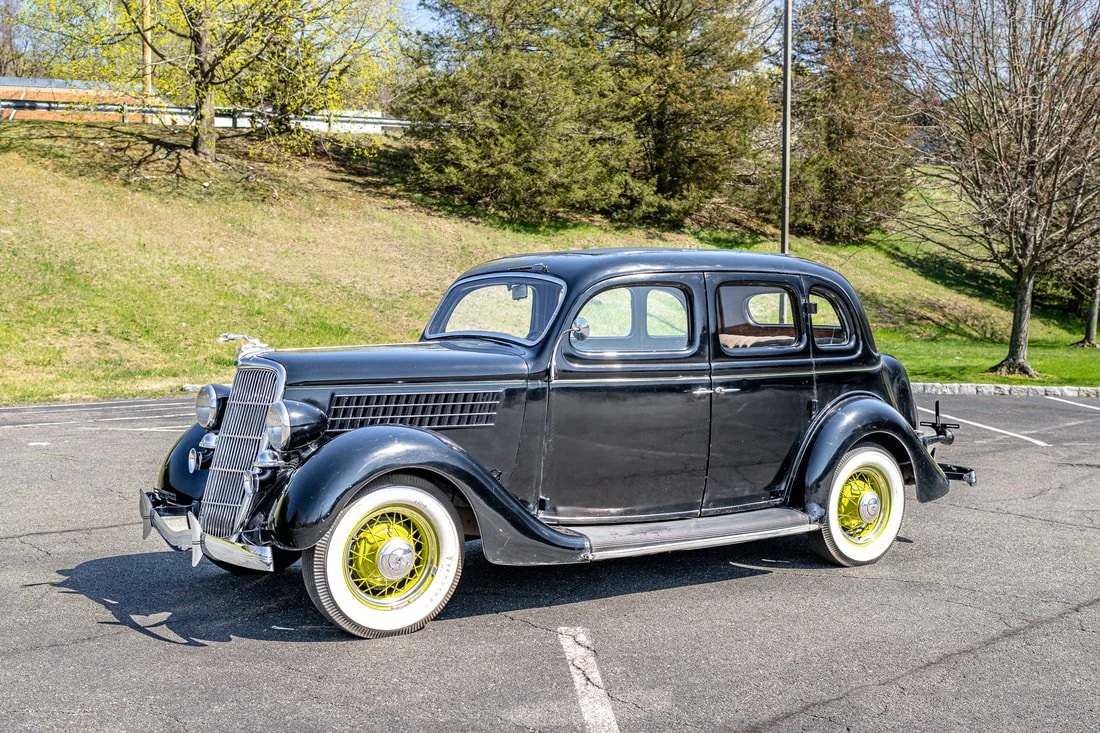
The Model 48 is the 1935 Ford — the year Ford's flathead V8 formula stopped looking like a warmed-over Model 40 and became the car people picture when they say "early V8 Ford." The designation is a model code, not a body name: Ford called its 1935 passenger-car line the Model 48, succeeding the 1933–34 Model 40, and replaced it for 1936 with the Model 68, a close facelift of the same car. That matters when you shop, because sellers routinely label 1936 cars "Model 48" — one of the five cars currently tracked on Classic Listings is a 1936 Fordor filed under this name.
What changed for 1935 was proportion and packaging. The wheelbase stayed at 112 inches, but the body grew wider and lower-looking, the engine sat further forward over the front axle, and the passengers moved forward with it — Ford advertised the result as "Center-Poise" ride, and for once the advertising had a mechanism behind it: with the occupants inside the wheelbase instead of over the rear axle, the car pitched less and rode noticeably better than the 1934. The styling, developed under Edsel Ford's direction, flowed the fenders into pontoon shapes, sloped the grille back, and hid the horns behind small grilles in the fender aprons on De Luxe cars.
Underneath, it is pure early Ford. A separate steel frame with a deep X-member carries an all-steel body (with structural wood still inside the open cars and framing the closed bodies). The engine is the 221-cubic-inch flathead V8, rated at 85 hp, driving through a three-speed floor-shift gearbox and an enclosed torque tube to a live rear axle. Suspension is a solid axle at each end on a transverse leaf spring — the layout Henry Ford defended until 1948. The brakes are mechanical, worked by rods, with no hydraulics anywhere; Ford did not fit hydraulic brakes until 1939, last of the American majors. The electrics are six-volt, positive ground. None of this is a defect, but all of it defines ownership: a properly sorted Model 48 is a sweet, torquey, 60-mph tourer, while a merely shiny one wanders, fades its brakes downhill and overheats in traffic — and the difference is entirely in maintenance you can inspect.
Ford built roughly 820,000 Model 48 passenger cars for 1935 in the United States — a huge year that put Ford back ahead of Chevrolet — across one of the widest body catalogues in the industry. Survival is correspondingly uneven: sedans and five-window coupes survive in numbers, while the open cars were always rare and are now genuinely scarce. On Classic Listings we currently track just five of these cars — four offered for sale and one recorded sold, all dealer cars, spread across Washington, Missouri, Minnesota, Pennsylvania and New York — and that thin pool is representative of how these surface today: one at a time, usually restored, occasionally hot-rodded, never in a run of ten you can cross-shop in a weekend.
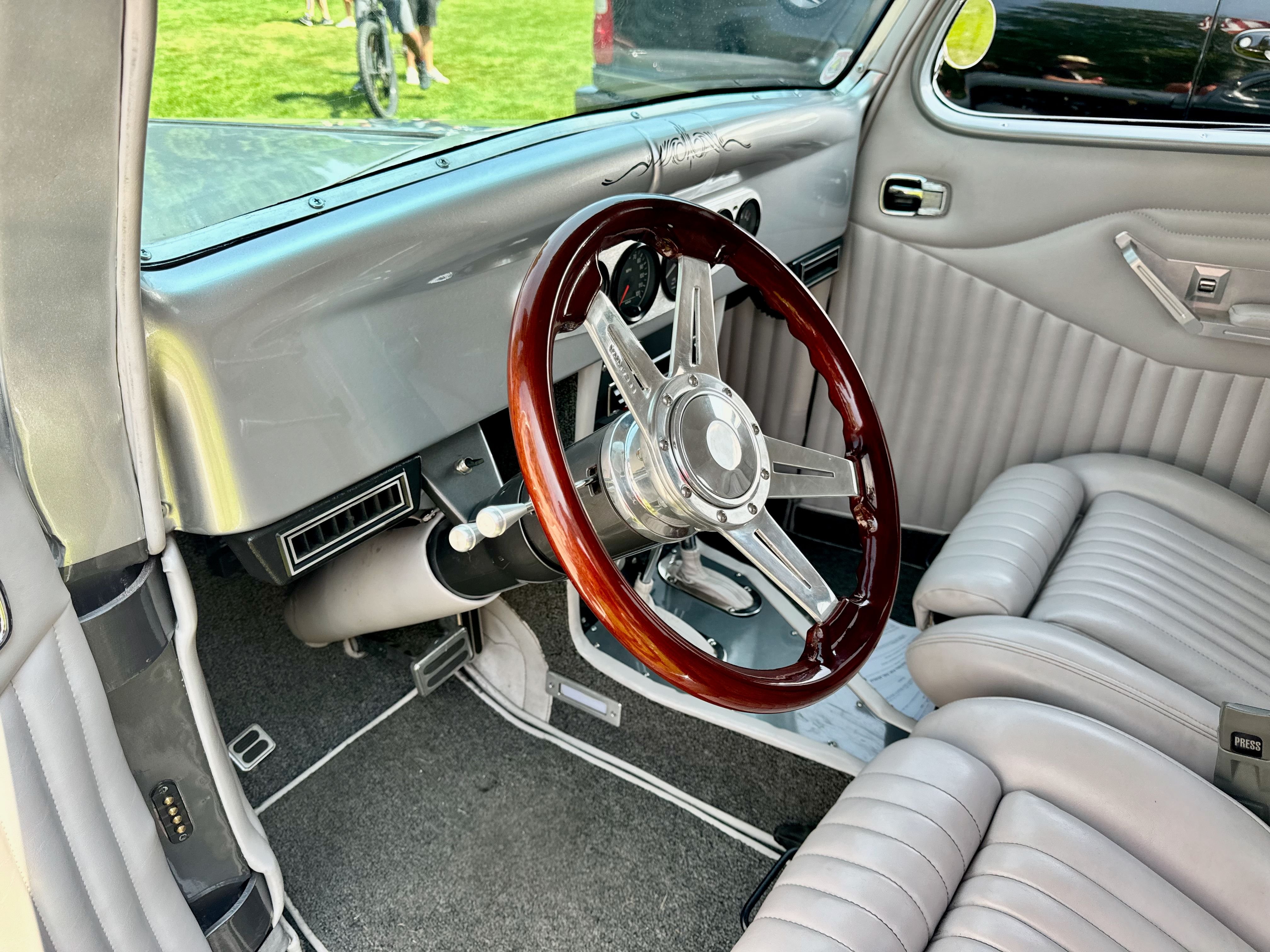
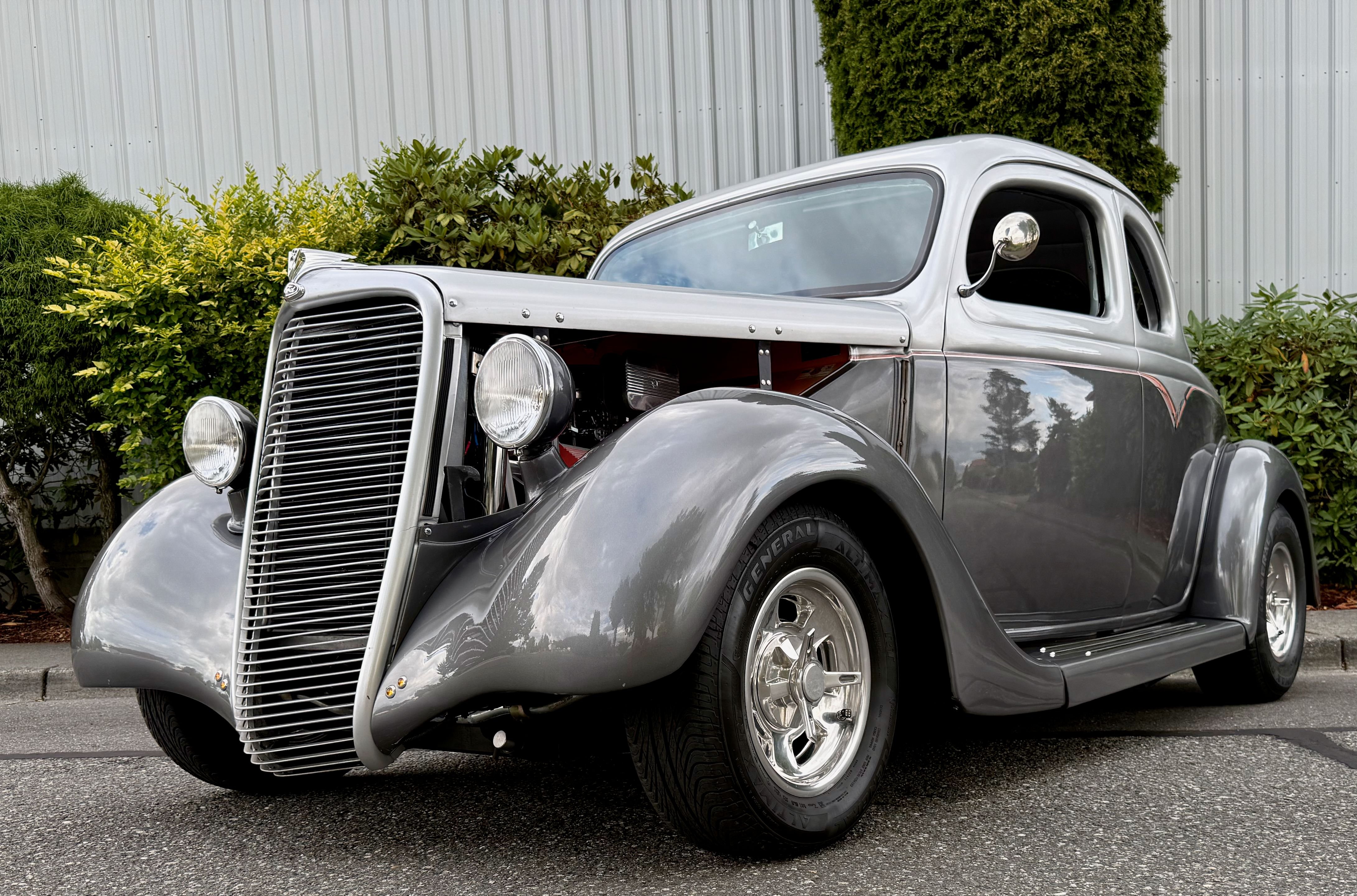
The second divide in this market runs through all early Fords: stock against modified. The 1935 Ford is a foundation shape of American hot rodding — the five-window coupe especially — and many survivors have been rodded at some point. Our own small pool contains the full spectrum: stock-presenting coupes, a phaeton and sedans, and a silver five-window coupe from Washington that has gone all the way — a 502-cubic-inch big-block Chevrolet under a hood with no sides, an automatic gearbox (the pool's lone "3 Speed Automatic" entry; Ford never built an automatic Model 48) and a fully custom interior. Neither end of that spectrum is wrong; they are different cars priced by different rules, and the problem-areas and inspection sections below are written for the stock car first and the modified car second — a modified car's 1935 body and frame still obey 1935 rules even when nothing under the hood does.
One more framing fact. These cars are ninety years old, and most have been restored at least once. An older restoration is not a restored car today; it is a car whose restoration is itself thirty or forty years old, with the rust, perished rubber and tired babbit that implies. In the four cars in our pool whose photographs we examined in detail, rust was noted in two and visible damage in two — a small sample, honestly stated, but it matches the wider market: assume every Model 48 needs a body-and-chassis audit first and an engine audit second, because that is the order in which the money goes.
The models
The 1935 range divides first by trim and only then by body. Ford sold two lines on the same chassis and engine: the Standard line, plainly trimmed with painted grille and headlamp shells and a single horn, and the De Luxe line, with a chromed grille surround, dual horns behind fender grilles, richer upholstery, woodgrained dashboard and window mouldings on closed cars, and the leaping greyhound radiator ornament. There is no mechanical difference worth a dollar between Standard and De Luxe. The De Luxe premium is trim completeness, and it is only worth paying if the trim is actually all there — De Luxe brightwork, the correct banjo steering wheel and the woodgrained mouldings are the parts that cost real money to replace piecemeal.
Body styles for 1935: the five-window coupe; the three-window coupe (De Luxe only, longer and sleeker, one side window per side); the Tudor (two-door) and Fordor (four-door) sedans; the Tudor and Fordor Touring Sedans — the "trunkback" versions with an integrated bustle trunk, against the flatback "slantback" standard sedans; the roadster; the phaeton; the cabriolet (a convertible with roll-up windows); the convertible sedan (four-door, windows, De Luxe only and rare); and the station wagon, whose wood body was built for Ford at its Iron Mountain plant from maple framing and birch or gum panels.
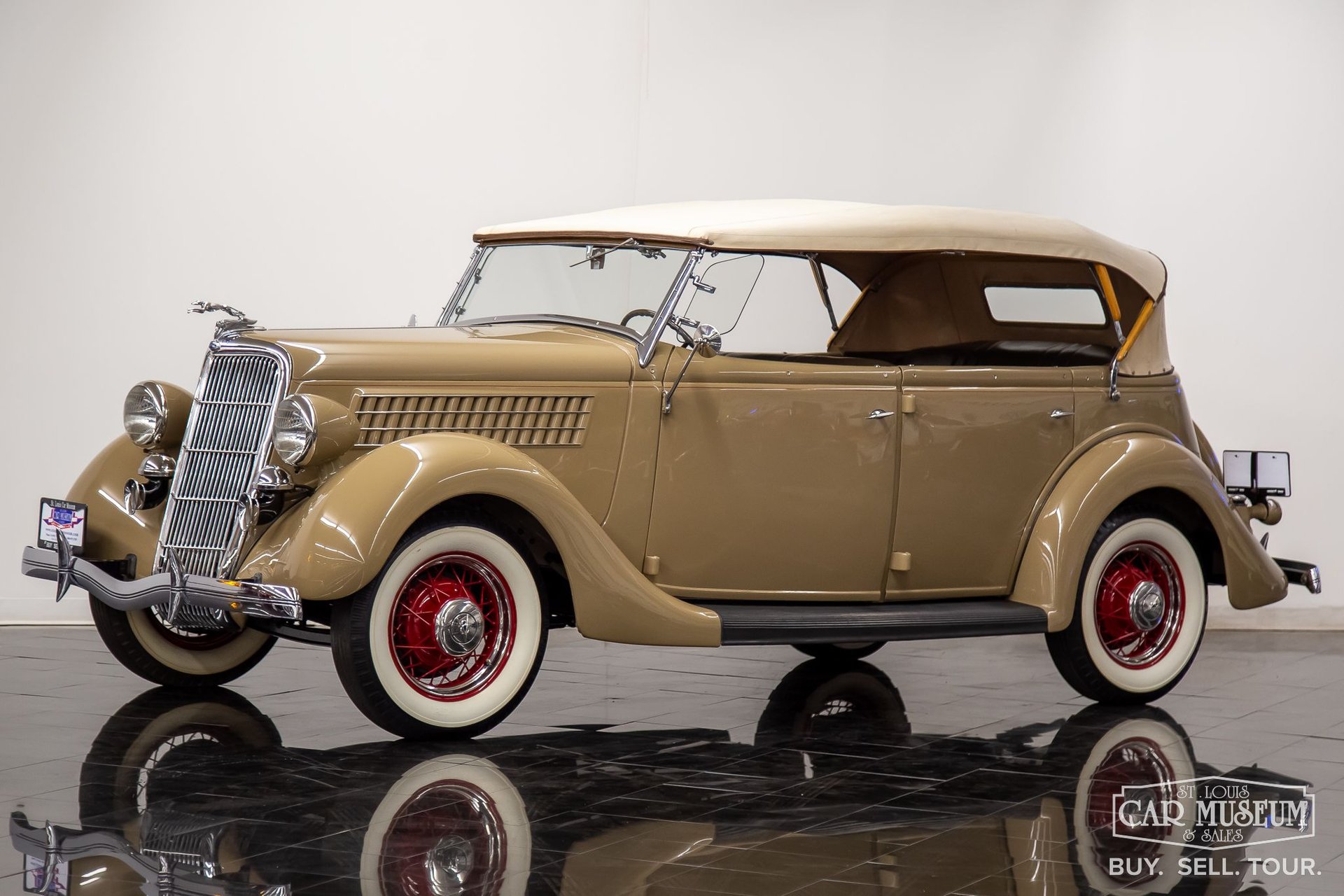
In today's market the hierarchy is set by two forces: original scarcity and hot-rod demand. The open cars were built in the hundreds and low thousands and survive in dozens; the De Luxe phaeton in our pool, a four-door open tourer in a tan Ford called Cordoba Gray, does not come up often, and originality on an open car — correct top irons, side-curtain hardware, sound wood framing — is worth more than shine. The coupes pull the other way: the five-window is the canonical 1935 hot rod, good bodies have been bid up by builders for fifty years, and a stock, uncut five-window with its original flathead is scarcer in practice than its production figures suggest. The three-window carries a premium over it in equal condition. Sedans are the value end: a Fordor gives you the same engine, chassis and four usable seats for the least money in the range.
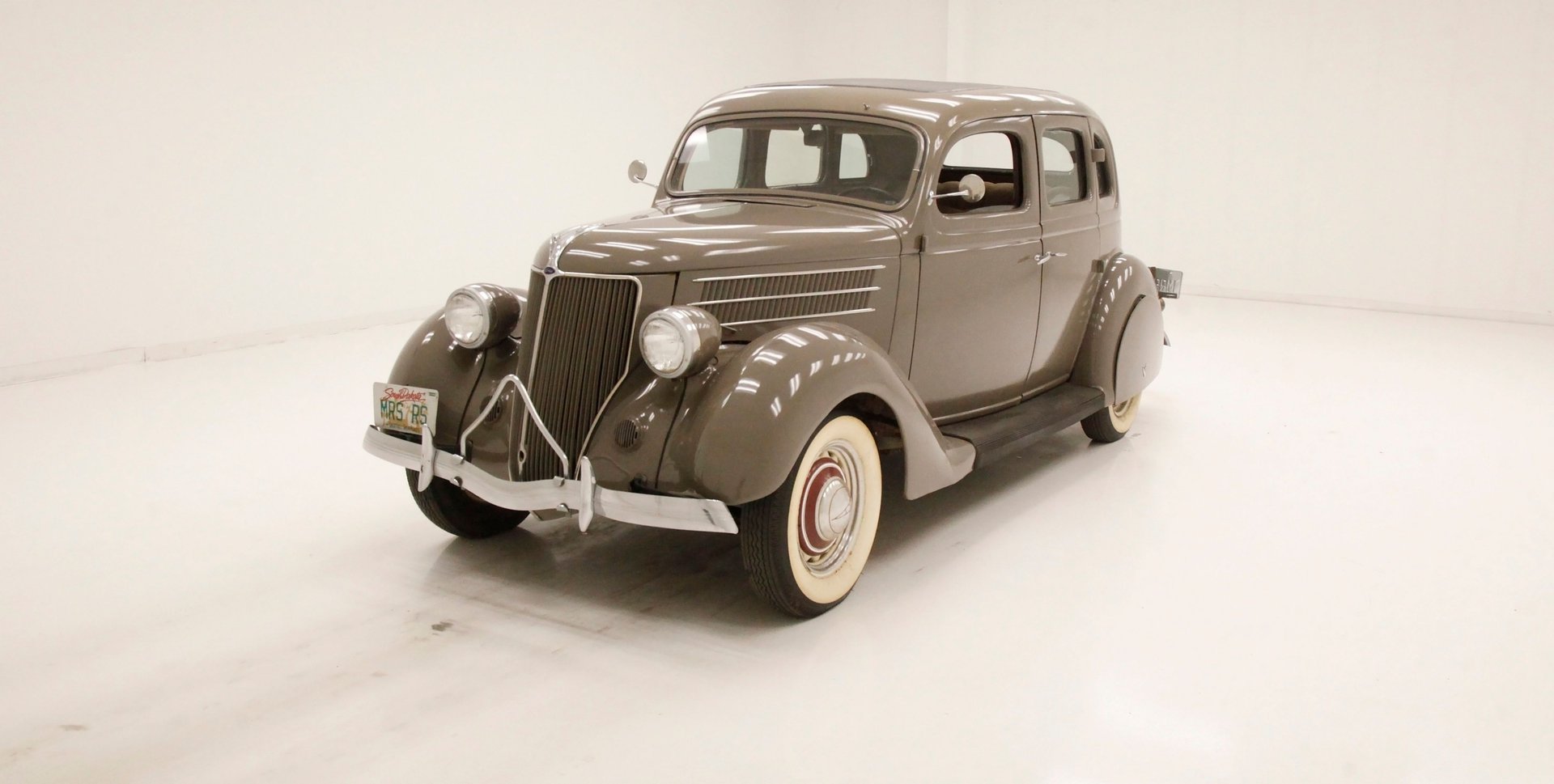
Watch the details that separate a 1935 from a 1936, because the two are confused constantly and the title year is what you are paying for. A 1935 wears a narrow, upright grille with vertical bars, hood sides with horizontal louvers in a single pressed panel, wire wheels, and horns that (on De Luxe cars) hide behind small round grilles low in the front aprons. A 1936 wears a deeper, more rounded grille, revised hood louvers with bright trim strips, pressed-steel disc wheels instead of wires, and exposed trumpet horns on the fenders. The 1936 Fordor in our pool shows the later face clearly. If the car in front of you has it, the car is a Model 68 whatever the listing calls it — not a worse car, arguably a slightly better one, but pay 1936 money and insist the paperwork says 1936.
| Model | Years | Engine | Output | Built | Character |
|---|---|---|---|---|---|
| Standard 5-Window Coupe | 1935 | 221 cu in flathead V8 | 85 hp | — | The plain coupe; painted trim, the hot-rod target in its cheapest original form |
| De Luxe 5-Window Coupe | 1935 | 221 cu in flathead V8 | 85 hp | — | The canonical '35 coupe; chrome trim, greyhound cap, the one builders and collectors fight over |
| De Luxe 3-Window Coupe | 1935 | 221 cu in flathead V8 | 85 hp | — | Longer roof, one window a side; the prettiest coupe and priced like it |
| Tudor Sedan (Standard & De Luxe) | 1935 | 221 cu in flathead V8 | 85 hp | — | Two-door family car; the volume seller and today's value entry |
| Fordor Sedan (Standard & De Luxe) | 1935 | 221 cu in flathead V8 | 85 hp | — | Four doors, same running gear; the cheapest way into a stock flathead Ford |
| Tudor / Fordor Touring Sedan | 1935 | 221 cu in flathead V8 | 85 hp | — | The trunkback cars; integrated bustle trunk, the tourer's pick |
| Roadster (De Luxe) | 1935 | 221 cu in flathead V8 | 85 hp | Low thousands | Rumble seat, side curtains, no roll-up windows; fair-weather only |
| Phaeton (Standard & De Luxe) | 1935 | 221 cu in flathead V8 | 85 hp | Very few — around a thousand De Luxe | Four-door open tourer; the rarest regular body, wood-framed and weather-exposed |
| Cabriolet (De Luxe) | 1935 | 221 cu in flathead V8 | 85 hp | Low thousands | Roll-up windows in a convertible; the usable open car |
| Convertible Sedan (De Luxe) | 1935 | 221 cu in flathead V8 | 85 hp | Hundreds | Four-door convertible with windows; flagship rarity |
| Station Wagon | 1935 | 221 cu in flathead V8 | 85 hp | Low thousands | Iron Mountain wood body; judge it as furniture first, car second |
| Model 68 (all bodies, successor) | 1936 | 221 cu in flathead V8 | 85 hp | — | The facelift year; steel disc wheels, Stromberg 97, same checks throughout this guide |
Per-style production figures are left approximate in that table on purpose: Ford's total for the year is solid, but per-style figures quoted around the hobby vary by source. What you can act on is the ranking — sedans in volume, coupes in the middle, open cars in the hundreds and low thousands — because the ranking is what survival rates and prices still follow.
Two identity traps deserve naming. First, the number trap: on a 1935 Ford the serial number is stamped on the frame — on top of the left frame rail near the steering box, repeated towards the rear — and the same number appears on the transmission case; the engine carries no separate serial that titles the car. A car whose frame number and title disagree is a paperwork problem you inherit, not a detail. Second, the built-car trap: because coupe bodies are valuable, the market contains coupes assembled from a sedan cowl, reproduction panels and a title bought separately. Look for factory spot-weld patterns and consistent ageing across panels before you pay coupe money for anything.

Engines and gearboxes
The 221 flathead: what the design actually is
Every stock Model 48 carries the same engine: Ford's 221-cubic-inch (3.6-litre) flathead V8, rated at 85 hp at 3,800 rpm with about 144 lb-ft of torque low down where a touring car uses it. "Flathead" describes the valve arrangement: the valves sit in the block beside the cylinders, opening upward into a recess in the flat cylinder head, rather than in the head itself. The layout is simple, quiet and tolerant, and it defines two permanent traits. It breathes poorly by modern standards, so power is modest and tuning gains are small without serious work; and the exhaust passages run through the water jacket inside the block, so a flathead puts more heat into its coolant than an overhead-valve engine of the same output — the root cause of the overheating stories that follow these cars, and a design fact, not a defect in any individual car.
The bottom end is a three-main-bearing crankshaft. On a 1935 engine the main bearings are poured babbit — a soft bearing metal cast directly into the block and caps, then line-bored and scraped to fit — not the replaceable insert shells of a modern engine or of the later "LB" flatheads. Babbit is quiet and long-lived when oil is clean and clearances are right, and a specialist, expensive job when it is not: re-pouring and line-boring is engine-out machine-shop work, and the number of shops that still pour babbit well is small and shrinking. That is why the tests in the problem-areas section — oil pressure hot at idle, engine fully warm — matter more than any receipt that says "engine rebuilt" without saying by whom, or how.
The 1935 engine in detail: 21 studs, pumps in the heads, and the helmet distributor
A correct 1935 engine is a "21-stud" motor: each cylinder head is held by 21 studs and nuts, a count you can make in thirty seconds with the hood open, and the fastest identity check in this guide. The 21-stud family ran from 1932 through 1937; the 24-stud engine that replaced it for 1938 looks similar at a glance and is a different, generally more desirable motor, so a 24-stud engine in a 1935 car means a later engine has been fitted — common, often honestly done in the 1940s and 1950s when a worn babbit block was exchanged rather than rebuilt, but it changes the car's originality and should change the price conversation. Count the studs. The heads also carry the water pumps: on 1932–36 engines the two pumps mount on the front of the cylinder heads, one per bank, driven by the fan belt (Ford moved them to the block in 1937). Rebuilt pumps with modern seals and bearings are available, but a weeping pump on a 1935 car dribbles over the front of the engine and is routinely misread as a head-gasket leak, and a seized pump bearing throws the belt that also drives the fan and generator — at which point the car stops cooling and charging simultaneously.
Ignition is by the front-mounted distributor Ford used from 1932 to 1936: a squat, helmet-shaped unit bolted to the front of the timing cover and driven off the camshaft, with twin contact points, the coil mounted on top, and a vacuum brake that retards the spark under load. It suffers from its address — low at the front of the engine, behind the fan, where road water and its own heat attack it — and setting the points properly is a bench job with the unit off the car, ideally on a distributor machine. A 1935 Ford that runs roughly, kicks back on starting, or goes flat at speed is very often wearing a tired front distributor a previous owner "tuned" by ear. Budget for a proper specialist rebuild rather than repeated roadside adjustment; it transforms these cars.
Fuelling is by a single downdraft two-barrel carburettor — a Stromberg 48 on the 1935 car (the larger-venturi Stromberg; the better-known Stromberg 97 arrived for 1936) — fed by a mechanical fuel pump at the back of the intake manifold, worked by a pushrod off an eccentric on the camshaft. Its two failure mechanisms, the wearing pump pushrod and ethanol's attack on 1935-spec rubber and cork, are covered in problem areas.
The engines you will actually find: later flatheads and the swapped car
Because the newest stock engine is ninety years old, the car in front of you may carry one of three things, and your first job is to establish which. First, a correct 21-stud 221, babbit mains, pumps in the heads — the originality case, judged by the tests below. Second, a later flathead: a 24-stud 221 (1938–42), the post-war 59A-type 239 (1946–48, basis of most performance flatheads), or a Mercury 255. These swaps were period practice, fit with minimal change, and bring insert bearings, better parts supply and useful extra torque — a well-built 59A in a 1935 coupe is a genuinely good touring engine. What they are not is original, and the market prices them between the correct engine and the full swap. Identify them by stud count, by water pumps in the block rather than the heads, and on 59A engines by the raised intake surface and head marking. Third, the overhead-valve swap: small-block and big-block Chevrolet, small-block Ford, modern LS — the hot-rod path; the silver coupe in our pool, with a 502-cubic-inch Chevrolet big-block, is the far end of it. On a swapped car the flathead paragraphs no longer apply to the engine, but everything about frame, brakes (unless converted), steering, body and rust applies in full — plus new questions: mounts welded how, cooling sized for the new engine, an axle that can take several times the original torque. Judge the engineering, not the shine: neat fabrication, proper mounts, cooling with headroom and receipts from a named builder are the value; a big engine dropped onto a stock torque tube and mechanical brakes is a liability wearing nice paint.
Gearboxes: the Ford three-speed, the torque tube, and what gets substituted
The stock gearbox is Ford's three-speed manual, floor-shifted with a long, curved lever, with synchromesh assistance on the upper gears by the standards of the day and a first gear you engage at a standstill. Drive passes from the clutch into an enclosed torque tube: the propeller shaft runs inside a steel tube bolted rigidly to the gearbox and the rear axle, the tube locating the axle and taking the drive thrust, with a single universal joint at the front. The rear axle is a banjo-type housing with a spiral-bevel final drive and a ratio around 3.78:1 — roughly 20 mph per 1,000 rpm in top, a 55–60 mph cruise at sane revs, and no more. Its shafts carry the car's weight on their outer bearings, a semi-floating design in which a broken shaft can let a wheel depart — one reason hub and key condition matters, covered below.
Gearbox behaviour to expect: second gear is the worker and the wearer, and the classic fault — jumping out of second on the overrun — has three causes at three prices, separated in the problem-areas section. Whine in the indirect gears is normal at period level; a car that will not take first without a crunch at rest has a dragging clutch or the wrong oil — these boxes want a heavy gear oil, and one filled with modern thin synthetic can shift worse, not better.
Two alternatives appear in real cars: the Columbia two-speed rear axle, a vacuum-operated period accessory giving an overdrive top (audited in problem areas — test it on the road in both ratios), and, on rodded cars, an automatic or five-speed behind the swapped engine. On any open-driveline conversion, confirm a properly located axle (four-bar, ladder bars or a triangulated link) has replaced the torque tube, because a conversion that leaves the axle located by the transverse spring alone is an accident in progress.

Problem areas
Rust and structure: the map of a 1935 Ford body
Rust decides what a Model 48 is worth, because the mechanical parts are all rebuildable by somebody, somewhere, while a body that has lost its lower six inches is a fabrication project priced in months. The floor pans go first, front footwells especially, where water sat under rubber mats for decades — lift every mat and carpet, because sellers glue carpet down over exactly the holes you are looking for, and press hard along the pan seams and around the body-mount bolts. The subrails and inner rockers beneath the doors carry the body; check the sill line from underneath with a torch, and on a coupe the lower cowl sides behind the front wheels, where road spray lived. Door bottoms rust from the inside out — the drain holes block, the window channel drips into the door, and the first sign is a paint blister along the lower edge. Run a weak fridge magnet along every lower panel; where it falls off, there is filler behind it, and you should budget for metal, not paint.
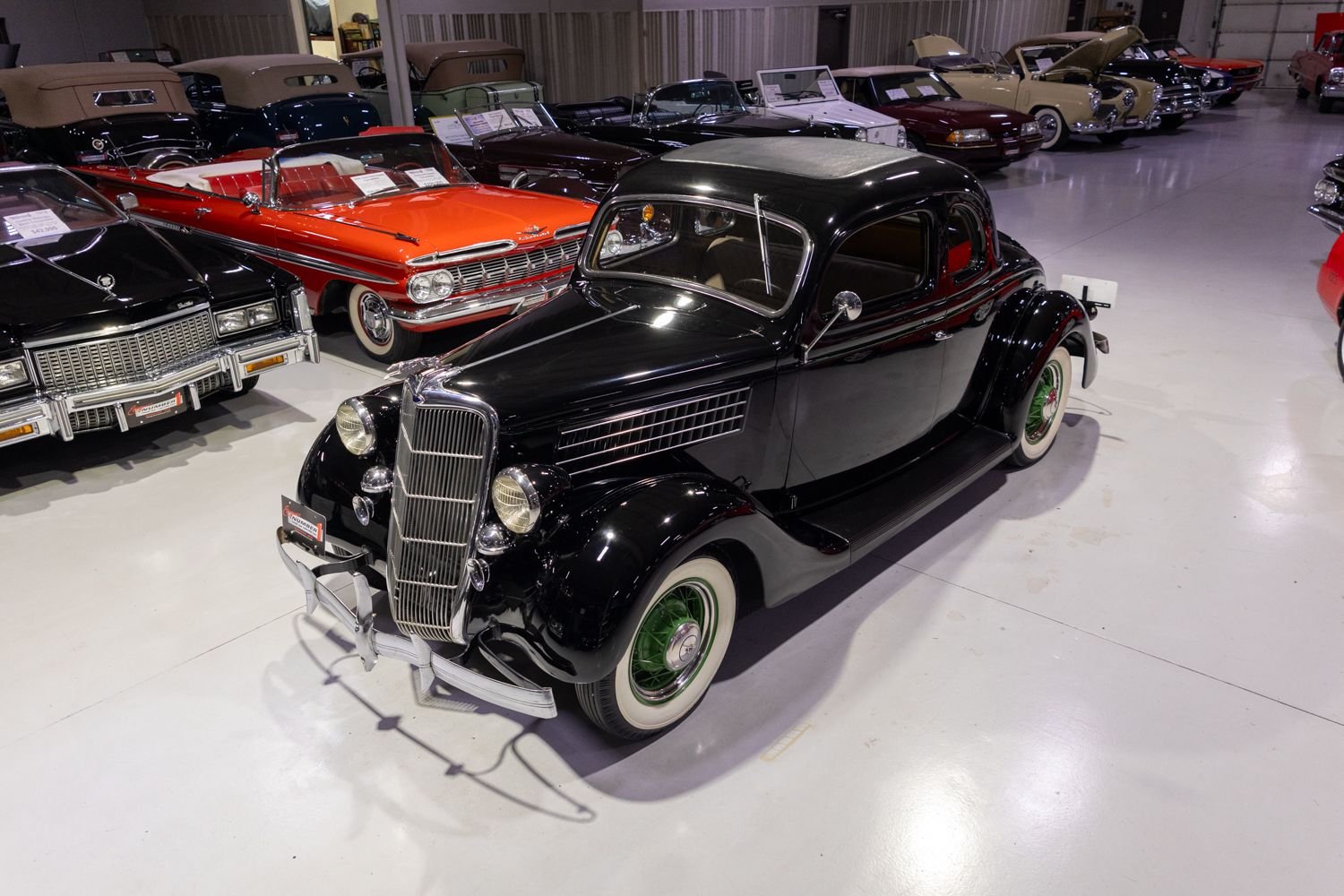
The roof deserves its own paragraph because buyers raised on later cars miss it: a closed 1935 Ford does not have an all-steel roof. The centre is a fabric-covered insert panel (visible on the black coupe in our pool), and its perimeter is a water trap. Leaks stain the headliner, rot the wooden roof bows underneath, and drip into the body where rust stays invisible. A shrunken or siliconed insert edge carries a real number — replacement with any bow rot repaired runs roughly $1,500–$3,500 — and a damp smell inside a closed Model 48 should start your eyes at the roof, not the floor. At the back, check the panel below the trunk or rumble lid, the trunk floor, the rear wheel arches and the bottoms of the bolt-on rear fenders, which trap mud against the body. Front fenders crack at the bead beside the headlamp bar; running boards are steel under the rubber mat and rot quietly. On open cars add the wood: door frames, cowl structure and sills carry significant timber framing, and a door that drops when opened usually means rot in the hinge pillar — carpentry at coachbuilder rates, not a hinge adjustment. The station wagon is the extreme case, judged as furniture first.
Then the frame, because a bent or rotten frame under a pretty body is the worst purchase in this market. The 1935 frame is a ladder design with a deep centre X-member. Rust concentrates where the X-member meets the rails, at the rear crossmember, around the spring hangers, and along the top of the left rail where the serial number is stamped — corrosion there is both a structural and an identity problem. Get the car on a lift (a serious seller of a ninety-year-old car expects the request), sight along both rails for ripple and cracks at the front crossmember, and measure the wheelbase side to side; a car that crab-tracks with a quarter-inch of difference has frame news. Frame repair by a shop that knows these cars is $2,000–$6,000 territory before the body comes off, and a full body-off frame restoration is the point at which a "cheap" Model 48 stops being cheap.
The flathead engine: heat, babbit and cracks
Start with heat, because overheating is the flathead's reputation and usually a stack of small causes rather than one big one. The mechanism matters: exhaust passages inside the block dump heat into the coolant, the pumps sit in the heads, the radiator is unpressurised, and the margin is thin. The distinguishing tests, in order: (1) Timing — a retarded front distributor makes a flathead run hot and gutless together; if the car is also flat at speed, suspect ignition before cooling. (2) The radiator core — look down the filler with the engine warm and running: you want visible flow once the thermostats open; a furred or silted core shows lazy flow. A recore runs roughly $700–$1,400. (3) The block — ninety years of plain water leave scale around the exhaust passages no flush fully removes; an engine that still boils with a clean core and correct timing needs a hot-tank and rodding-out at rebuild, not another additive. (4) The pumps — grab each pulley (engine off) and feel for bearing play. Never accept "they all run hot" from a seller: a healthy stock 221 runs at temperature all day at touring speeds. They run hot when something is wrong, and finding out what is the difference between a $300 fix and a $9,000 one.
Oil pressure is your babbit test. A warm engine should show strong pressure at road speed and a steady reading at hot idle — but the dash gauge and its sender are ninety-year-old electrics, so the test that settles it is a mechanical gauge teed into the gallery, engine fully hot after the road test. Pressure that is healthy cold and fades as the oil warms is the signature of worn babbit clearances opening up; pressure low everywhere, with a rattle from the centre of the engine under load, is worse. A full babbit job — strip, pour, line-bore, rebuild — is $6,000–$12,000 at a specialist, which is why a tired bottom end reprices the whole car. Listen also at the front: a worn fibre cam gear gives a whirring or rattle that changes with revs and, if it sheds teeth, stops the engine entirely; replacement is a front-of-engine job, $600–$1,200, with the distributor re-timed on a machine while you are there.
Cracks are the third flathead audit. The classic locations are between the valve seats and the cylinder bores (heat cracks around the exhaust seats), along the pan rails of blocks that froze in a northern winter sometime in the last ninety years, and in the decks of blocks run hard while boiling. Some seat cracks are cosmetic and live happily for decades; cracks into a bore or a water jacket are a dead block. You cannot see most of this on an assembled engine, so a running car's evidence is behavioural: coolant that pressurises the top hose within a minute of a cold start (combustion gas, not heat), oil and water mixing in either direction, one plug that stays clean and steam-washed, or a receipt file showing repeated head-gasket changes — each is a reason to price the car as needing an engine, or to walk. Head studs are the smaller, certain cost: studs heat-cycled since 1935 seize in the block, and a head removal that snaps them turns a gasket job into a machine-shop job, so ask when the heads were last off.
Fuelling faults present as hot-start failure and high-speed starvation more than as non-running. The mechanical pump's pushrod wears at its foot and in its guide; the stroke shortens by thousandths and the pump keeps up at idle but not at 50 mph or after a hot soak, when vapour lock joins in — the classic complaint is a car that dies at a fuel stop and restarts twenty minutes later. The test is a pressure and volume check at the carburettor inlet (roughly 2.5–3.5 psi, and a pint delivered in well under a minute of cranking), plus a look in the pump's glass bowl for the rust dust that says the tank is shedding. Tanks rust from the inside top surface down; a clean-and-seal or a reproduction tank is $400–$900. The Stromberg itself (48 on the '35, 97 on the '36) wears at the throttle shaft, leaks at the float bowl, and suffers with ethanol in its older gaskets and floats; a specialist rebuild with ethanol-tolerant parts is $350–$650, money well spent on any car that will be driven.
Gearbox, torque tube and rear axle
The drivetrain faults are few and specific. Jumping out of second on the overrun is the signature complaint, with three distinct mechanisms at three prices: worn synchromesh and gear dogs inside the box (gearbox out, rebuild $1,200–$2,500); a worn detent and selector (cheaper, same labour to reach); and driveline movement from worn torque-tube bushings letting the shaft push the gear out (tube out, bushings and the enclosed universal joint renewed, $800–$1,800). Axle whine that rises with road speed and changes between drive and coast points at pinion bearings or ring-and-pinion mesh; a clonk on take-up is backlash plus worn axle keys. Those keys matter beyond noise: the rear hubs drive through tapered shafts and keys, and a hub that has run loose frets the taper until the hub can spin or the shaft fails — pull a rear hub on any car you are serious about, or at minimum check the hub nuts and look for the rust dust of fretting around the keyway. A Columbia two-speed axle, where fitted, adds its own audit — perished vacuum lines, a shift mechanism seized from disuse, scarce internals; a working one is worth money, a dead one is $1,500–$3,000 to put right if parts can be found.
The clutch is a conventional single dry plate; judder on take-up usually means oil from a weeping rear main or a flywheel face needing a skim, and a clutch job prices at $900–$1,600 with the torque tube dropped.
Chassis, steering and the mechanical brakes
Everything at the corners of a Model 48 is adjustable, wear-prone and safety-critical, and none of it is hydraulic. The brakes are mechanical drums on all four wheels, worked by rods from a cross-shaft. Set up correctly — rods equal, clevis pins unworn, drums round, linings arced to the drums — they stop a 2,600-pound car adequately and evenly. When they are not, the car pulls, the pedal goes long, and stopping distances double — the wear points are elongated clevis holes, bent rods, worn cross-shaft bushes, scored drums and oil-contaminated linings. A full mechanical-brake overhaul — drums skimmed or replaced, new linings arced, rods and pins renewed, everything set up by someone who knows the system — runs $1,000–$2,500, and a car whose brakes "just need adjusting" usually needs exactly that overhaul, because adjustment is its last step, not a substitute. Some owners convert to 1939–48 hydraulic brakes ("juice brakes"); a well-done conversion is a legitimate touring upgrade, while one with a single-circuit master and kinked lines is worse than good mechanicals. Judge the work, not the idea.
Steering is by a worm-and-roller box (Gemmer type) with a drag link and a tie rod across. Wear accumulates in the box, the kingpins and their bushes, the spring shackles and perch pins, and the wheel bearings, and the symptoms stack: play at the wheel, a wander needing constant correction, and in the worst case a front-end shimmy — the "death wobble" — set off by a bump at 30–40 mph. Understand its mechanism, because sellers blame the last thing they replaced: the whole system oscillates when worn shackles, kingpins and loose bearings let the axle steer itself faster than the steering can damp it. The cure is systematic — kingpins and bushes ($500–$1,100 fitted), shackle pins and bushes (a few hundred dollars and an afternoon), box adjustment or rebuild ($400–$900), bearings and a caster check — and a car that wobbles on your test drive is giving you a written estimate of its front end's condition. Transverse springs sag and crack leaves at the centre bolt; lever-action Houdaille shocks leak and go slack, and a car bouncing twice after a fender press needs them rebuilt ($150–$300 each). Tyres are 6.00-16 crossplies on stock cars: read the date codes, because shiny ancient whitewalls are show-field tyres, not road tyres, and budget $1,200–$2,000 for a fresh set.
Electrics, interior and the open-car extras
The electrical system is six-volt, positive ground, charged by a three-brush generator with a cutout — output is set by the third brush and the driver's use of the lights. Six volts is not a problem — a healthy system with clean grounds and correct heavy cables starts a flathead eagerly — but it is unforgiving of resistance: every corroded ground strap, undersized replacement cable and dirty switch subtracts from a budget with no slack. Dim lights, a lazy starter and a lying gauge are usually connection faults, not component faults, fixed with a wire brush and a multimeter rather than a 12-volt conversion. Original cloth-braided wiring has insulation that crumbles at ninety years; a new cloth-look harness is $500–$900 plus fitting and is the best reliability spend on a car still wearing its 1935 loom. The gauges fail individually and are rebuildable; vacuum wipers slowing to a stop uphill in rain is their design, not a fault. And a flathead that kicks back against the starter has its timing or vacuum brake wrong — repeated kickback breaks starter drives, another symptom leading back to the distributor rebuild.
Interior condition is where restoration costs surprise people: the cabin is simple in shape and expensive in materials. Standard cars wear mohair or broadcloth; De Luxe cars wear better cloth or, in open cars, leather. A full correct interior — seats, door cards, headliner, carpets — is $4,000–$9,000 at a trimmer who knows pre-war Fords, and "original" on a ninety-year-old car usually means tired, split and mouse-nibbled: charming on a driver, a bill on a show car. On open cars, add the top: correct irons, sound bows and side curtains are a substantial asset — a new top with curtain work runs $3,000–$6,000, and bent or missing irons are coachbuilder work. On the cabriolet and convertible sedan, work every window and the top through its full travel before you value the car, because a convertible that does not convert is a sedan with leaks.
Finally, the myth to retire: a stock Model 48 does not cruise at 75 mph — its honest cruising speed is 50–60 mph, and your test drive should be planned accordingly.

How to inspect one
Inspect in this order — identity, structure, running gear cold, then hot, then on the road — and bring a magnet, a torch, a tyre gauge, a mechanical oil-pressure gauge if the seller will allow it teed in, and a friend to work the pedals while you watch the brake rods. A seller who will not allow a cold start, a lift, or a proper road drive has told you the most important thing about the car.
- Identity first. Find the serial number stamped on top of the left frame rail near the steering box (clean the rail with a wire brush if you must) and compare it with the title, character for character. Check the matching number on the transmission case. If the rail stamping is corroded away or the numbers disagree, stop and resolve it before anything else — everything else you inspect is a car you may not be able to register.
- Year and model honesty. Read the face: narrow vertical-bar grille, single-panel hood louvers and wire wheels say 1935; the deeper rounded grille, trimmed louvers and steel disc wheels say 1936 (Model 68). Price and paperwork should agree with the face, not with the listing's headline.
- The magnet walk. Work every lower panel — door bottoms, cowl sides, quarters behind the rear wheels, the panel below the trunk, fender beads — with a weak magnet. Note every dead spot. Then look underneath those spots from behind with the torch.
- Floors, sills and roof. Lift every mat. Press the footwells and the floor around the body mounts. Open and close every door twice, watching the gaps change; a door that drops is telling you about its hinge pillar and, on open cars, its wood. On a closed car, inspect the roof insert's edges and the headliner beneath them for staining — the roof-insert leak from the rust section starts here.
- Frame on the lift. Sight both rails; check the X-member junctions, crossmembers and spring hangers for rust, cracks and old repairs. Measure wheelbase both sides, and sight down the car for a bent axle or shifted body.
- Engine identity, cold. Count the head studs: 21 is the 1935 engine; 24 means a later flathead. Note where the water pumps live (heads = 1932–36 pattern; block = later). Look for the Stromberg carburettor type, the helmet distributor, and — on a car claimed original — any part that belongs to a different decade. Photograph everything; you will compare it with the receipts later.
- Cold start. Insist the engine is stone cold when you arrive. A flathead that starts eagerly cold, on choke that you can push home within a minute or two, with no kickback against the starter and no blue smoke that fails to clear, has passed its first real test. Kickback points at the distributor; lasting smoke points at rings and guides; a long crank points at the fuel pump and its pushrod draining back.
- Oil pressure, hot — after the drive, not before. Note the dash gauge now for comparison, then plan the mechanical-gauge check for step 12 when the oil is fully warm; pressure that fades with heat is the babbit test, and it can only be run hot.
- The brake walk. With your friend pressing the pedal, watch each brake rod move: equal travel, no bent rods, no slop at the clevises. Then, from 30 mph, a firm stop should pull straight with the wheel lightly released. Pull, a long pedal, or a second pump of travel each map to the mechanical-brake overhaul described earlier — price it, don't excuse it.
- The road drive, at period speeds. Twenty minutes minimum, including a hill. Work through the gears; hold second on a trailing throttle down a gentle slope — jumping out of second is the torque-tube/gearbox test, and this is where it shows. Listen for axle whine changing between drive and coast. Note the temperature gauge in a two-minute idle after the drive: a car that boils standing still after behaving on the road has the cooling-stack problem from the engine section. Feel for shimmy over bumps at 30–40 mph and for wander needing constant correction.
- Steering and suspension static checks. Rock the wheel for box play; jack each front wheel and rock it top-and-bottom (kingpins and bearings) and side-to-side (tie-rod and drag-link joints). Press each fender and count the bounces for the Houdaille shocks. Check tyre sizes match, and read the date codes.
- Hot re-check and paperwork. Mechanical oil-pressure gauge on the hot engine, at idle and at 2,000 rpm. A compression test if the seller allows it — even numbers matter more than high numbers on a flathead. Then the file: restoration receipts with names and dates, engine work by whom (babbit work should name the shop), title and club history. A thick file from the Early Ford V8 world means the car has been maintained inside the knowledge network you are about to need.
Two judgements before you leave. First, classify the car honestly — stock, period-modified (later flathead, Columbia axle, juice brakes), or rodded — because your offer, your insurer and your parts orders all depend on it, and the asking price usually assumes the most flattering classification. Second, sort the faults into safety-now (brakes, steering, tyres, frame), drivability-soon (cooling, distributor, fuel pump, clutch), and cosmetic-later (paint, chrome, trim). A Model 48 with sound structure and safety faults is a good purchase at the right price; one with perfect paint over a rotten X-member is not a purchase at any price you will be offered.
Values
The build's market block beneath this guide carries the current numbers — what is listed now and what recorded sales have achieved — and this section deliberately carries none, because the numbers move and the way to read them does not. Read the Model 48 market as three separate markets wearing one name. The stock market prices originality and structure: a correct 21-stud engine, an uncut body, complete De Luxe trim and a documented history are the value, and within it the open cars and the three-window coupe sit at the top, the five-window coupe just behind (pulled up by a second, competing demand from builders), and the sedans at the accessible end. The touring market prices usability: a sorted later flathead, a Columbia overdrive or hydraulic brakes, fitted honestly and working, add real money here and subtract it in the stock market — the same modification is a premium or a deduction depending on which buyer is standing in front of the car. The rod market prices the build: engine, chassis engineering, paint and interior quality, with the 1935 body as the entry ticket; a well-engineered rod by a known builder holds money, and a home-built rod with unknown fabrication is worth its parts and its paint.
Across all three, the condition spread is wider than the model spread. The gap between a project and a sorted car is not a percentage — it is the full cost of the work in the problem-areas section, and on a car needing floors, a babbit rebuild and a brake overhaul, that work exceeds the finished car's value, which is why "restore it yourself and save" is arithmetic that fails on this model more often than it succeeds. Price the driver you want, price the project honestly at shop rates rather than your optimism, and the project only wins if the difference covers the work with a margin for the fault you have not found yet — on a ninety-year-old car there is always one.
Asking and achieved prices diverge in a pattern worth knowing. Dealer asking prices for restored cars — and nearly every car in our current pool is a dealer car — are set against the best comparable the seller can find, and sit until the right buyer appears; auction and private-sale results typically clear lower, and the recorded-sales block below is the corrective. Sedans and modified cars show the widest gaps, because their sellers price them against coupe and stock comparables they do not match; open cars show the narrowest, being rare enough that both sides know the market. Negotiation reality, finally: your strongest lever is not a comparable screenshot but a costed fault list from your inspection — a frame measurement, a hot oil-pressure figure, a magnet map. Sellers respect a buyer who has done the tests, and a car that has sat at an aspirational ask through a season is usually a seller waiting for exactly that conversation.
Parts and ownership
Ownership is supported by one of the deepest parts ecosystems in the pre-war world, because the early Ford V8 hobby organised itself early and never stopped. The Early Ford V8 Club and its regional groups are the knowledge network — judging standards, technical advisors by year, and the classifieds where rare trim actually changes hands. Mechanical supply is strong: engine internals, babbit-era components, water pumps with modern internals, carburettor kits in ethanol-tolerant materials, brake linings and rods, kingpin and shackle kits, cloth-look wiring harnesses, and reproduction sheet metal for the common rust panels (floor pans, lower cowls, door bottoms) are all catalogue items. Where supply thins is exactly where the values section said the money is: De Luxe trim and small brightwork, quality greyhound ornaments, phaeton and convertible top hardware and side curtains, station-wagon wood (available as a kit of shaped timber at furniture prices), and good original fenders — reproduced in steel for some applications and fibreglass for others, so ask which you are looking at on any restored car.
Running one asks for a rhythm, not a budget crisis. The flathead wants clean oil at short intervals by modern standards — 1,000–2,000-mile changes on a touring car, with a classic-formulation oil of appropriate grade, because there is no oil filter as standard (a bypass filter was an accessory) and the babbit bearings are the filter's customer. The chassis wants grease at its many points on a similar cadence — kingpins, shackles, brake linkage pivots — and the mechanical brakes want an annual adjustment-and-inspection routine even on a car that stops straight, because rod brakes wear their clevises whether you look or not. Cooling maintenance is a yearly flush, a correct antifreeze mixture (also your freeze protection against those pan-rail cracks), and a belt check. Storage is the quiet killer — fuel varnishes, clutch discs stick, brake rods seize, mice eat mohair — so a car driven monthly costs less to own than one admired quarterly. Budget in the low thousands of dollars a year for a driven car, and keep a reserve for the one specialist job — distributor, shocks, a pump pair — that each year tends to nominate.
Practicalities: the car fits a standard garage, tows on a normal trailer, and insures on agreed-value classic policies at modest cost — declare modifications honestly, because an undeclared big-block swap is a coverage problem, not a detail. Fuel is modern regular with an ethanol caveat: run the car regularly and keep the tank full in storage. And the driving is the proposition: a Model 48 tours happily at 50–55 mph on secondary roads and draws a crowd anywhere. Buy the car for that, maintain it on the rhythm above, and it is among the most usable ninety-year-old cars there is.
Which one to buy
- The all-rounder: a De Luxe Fordor or Tudor Touring Sedan (trunkback). The same flathead, chassis and presence as the coupes, four seats, a real trunk, and the softest prices in the range — the most Model 48 per dollar, and the easiest to live with on tour.
- The value buy: a Standard Fordor or flatback Tudor in honest, older-restoration condition. Sedans carry no builder or rarity premium; a structurally sound one with tired cosmetics is the cheapest route into a stock flathead Ford.
- The collector's pick: a De Luxe five-window coupe, stock and uncut. The canonical 1935 shape with its correct 21-stud engine and trim intact — verify frame number, stud count and body originality hardest here, because this is where the assembled cars live.
- The prettiest car: a De Luxe three-window coupe. Lower, rarer and priced accordingly; buy the best body you can find, because its panels and glass are the hardest to replace in the coupe family.
- The rare-air pick: the De Luxe Phaeton (or a Cabriolet, if you want windows). Built in tiny numbers, wood-framed and wonderful. Buy completeness — top irons, side curtains, sound wood — over shine, because the missing pieces are the expensive ones.
- The driver-engineered pick: a period-modified tourer — later 24-stud or 59A flathead, Columbia axle or well-fitted juice brakes. More usable and cheaper than the equivalent stock car — provided you inspect the engineering as hard as the car.
- The rod: the big-block five-window, bought as a rod. Judge it as fabrication and finish, never as a 1935 Ford; the value is in the build quality and the builder's name, and the stock-car parts of this guide — body, frame, rust — still apply in full.
- The one to walk away from: any body style with a rotten frame, a corroded-away serial stamping, or a title that does not match the rail. No rarity in this range outruns an identity or structure problem.
The overriding rule: buy structure and identity first, engine second, cosmetics last — a Model 48 with a sound frame, honest floors and matching numbers can be improved in every other respect, but a shiny car with a rotten X-member or a mismatched title is a problem you own, not a car you bought.
See the 4 Model 48 cars currently listed.
For sale now
 $18,000 · 64% below typical
Expand
 $59,900 · 20% above typical
Expand
 $65,000 · 31% above typical
Expand
 $55,995 · 13% above typical
Expand
What they sell for: Model 48 sale prices.