
Ford Phaeton buyer's guide
Ford Phaeton -- the model's own buyer's guide: variants, values and what to check.
Years listed: 1936-1936 · Series: Full Size
# Ford Phaeton — Buying Guide
Overview and history
The Ford Phaeton is not a model. It is a body style — the open, four-door touring body Ford fitted to its mainstream chassis from the Model A era through 1936 — and understanding that distinction is the first thing that will save you money. When you stand in front of one, you are not buying "a Phaeton" in the abstract. You are buying a specific chassis — a four-cylinder Model A or Model B, or a flathead V-8 car — wearing the lightest, simplest, most weather-exposed body Ford catalogued. The chassis decides how the car drives, what it costs to mend, and which specialists and parts shelves apply. The body decides how much of the car's structure is wood, how much weather it has swallowed in ninety years, and how honest you have to be with yourself about using it on a wet road.
The phaeton form is older than Ford's use of it. In the 1920s the open touring car was the default family body across the industry: four or five seats, a folding canvas top, no glass side windows at all, and removable side curtains — canvas and isinglass panels that clipped or snapped into place when the weather turned. Through the 1920s buyers steadily abandoned it for closed sedans with roll-up windows, warmth, and locks. Ford, whose Model T had defined the open tourer, followed the same curve with the Model A of 1928–31: the Phaeton (Ford's capitalised spelling of the style) sold respectably at first and then dwindled as Tudor and Fordor sedans took over. By the time the V-8 arrived in 1932, the phaeton was already a catalogue survivor — kept on for traditionalists, for export markets where open cars still made sense, and for buyers who simply liked the wind. Production thinned every year. Ford offered the body through the 1935 Model 48 and the 1936 Model 68, and then dropped it from the US line entirely; the convertible sedan, with real windows and a folding top, had taken its place as the open four-door a family would actually buy.
That decline is why the cars matter now. A phaeton is the rarest mainstream Ford body of its year — far rarer than the tudors and coupes that dominate every show field — and the most fragile, because an open, wood-framed body with a canvas roof admits water for its entire life. Most were used hard and scrapped early. Survivors divide sharply: a few carefully kept or properly restored cars, and a long tail of tired tourers whose wood, floors, and top irons have quietly rotted behind presentable paint.
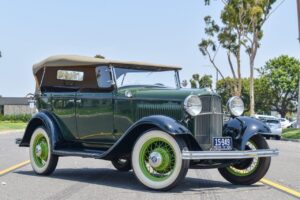
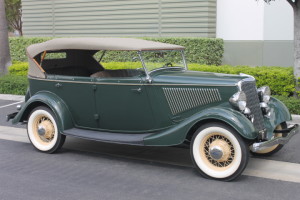
On this site's own pool the shape of the market is visible in miniature: three cars recorded, spanning 1932, 1934, and 1936 — one four-cylinder-era survivor and two V-8s, all three through dealers. Only one of the three carries a written photo examination in our records, and that examination records no rust, smoke, leaks, or damage — a sample of one, which tells you nothing statistical, but it underlines the real point: with so few cars, you buy the individual, never the average. This guide works through the four-cylinder and V-8 generations in turn, then the rust, wood, mechanical-brake, and overheating problems that actually decide what a given car is worth, and finishes with a twelve-step inspection you can run in a seller's driveway.

The models
Ford sold the phaeton across three chassis generations, and the generations matter more than the calendar years. Learn to place a car in its generation at a glance, because almost nothing — engine parts, brake parts, body wood, top hardware — is interchangeable in the way sellers casually assume.
The first generation is the Model A Phaeton of 1928–31. The Model A is a conventional, well-built car: a 200.5 cu in (3.3-litre) side-valve four of 40 hp, a three-speed sliding-gear manual gearbox, torque-tube drive, transverse leaf springs front and rear, and rod-operated mechanical brakes on all four wheels. Ford offered the phaeton in standard and, from 1930, Deluxe trim — the Deluxe (body 180-A in 1930–31) adding cowl lamps, fancier upholstery, and a choice of colours against the standard car's plainer specification. Model A production in total ran into the millions, and phaetons were a healthy slice of early output before closed cars took over; even so, a genuine Model A phaeton is a much rarer sight today than the tudors that survive in droves. The Model A phaeton is the gentlest of these cars to own: the slowest, the simplest, and the best supported by reproduction parts anywhere in the pre-war Ford world.
The second generation is the 1932 car — a single model year that carries two engines and a great deal of confusion. For 1932 Ford launched the Model B, an improved four-cylinder car, and alongside it the Model 18, the first mass-produced V-8 Ford, with the new 221 cu in flathead V-8 of 65 hp. Both wore the same new body range on the same 106-inch wheelbase chassis, and both were offered as phaetons, in standard and Deluxe trim. A 1932 phaeton with the four (a Model B car) and one with the V-8 (a Model 18 car) look near-identical across a show field; the V-8 car carries the famous V-8 emblem on the headlamp bar, and the engine number stamped on the chassis tells the truth regardless of badges. The 1932 V-8 phaeton is the blue-chip car in this guide — the first year of the flathead, the last year of the upright, separate-fendered styling — and it is also the car most often faked, re-engined, or misdescribed. Treat every 1932 claim as unproven until you have read the chassis number and the engine.
The third generation is the streamlined V-8 car of 1933–36. For 1933 (Model 40) the wheelbase grew to 112 inches, the bodywork swooped, a new X-member chassis arrived, and the flathead gained power — 75 hp for 1933, then 85 hp from 1934 (Model 40A) with a better carburettor and higher compression. The four-cylinder engine lingered into 1933–34 in tiny numbers as the Model B/C, but the overwhelming majority of 1933–36 phaetons are V-8s, and a four-cylinder car of these years should be examined very carefully for originality before you pay a rarity premium for it. The 1935 Model 48 brought a narrower grille, revised suspension geometry with the front spring moved ahead of the axle, and hydraulic shock absorbers in place of the earlier Houdaille lever-action units on later cars; the 1936 Model 68 refined the grille into the tall, narrow form you see in this guide's photographs and was the phaeton's final year. Through this whole generation the phaeton sat in the Deluxe line, sold in the low thousands per year at best — by the mid-1930s a phaeton was a deliberate anachronism, and Ford's own convertible sedan outsold it as the open four-door of choice.
Two naming traps catch buyers out. First, "Phaeton" on a title or an advert tells you nothing about the engine: always ask, and verify, whether the car is a four or a V-8. Second, Ford also built a two-door open car, the Roadster, and a closed-window open car, the Convertible Sedan; neither is a phaeton, and a roadster with rear seats added or a convertible sedan with its window frames removed is not made a phaeton by the seller's description. Count the doors, look for side-curtain fasteners on the door tops, and check for the complete absence of window regulators and glass channels — a true phaeton never had them.
| Model | Years | Engine | Output | Built | Character |
|---|---|---|---|---|---|
| Model A Phaeton (Std & Deluxe 180-A) | 1928–31 | 200.5 cu in side-valve four | 40 hp | Large early share of Model A output; survivors now uncommon | The gentle starter classic: simple, slow, superbly supported |
| Model B Phaeton (four) | 1932 (four continued 1933–34 in tiny numbers) | 200.5 cu in side-valve four, improved | 50 hp | Low thousands across the run | The connoisseur's oddity — smoother than an A, rarer than the V-8, worth no more |
| Model 18 Phaeton (V-8) | 1932 | 221 cu in flathead V-8 | 65 hp | Low thousands, Std & Deluxe combined | The blue-chip: first flathead year, last upright styling |
| Model 40 / 40A Phaeton | 1933–34 | 221 cu in flathead V-8 | 75 hp (1933), 85 hp (1934) | Low thousands per year | Streamlined, faster, still on mechanical brakes and a 6-volt system |
| Model 48 / 68 Phaeton | 1935–36 | 221 cu in flathead V-8 | 85 hp | Low thousands per year; 1936 the final year | The most developed phaeton — and the last; convertible sedan had replaced it in buyers' hearts |
A note on the "Built" column: Ford's surviving body-style tallies for the phaeton are quoted differently by different marque references, and the honest summary for every post-1931 phaeton is "low thousands per year, falling" — anyone who quotes you an exact production figure to justify a price should be asked for the source, and the car's value argued from its condition and originality instead.
Engines and gearboxes
The four-cylinder: Model A and Model B
The four that powers the Model A and Model B phaetons is one basic engine: a 200.5 cu in (3.3-litre) side-valve (L-head) four with a three-bearing crankshaft, cast-iron block and head, and a Zenith updraught carburettor. In Model A form it makes 40 hp at low revs with the flat, chuffing torque that defines the car's character — it will pull from walking pace in top gear and cruise honestly at 40–45 mph, and asking more of it is asking the wrong car. The design is agricultural in the best sense: babbitt main and big-end bearings poured directly into the block and rods, splash-and-gravity lubrication assisted by an oil pump that feeds the valve chamber and lets oil run down to the bearings, a fibre timing gear driven off the crankshaft, and a cooling system that works by thermosyphon assistance from a big four-blade fan and a generous radiator — there is no water pump doing the real work in the way a modern engine has one; the Model A pump is a small impeller in the head outlet, and circulation is largely thermal.
What wears, and how you tell: babbitt bearings knock when they wear, and the knock has a rhythm you can isolate. A main-bearing knock is a deep thud under load that softens when you lift off; a big-end knock is lighter, sharper, and loudest on the overrun. Shorting out one spark plug at a time with an insulated screwdriver at idle changes the note cylinder by cylinder — the cylinder whose knock disappears when shorted is the worn big end. Oil pressure tells you little because the system barely has any to measure; instead, judge a four by its sounds, its oil consumption, and whether the oil that drains out carries the grey glitter of babbitt. A rebuild with re-poured babbitt is specialist work — budget $2,500–4,500 for a properly rebuilt four-cylinder short engine from a marque specialist, more if the crank needs grinding and the block needs line-boring. The fibre timing gear strips its teeth without warning at age, leaving the engine to stop dead with no spark and no compression faults anywhere else; if a four cranks with spark at the coil wire but nothing timed at the plugs, suspect the gear before the distributor. Replacements are cheap; carry one.
The Model B improvements — and the myth of the "B" engine
For 1932 Ford revised the four into the Model B engine: output up to 50 hp through a higher compression ratio and better breathing, a diaphragm fuel pump replacing the Model A's gravity feed from the cowl tank, centrifugal spark advance added to the distributor, a counterweighted crankshaft on later production, and improved main-bearing oiling with pressurised feed to the mains. It is a noticeably smoother, more willing engine than the A unit, and the cars are nicer to drive. The myth to correct is that a Model B phaeton is somehow a lesser 1932 than the V-8 and should be priced as a failed V-8 car. It is a different car with its own following; the four is lighter over the front axle, simpler to keep, and cheaper to rebuild. What it is not is interchangeable: B engines carry their own distributor, fuel pump, and manifolds, and a seller who tells you "all four-cylinder Ford parts are the same" is telling you he has never ordered any. The B engine's pressurised mains also change diagnosis — a B with genuinely low oil pressure on a test gauge teed into the gallery is telling you about bearing wear in a way an A never can, so on a B, do take the reading.
The flathead V-8: 1932–36
The engine that makes the later phaetons interesting is the 221 cu in (3.6-litre) flathead V-8 — Henry Ford's 1932 gamble, a one-piece V-8 block casting with the crankcase, produced at a price no rival could match. It is a side-valve design: the valves sit in the block beside the cylinders, the heads are simple flat slabs (hence "flathead"), and the exhaust passages run through the water jacket inside the block to exit low on the sides — a layout that makes the engine compact and quiet and also bakes its centre exhaust ports in their own heat for its entire life. Output runs 65 hp for 1932, 75 hp for 1933, and 85 hp from 1934 on, the gains coming from compression, carburation, and ignition detail rather than any change of architecture. The 1932–36 engines are the "21-stud" family — count the head studs or nuts: 21 per head. The later 24-stud engine (from late 1938) is a different unit with different heads, water pumps, and interchangeability, and a 24-stud engine in a 1936 car is a replacement, not an upgrade to pay extra for, whatever the seller says.
Detail changes matter when you order parts and when you judge originality. The 1932 engine uses a Detroit Lubricator carburettor and a distinctive early intake; 1933 kept the Detroit unit; from 1934 the Stromberg 48 twin-choke downdraught carburettor became standard and is the carburettor most surviving cars wear, with Chandler-Groves (later Holley/Ford 94-type) units appearing as period service replacements. The distributor sits at the front of the engine, driven off the nose of the camshaft, and carries twin contact-breaker points with a vacuum-brake piston that retards the spark under load — an elegant device that, when its piston seizes or its diaphragm perishes, gives you a flat spot and pinking that owners misdiagnose as carburettor trouble for years. The coil sits on top of the distributor under a bakelite cap on early cars. Water pumps on 1932–36 engines mount at the front of each cylinder head and double as the engine's front mountings' neighbours — they push coolant into the block; the later practice of block-mounted pumps belongs to newer engines. The fuel pump stands on the rear of the intake manifold, driven by a long pushrod from the camshaft, sitting directly in the hottest air in the engine bay — remember that location when we reach vapour lock in the problem areas.
Running a flathead: what healthy looks and sounds like
A healthy early flathead starts readily on its 6-volt starter, idles with a soft, uneven lope, and pulls cleanly to a cruise of 50–55 mph in a phaeton — the open body is light, and a good 85 hp car feels genuinely brisk by pre-war standards. It runs hot by modern gauge standards and the temperature gauge (a motometer on the radiator cap of many cars, a dash gauge on later ones) should stabilise rather than climb relentlessly. Oil pressure on a warm engine should hold a steady mid-gauge reading at cruise and may fall low at idle without indicating failure — the flathead's bearing clearances and pump capacity make idle pressure a poor health test on its own. Judge instead by bearing noise under load, smoke, and consumption. Blue smoke on the overrun after a long descent points to valve guides and piston rings worn together; smoke under hard acceleration is rings. The flathead's valves are adjusted by grinding valve stems or fitting adjustable lifters — there are no accessible tappet screws on a stock early engine — so a seller who claims the "tappets were adjusted last month" on a standard engine is either describing lifter work or inventing history; ask which.
The single most feared flathead fault is the cracked block: hairline cracks running from an exhaust valve seat toward the cylinder bore, or between the seat and the water jacket, caused by decades of heat cycling in exactly the area where the exhaust passage bakes the casting. A crack into the bore or jacket may show as a cylinder that misfires when hot, coolant loss with no visible leak, exhaust gas bubbling in the radiator header tank, or a plug that steam-cleans itself whiter than its neighbours. Many cracks are stable and lived-with for decades; some are terminal. There is no cheap test that settles it in a driveway beyond a long hot run, a cooling-system pressure test, and a plug inspection — which is why the inspection section insists on all three. A crack-free original block is a genuine asset; price a car with a known cracked block as a car that needs an engine, because one day it will.
Gearboxes and the driveline
Every phaeton in this guide uses Ford's three-speed manual gearbox: sliding-mesh, non-synchromesh except for synchromesh on second and top on V-8 cars from 1932 onward (the Model A box has no synchromesh at all, and Model A drivers double-declutch as a matter of rhythm). The lever works in a conventional H gate with reverse to the left and back on most cars. Behind the gearbox, Ford's torque tube encloses the propeller shaft: the tube bolts to the rear axle and to a ball joint at the back of the gearbox, locating the axle, taking the drive thrust, and making the whole rear assembly a single rigid structure sprung by one transverse leaf spring. The rear axle itself is a banjo-type housing with spiral-bevel final drive on later cars (straight bevel on Model A), axle shafts that carry the car's weight on their outer bearings (a semi-floating design on the V-8 cars; the Model A arrangement differs in detail), and a pinion supported from the torque tube.
Gearbox wear shows as jumping out of second gear on the overrun — the classic Ford symptom, caused by worn synchromesh cones, tired detents, and end-float in the cluster — and as a whine in the indirect gears that quiets in top, where drive is direct. A box that jumps out of top is worse news than one that jumps out of second; both are rebuildable, and a gearbox rebuild by a specialist runs roughly $900–1,800 in parts and labour before the torque tube and axle work that usually accompanies it. Clutches are single dry plate, mechanically operated: a pedal that takes up at the very top of its travel with slip under load in top gear means a worn plate, and on a torque-tube car the clutch job means separating the rear assembly or pulling the engine — either way it is a day's work in a equipped shop, $800–1,500 fitted, not a Saturday-morning job. Learn to test the clutch properly on the inspection drive, because its replacement cost hides inside the driveline's architecture.
The driveline's other wear point is the torque tube's centre bearing and the universal joint at its front, enclosed in the ball housing at the gearbox. A clonk on taking up drive, felt through the seat rather than heard, is usually UJ or centre-bearing wear or loose axle-shaft keys at the rear hubs — and loose hub keys, left alone, wallow out the keyways in hub and shaft until both need replacement. Any rhythmic vibration that arrives with road speed and disappears when you declutch at that speed lives in this assembly; walk away from a seller who calls it "character."
Problem areas
Rust and the wooden skeleton
Every other problem in this section is negotiable. This one is not, because a phaeton's body is not an all-steel shell. Ford built these open bodies the coachbuilt way: steel panels nailed and screwed over a hardwood frame — ash and oak framing, wooden floorboards and body sills (subrails), wooden tacking strips everywhere the upholstery and top material attach. The steel you see is, structurally, a skin. The shape of the car — the door gaps, the alignment of the cowl with the rear body, the fit of the top irons — is held by wood that has spent up to ninety years getting wet every time the car was caught in rain, washed carelessly, or stored under a leaking roof. When you inspect a phaeton, you are inspecting a piece of furniture wearing a steel coat.
Rot starts where water sits: the bottoms of the door frames, the body sills under the doors, the cowl posts, the rear body corners where the top folds down and traps moisture against the frame, and the floor structure under the front and rear seats. The test is physical. Open each door and lift it gently by its rear edge: a sound door rises as one piece with the body; a rotten one flexes, creaks, and shows movement at the hinges because the frame inside it has gone soft. Push a bradawl or a small screwdriver — with the seller's permission, and if he refuses, ask yourself why — into the exposed wood at the door bottoms, the sill ends visible under the running boards, and the rear corners inside the top well. Sound hardwood resists and squeaks; rot takes the point like cake. Door gaps are your map: gaps that are wide at the top and pinched at the bottom, or doors that must be lifted to latch, mean the body has sagged on soft sills. Rebuilding a phaeton's wood is the single most expensive common job on the car: a proper re-wooding of the body frame by a specialist, before any paint, runs $5,000–12,000 depending on how much must be replicated, and it is skilled coachbuilding work with a short list of people who do it well. A car that needs it is a project priced as a project, whatever its paint looks like.
The steel rusts in its own predictable places, and on a phaeton the list is longer than on a closed car because the interior has been rained into for decades. Floors first: lift every carpet and mat — a seller who has glued the mats down has told you what is under them — and check the steel floor pans and the wooden boards around the seat risers, the toe boards, and the area under the rear seat where the top well drains. Subframe and chassis: the frame rails themselves are heavy and usually sound, but check the crossmembers under the body, the running-board brackets, and the rear spring's crossmember, which traps mud. Fenders crack and rust at their beads and where the running boards bolt on; rear fenders bubble over the wheel arch where the body joint traps water. The cowl rusts at its feet and around the fuel tank on Model A cars, where the tank is the cowl — a Model A with a rusted tank-to-cowl seam leaks petrol into the cockpit, which is as serious as it sounds, and the correct repair is tank removal and proper metalwork, not sealer. Budget $1,000–2,500 per side for sill and lower-body welding on a steel section, and treat any car with fresh underseal over everything underneath as a car whose underside you have not seen.
A phaeton-specific trap: because the body is rare, some cars wear bodies that began life as something else — a cut-down sedan, a roadster body with rear doors grafted, or a reproduction body on an original chassis. Reproduction phaeton bodies exist and a declared one, well built, is a legitimate car at a lower price. An undeclared one is a misdescription. Look for factory body-number stampings, correct side-curtain fasteners along the door tops, original-style wood joints and fasteners, and the general grain of age: ninety-year-old wood that has survived looks different from ten-year-old wood, and a magnet, a torch, and patience will tell you more than the paperwork.
Brakes, steering, and suspension: the mechanical car
No phaeton in this guide has hydraulic brakes. Ford stayed with mechanical brakes — steel rods (and on the very last cars of the era, cables) pulling expanding shoes inside the drums — through 1938, and every car covered here stops by linkage and leverage alone. This is not a defect to apologise for; a correctly set-up mechanical system stops a light phaeton adequately and with good feel. It is, however, a system whose performance depends entirely on adjustment and wear state, and a badly kept one is genuinely dangerous. Worn clevis pins and elongated holes in the rods add lost motion at every joint; the cross-shaft bushes wear oval; the brake rods stretch and their adjusters seize. The result is a pedal that travels most of the way to the floor before anything happens, and then pulls to one side as the best-adjusted wheel does the work.
The tests are simple and non-negotiable. Pedal travel: with the car stationary, press the pedal firmly — you should meet solid resistance with travel to spare before the floor. Pull-up test: on a quiet road at 25 mph, brake firmly with a light grip on the wheel; the car must track straight. Any pull means one side is doing more than the other, and on mechanical brakes that is adjustment, oval drums, oil-soaked linings, or worn linkage — find out which before money moves, because a full mechanical brake overhaul with drums skimmed or replaced, new linings, and every pin and bush renewed runs $1,200–2,500 and a weekend of careful adjustment afterwards. The handbrake works on the rear wheels (on Model A cars, separate emergency bands or the same shoes depending on year) and must hold the car on a slope; a handbrake that pulls to the top of its ratchet and still creeps is telling you the rear brakes are as tired as the fronts.
Steering is by worm-and-sector (Model A: worm and two-tooth sector; V-8 cars: worm and roller on later production) in a box mounted on the frame rail, working through a drag link to the left front wheel with a tie rod across. Wear shows as free play at the wheel rim — more than about two inches of rim movement before the road wheels stir is too much — and as wander that no alignment cures. The box itself adjusts to a point; beyond it, a rebuilt box or a good used one is the fix, $400–900 exchanged. Kingpins and their bushes wear on all these cars because they are greased by hand and were often not: jack each front wheel under the axle, grip the wheel top and bottom, and rock — movement with a metallic clunk is kingpin wear; movement without the clunk, felt also side-to-side, points to wheel bearings. A kingpin and bush job, reamed in place, is $500–1,000 per side at a shop. The transverse leaf springs sag and their shackles wear sideways; a car that sits visibly low at one corner or whose spring leaves are fanned and rusty between the leaves needs spring work, and the rear spring on a torque-tube car is a bigger job than it looks because the axle assembly hangs from it. Lever-action Houdaille shock absorbers (rotary vane type) on pre-1935 cars leak and go slack; rebuilt exchange units are available at $200–350 a corner, and a car bouncing unchecked on its springs after a firm push on each fender needs them.
Heat, fuel, and the flathead's temper
Overheating is the flathead V-8's defining anxiety, and it is worth understanding properly, because most overheating early flatheads are not broken — they are dirty. The cooling system holds a large volume of water in a block whose internal passages fur up with rust scale and sediment over decades, especially around the rear cylinders and the exhaust-seat areas where heat is greatest. The radiator cores silt from the bottom up. The head-mounted water pumps wear their impellers and leak from their seals into the front of the engine. The result is a car that runs at a stable temperature at 40 mph and climbs relentlessly in traffic or on a long grade. Diagnosis before parts: an infrared thermometer across the radiator core finds the cold, blocked tubes (a healthy core shows a smooth temperature gradient); a car that boils after shutdown is usually running retarded timing or a weak mixture rather than suffering a cooling fault at all — heat soak after switch-off raises temperatures in any flathead, and brief after-boil on a very hot day with a marginal system is a symptom to investigate, not a verdict. A full cooling-system restoration — radiator re-core ($600–1,100), pumps rebuilt ($150–250 each), block and heads hot-tanked and the passages rodded out during any engine work — cures most cars. The four-cylinder cars overheat more simply: a scaled radiator, a slipping fan belt, a perished head gasket, or timing adrift, and the Model A's thermosyphon circulation punishes a half-blocked radiator quickly.
Vapour lock is the flathead's other hot-day trick, and the mechanism is in the layout you read earlier: the fuel pump sits on top of the intake manifold at the back of the engine, fed by a pushrod, in the hottest, stillest air under the bonnet. On a hot restart or a slow climb, the fuel in the pump and line boils, the pump pumps vapour, and the engine starves and dies — then restarts happily twenty minutes later when everything cools. Owners chase it through carburettors and coils for years. The driveway test is circumstance, not equipment: a car that dies hot and restarts cold, repeatedly, with a full tank and a clean filter, is vapour-locking until proven otherwise. Period cures — an electric auxiliary pump back at the tank, insulating the line, a phenolic spacer — all work to a degree; budget $150–400 for an electric pump conversion done neatly, and regard a car already fitted with one as a car whose owner understood the problem, not as a bodge.
The Stromberg 48 and its Chandler-Groves alternative wear their throttle spindles and leak air, giving an idle that will not settle and a flat spot just off idle that no mixture adjustment cures; the test is to spray a little carburettor cleaner at the spindle ends on a running engine and listen for the idle change that confirms the leak. Rebuilt carburettors exchange at $300–500. The four-cylinder Zenith is simpler and hardier; its classic faults are a sticking float needle with modern fuel, a perished cork float seal, and dirt — a Zenith that floods after standing usually needs its float level and needle seen to, a $30 parts job, before it needs replacing.
Electrics, the top, and the trim
All these cars are 6-volt, positive-earth (positive ground), with a three-brush or two-brush generator and a cut-out or voltage regulator depending on year. Six volts is not a problem in itself — a healthy 6-volt system with clean, heavy cables starts a flathead eagerly — but it is unforgiving of resistance: every corroded earth strap and thin modern replacement cable steals cranking speed, and a slow-cranking flathead is very often a cable problem wearing the disguise of a starter or battery problem. Test by voltage drop: crank the engine with a voltmeter across each cable run in turn; more than about 0.3 volts lost in any single run is the fault found. Starter motors and generators rebuild at $200–400 each. The early flathead's distributor-mounted coil and twin-point distributor need their vacuum-brake piston free and their points correctly synchronised — a specialist job with a distributor machine, $250–450 for a full distributor rebuild, and money well spent on any car that pinks, hesitates, or eats points. Model A ignition is simpler still, and its classic failure is the armoured cable and condenser, both cheap.
The top and side curtains are where phaeton ownership gets expensive in small, irritating ways. A full new top, fitted, with correct material and a rear window, runs $1,500–3,000 from a trimmer who knows pre-war work; a full set of side curtains, made to pattern with fasteners, $800–1,800 — and patterns for a phaeton are body-specific, so a car missing its curtains entirely is a car that needs a trimmer's skill, not a catalogue order. Check that the top irons (the folding frame) are complete, unbent, and fold without forcing: bent irons mean the top was forced against a seized joint at some point, and straightening them is blacksmith work. The irons' wood bows rot at their ends. Windscreens fold or open on many of these cars; seized windscreen frames and cracked glass are small bills ($150–400) that signal big neglect. Inside, upholstery in leather or leathercloth over horsehair and springs: seat springs collapse at the driver's cushion first, and a full retrim in correct materials is $3,000–6,000 — which is why a car with a sound, original, honestly worn interior is worth more than a car with a shiny new wrong one.
Finally, the myth that closes this section: "it's a simple car, so condition doesn't matter — everything is cheap to fix." Everything on a phaeton is available, and almost nothing on a phaeton is cheap once wood, paint, trim, and a flathead rebuild are stacked together. Simple is not the same as inexpensive. The problem areas above are the difference between a car you drive home and a car you restore at home, and the inspection that follows is how you tell them apart.

How to inspect one
Take a torch, a small magnet wrapped in cloth, a bradawl, an infrared thermometer if you have one, a tyre-pressure gauge, and a friend. Allow ninety minutes. Do not inspect a phaeton warm and ready in the driveway — insist on a cold start, and say so when you make the appointment, because half the faults in the problem-areas section only speak when the car is cold, and a seller who has pre-warmed the car has answered your first question already.
- Paperwork and identity first. Match the chassis number — stamped on the top of the left frame rail near the steering box on V-8 cars, and on the engine and frame on Model A/B cars — to the title. On a 1932, decide now whether the car is a Model B four or a Model 18 V-8 and whether the engine number agrees; the V-8 emblem on the headlamp bar is decoration, the stampings are identity. Note the body style on the paperwork: if it does not say phaeton or touring, ask why.
- The wood test, before anything else. Work through the door-lift and bradawl checks from the rust-and-wood section: each door lifted at its rear edge, the point pressed into door bottoms, sill ends, cowl posts, and the rear corners inside the top well. Read the door gaps as you go. If the wood fails, stop pricing the car as a driver — everything after this step is valuing a project.
- Panels and floors. Magnet across the fenders, cowl, and door skins for filler; torch along the floor pans, toe boards, and under the rear seat with every mat lifted. Check the Model A fuel-tank cowl seam for staining or smell. Crouch behind the car and sight along both sides: ripples in a phaeton's long, flat door skins show every repair.
- Top, irons, and curtains. Raise and lower the top yourself, twice. It should fold without force and sit level. Inventory the side curtains — all of them, with fasteners — and the rear curtain and its window. Price anything missing using the figures in the problem-areas section, and check the top well and rear corners again now that you can see into them.
- Cold start. With the engine stone cold, watch and listen. A four should start on the choke with a few turns; a flathead should catch readily on 6 volts — laboured cranking sends you to the cable voltage-drop test from the electrics section. Note the exhaust: a puff of blue that clears is guides and age; continuous smoke is the problem-areas diagnosis, and white vapour that persists after warm-up, with a sweet smell, is coolant until proven otherwise.
- Engine, stationary. Listen for the four-cylinder's bearing knocks, using the plug-shorting test if you hear one. On a flathead, listen for the soft ticking of a valve that has lost its clearance and look at all eight plugs if the seller allows — one steam-cleaned white plug among seven sooty ones points at the cracked-block test in step 9. Check oil for grey babbitt glitter on a four, and coolant for oil sheen or rust sludge on both.
- Clutch and gearbox, stationary then moving. Pedal free play first, then, on the move, load the clutch in top gear at low speed: revs that flare without road speed mean slip, and the torque-tube architecture makes that a workshop bill, not an adjustment. Work through the gears listening for the indirect-gear whine and, above all, lift off repeatedly in second and top — the box that jumps out under you is the box from the gearbox section, priced accordingly.
- The brake test. Pedal travel and firmness stationary, then the 25 mph pull-up test on a quiet, straight road, hands light on the wheel. Any pull, any pedal that creeps toward the floor, any handbrake that will not hold on a slope: the car needs the full mechanical overhaul budgeted in the problem areas, and you should not drive it further than the test requires until it has had it.
- The hot run. Drive at least twenty minutes, including a sustained climb or a fast road stretch, and watch temperature behaviour the whole way. A flathead that climbs steadily in traffic or on the grade has the scaled-block or silted-radiator problem; check the radiator core with the infrared thermometer when you stop, feeling for the cold patches of blocked tubes. After shutdown, watch for after-boil, then check the header tank for bubbles or oil, and re-inspect the plugs if anything smelled or looked wrong. This step, and no other, settles the cooling system and gives the cracked block its chance to confess.
- Steering and front axle. On the move, note wander and shimmy; stationary, have your friend rock the steering wheel while you watch the drag link and tie-rod ends for lost motion, then jack each front wheel and rock it top-and-bottom for the kingpin clunk from the suspension section. Measure steering free play at the rim: over two inches is a negotiation point with the steering-box figures behind it.
- Hot restart and vapour lock. After the hot run and a ten-minute heat soak, restart. A flathead that cranks and will not fire, or fires and starves, and then starts cheerfully after twenty minutes' cooling, has demonstrated vapour lock in front of you — common, curable, and a legitimate price chip using the electric-pump figure. Check for fuel smells around the manifold-mounted pump and its lines while everything is hot.
- The underside and the walk-away sums. On ramps or a lift if you can, torch the frame rails, crossmembers, torque tube, spring shackles, and shock absorbers; look for the clonk sources — worn UJ, loose rear hub keys — and for fresh underseal hiding fresh secrets. Then sit down with the numbers from this guide: wood, brakes, cooling, top and curtains, clutch. A phaeton that passes steps 2, 8, and 9 cleanly is a car you can buy with your eyes open. A car that fails any one of them is a restoration with a price that must say so.
Values
The phaeton market is thin, and thin markets lie to you in both directions. With only a handful of cars offered in any year — our own pool holds three, one currently for sale and two recorded sold — there is no meaningful "average price" for a Ford Phaeton, and any guide or advert that quotes you a tidy figure for the model is averaging cars that have almost nothing in common. Read the market instead as a ladder of condition and originality, and place the car in front of you on the right rung before you talk about money at all.
The condition spread on a phaeton is wider than on almost any other pre-war Ford, and the wooden body is the reason. At the top sit the genuinely original or correctly restored V-8 cars — sound wood, correct engine, complete top and curtains, documented history — and these sell to buyers who have usually been looking for a year or more and know exactly how few exist. At the bottom sit the projects: cars with rotten sills, missing curtains, tired engines, and shiny paint, and the gap between the two is not a percentage, it is a multiple, because the distance between them is measured in coachbuilding, trimming, and engine-shop invoices rather than in detailing hours. The project-versus-driver gap is the defining feature of this market: a running, driving, wood-sound phaeton is worth far more than a non-runner plus the apparent cost of making it run, because the non-runner's true costs are hidden inside its doors and under its floors until the trim comes off.
Variant premiums are real but narrower than sellers claim. The 1932 V-8 car carries the strongest premium — first flathead year, last upright styling, genuine historical significance — and a correct Model 18 phaeton will always find its buyer. The 1932 four-cylinder car does not share that premium and should not be priced as if it nearly does; it is a fine car valued as a Model B, not as a discounted V-8. Among the streamlined cars, the 1934 and 1936 models attract the most interest — the 1934 for its grille and its 85 hp engine's arrival, the 1936 as the last phaeton Ford built — but the premium buys correctness: a 1936 car with a later 24-stud engine, hydraulic brakes retrofitted, or a reproduction body declared late in the conversation loses the premium it was advertised with. Model A phaetons trade in the broad, well-populated Model A market, where Deluxe trim and originality help, but supply keeps a lid on enthusiasm.
Asking prices and achieved prices part company most widely at the project end. Sellers price projects by adding what they spent to what they paid; the market prices them by subtracting what the next owner must spend, with a risk margin for the wood nobody has seen yet. Expect long selling times for phaetons at any level — this is a car a buyer chooses deliberately, not an impulse purchase — and treat time on the market as information, not as a defect in the car. When you negotiate, negotiate from the inspection: itemised, costed findings from the problem areas in this guide move a phaeton's price; general remarks about rarity do not. The computed market block beneath this guide, built from this site's own listings and recorded sales, gives you the current numbers — read them against the ladder above, and weight the recorded sales of genuinely comparable cars (same generation, same engine, same honesty of description) far above any asking price.
Parts and ownership
Ownership of a phaeton divides neatly into the easy 90 percent and the phaeton-specific 10 percent, and your life will be arranged by the second figure. The mechanical car underneath — Model A, Model B, or flathead V-8 — sits inside the best-supported pre-war ecosystem in the world. The Model A and early V-8 Ford hobby has multiple national clubs (the Model A Ford Club of America and the Early Ford V-8 Club of America chief among them), marque specialists on both coasts and in between, and reproduction parts catalogues that run from engine bearings and brake linings to complete wiring looms, gaskets, water pumps, and carburettor kits. Mechanical consumables — points, plugs, linings, hoses, fan belts, kingpin kits, spring shackles — are order-by-phone items at ordinary classic-car prices, and the accumulated knowledge base is enormous: there is no fault your car can develop that a club forum has not diagnosed, photographed, and argued about already.
The phaeton-specific 10 percent is coachwork. Body wood, top irons, side curtains, windscreen frames, and the small bright fittings unique to the open four-door body are not catalogue items. Wood kits exist for the more popular years from specialist suppliers and can cut the cost of a re-wooding substantially, but fitting them remains coachbuilder work. Side curtains are made to pattern by trimmers; top irons are repaired by the few shops that still straighten and re-bush them. None of this is impossible and none of it is quick — plan trim and wood work in seasons, not weekends, and join the clubs early, because the used-parts network for phaeton-specific pieces runs through club classifieds and swap meets (Hershey above all) rather than dealers' shelves.
Running one is straightforward and slightly ceremonial. These are hand-maintained cars: grease points that want a gun every few hundred miles in regular use (kingpins, shackles, brake linkage, torque-tube and UJ points), mechanical brakes whose adjustment belongs in your season-opening ritual rather than when the pedal feels long, and coolant changed and flushed rather than topped up forever. Fuel is modern petrol through ninety-year-old carburettors: expect ethanol-related perishing of cork and rubber parts, keep the tank full over winter, and use the car — a phaeton driven monthly gives a fraction of the trouble of one admired quarterly. Storage matters more than for a closed car: dry, ventilated, never damp under a plastic sheet, because the wood and top material are the car's structure and its most expensive consumables at once. Insure it on an agreed-value classic policy, and record the chassis and engine numbers somewhere other than the car.
Which one to buy
- The all-rounder: a 1934–36 V-8 phaeton with sound wood and a documented engine. The 85 hp flathead, the most developed chassis of the run, and the streamlined looks — buy the best example you can find and drive it everywhere a pre-war car can go.
- The blue-chip: a correct 1932 Model 18 (V-8) phaeton. First year of the flathead, last year of the upright styling, the strongest following and the firmest values — but only with chassis and engine numbers that prove it is what it claims to be.
- The value buy: a 1932 Model B four-cylinder phaeton. The same landmark styling, a smoother engine than the Model A, a fraction of the V-8 car's price — priced as a Model B, it is the cheapest way into a genuine 1932 open Ford.
- The starter classic: a Model A Deluxe phaeton. The gentlest ownership proposition here — the deepest parts support, the simplest mechanics, and an interior and top you can retrim without coachbuilder money — provided the wood and the cowl tank pass inspection.
- The project, knowingly: any phaeton with rotten wood at a project price. Worth doing exactly once in a life, with a coachbuilder booked and the arithmetic from the problem-areas section done before the deposit, not after.
The overriding rule: on a phaeton, buy the wood and the numbers, and let everything else be negotiable — sound body framing and a correct, matching identity are the two things money cannot easily add later, and a shiny car that fails either test is the most expensive phaeton you will ever own.
See the 1 Phaeton cars currently listed.
For sale now
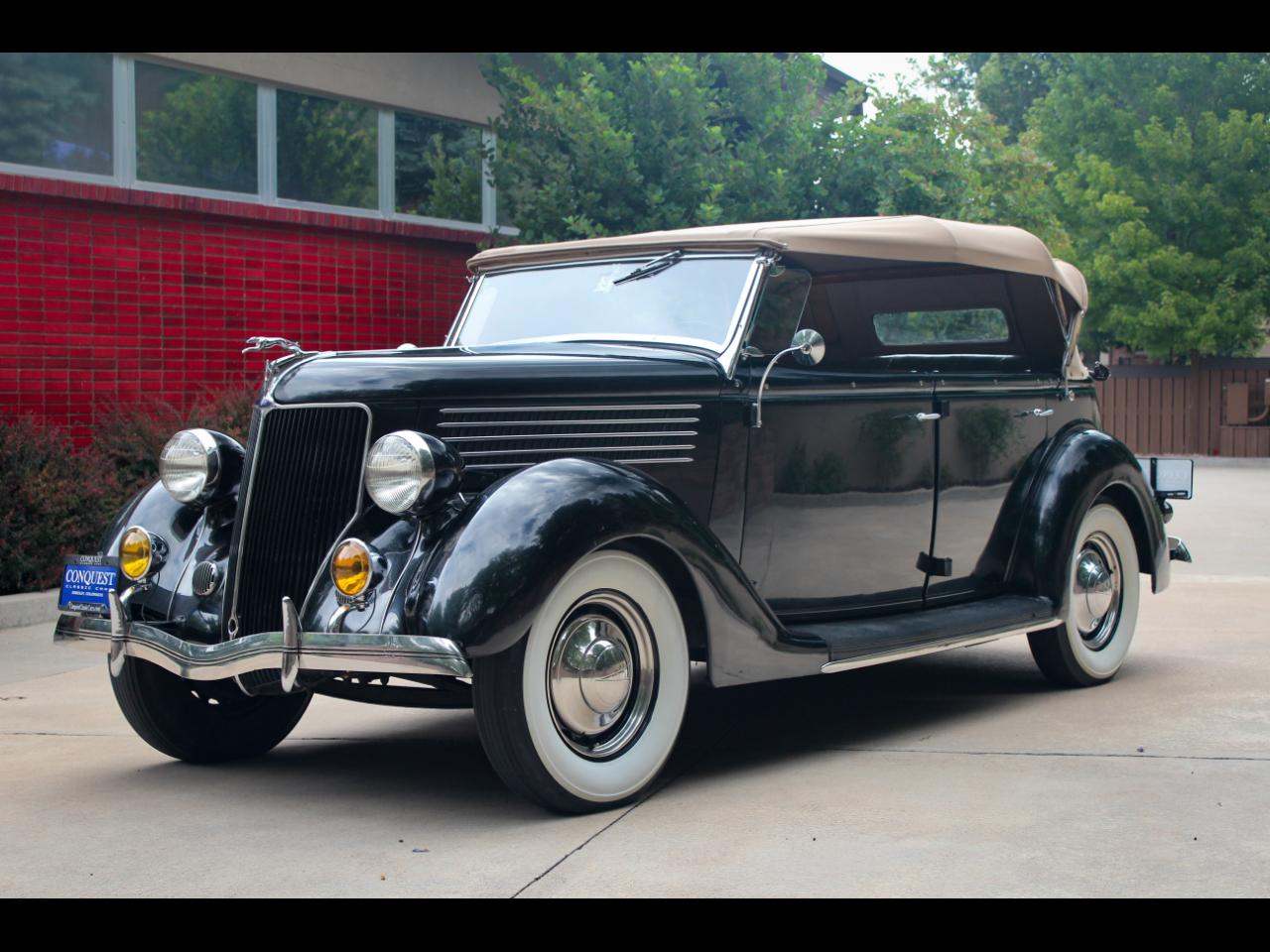 $24,950 · In line with typical
Expand
What they sell for: Phaeton sale prices.