
Ford Tudor Sedan buyer's guide
Ford Tudor Sedan -- the model's own buyer's guide: variants, values and what to check.
Years listed: 1937-1940 · Series: Full Size
Overview and history
Start with the name, because the name is the first thing sellers get vague about and the first thing you should pin down. Tudor is not a model. It is Ford's old pun — Tudor for two-door, Fordor for four-door — applied to a closed two-door sedan body, and Ford used it across several generations of car. A Tudor Sedan can be a Model A of 1928–31, a V8 car of 1932–40, a wartime-era car of 1941–48, or an early shoebox Ford of 1949–51, and those cars share a silhouette and a name and almost nothing else: not an engine, not a brake system, not a parts catalogue. So the first question on any viewing is never "is it a good Tudor?" It is "which generation of Tudor is this, and how much of that generation is still in it?" Everything in this guide follows from those two questions.
The cars in the site's own pool tell you where the surviving market concentrates. The pool is small — four cars at the time this guide was prepared, three offered for sale and one recorded sold, all dealer-sourced — and every one of them is a flathead-era car: a 1934, a 1937, a 1938 and a 1940. That is not an accident of sampling. The 1932–40 V8 Tudors are the cars that survived in numbers, that the parts trade supports best, and that two different kinds of buyer — the stock-restoration buyer and the traditional hot-rod buyer — have been competing for since the 1950s. This guide therefore concentrates on the 1932–40 cars, deals with the Model A Tudor as the ancestor you will also meet in adverts, and touches the 1941–51 cars where they differ in ways that matter at a viewing.
The revolution arrived in March 1932, and it was under the bonnet, not in the body. Ford's Model B Tudor looked like a grown-up Model A, but you could order it with the new 221-cubic-inch flathead V8 — the engine that put eight cylinders into the low-price field for the first time. The four-cylinder Model B car existed alongside it and sold on price, but the V8 is the car history kept. The 1933–34 cars (the Model 40 in period parlance) wrapped that engine in the era's prettiest Ford styling: a raked, heart-shaped grille, skirted fenders and flowing lines that made the Tudor look like a scaled-down Lincoln. These are also, not coincidentally, the cars Bonnie and Clyde-era folklore attached itself to — Clyde Barrow's famous (and possibly apocryphal in its details) letter praising the Ford V8 was written about exactly this generation — and the 1933–34 Tudor has carried a glamour premium ever since.
The models
Because Tudor is a body style and not a model, the table below is organised by generation — the years and the car underneath the body — rather than by badge. Learn the generations first; trim (Standard versus DeLuxe) sits inside each generation and matters second.
| model | years | engine | output | built | character |
|---|---|---|---|---|---|
| Model A Tudor Sedan | 1928–31 | 200.5 cu in L-head four | 40 hp | very high volume — the standard closed Ford | the ancestor; simple, slow, wood-framed body |
| Model B / V8 Tudor | 1932 | 200.5 cu in four or 221 cu in flathead V8 | 50 hp (four) / 65 hp (V8) | one-year body, V8 cars the minority | the original hot-rod basis; the connoisseur's year |
| Model 40 Tudor | 1933–34 | 221 cu in flathead V8 (four-cylinder option, rare) | 75 hp (1933) / 85 hp (1934) | high volume | the glamour years; skirted fenders, heart grille |
| Models 48 / 68 Tudor | 1935–36 | 221 cu in flathead V8 | 85 hp | high volume | longer, softer, quieter; the tourer emerges |
| Model 78 / 81A Tudor (flatback and humpback) | 1937–38 | 221 cu in flathead V8 or 136 cu in V8-60 | 85 hp / 60 hp | high volume | all-steel roof; humpback gains a real trunk |
| DeLuxe / Standard Tudor | 1939–40 | 221 cu in flathead V8 (V8-60 to 1940 in Standards) | 85 hp (60 hp V8-60) | high volume | hydraulic brakes for 1939, column shift and sealed beams for 1940 |
| Super DeLuxe / DeLuxe Tudor | 1941–48 | 226 cu in L-head six or 239 cu in flathead V8 | 90 hp (six) / 100 hp (V8) | high volume, war-interrupted | bigger, heavier; the six joins the range |
| Custom / DeLuxe Tudor (shoebox) | 1949–51 | 226 cu in six or 239 cu in flathead V8 | 95–100 hp | high volume | slab-sided postwar car; independent front suspension |
1932: Model B and the first V8. One year only, and the most argued-over Tudor of all. The body is a bridge design — recognisably Model A in its upright proportions, but on a new double-drop frame with a longer, 106-inch wheelbase. The four-cylinder car (Model B, 50 hp from an improved, counterweighted version of the A engine) outsold the V8 at the showroom; the V8 car (confusingly also sold under the Model B umbrella in much period paperwork, and identified by its 18-series serial prefix) is the one the market wants. Originality is everything here and everything is checkable: the serial is stamped on the left frame rail near the steering box and should match the number on the transmission case. A "1932 V8 Tudor" with a later engine and no frame number story is a 1932 body, and should be priced as one.
1933–34: Model 40. The styling peak of the prewar Ford and the Tudor most people picture. For 1933 the wheelbase grew to 112 inches, the grille leaned back into its heart shape, fenders gained skirts, and the V8 rose to 75 hp with a new intake and the Stromberg EE-series downdraft carburettor replacing the Detroit Lubricator single-barrel of 1932. For 1934 output reached the famous 85 hp, the grille bars went more vertical, and small details — hood louvers, trim, interior — changed again. DeLuxe cars carried better trim, a choice of colours beyond black, and in some markets twin side-mounts or a rear luggage rack. These cars are also the hot-rod movement's foundation document, which cuts both ways for you: demand is permanent, and so is the proportion of cars that have been modified, de-modified, or assembled from several donors. The red 1934 car in the site's pool, photographed below, is the modern expression of that tradition.

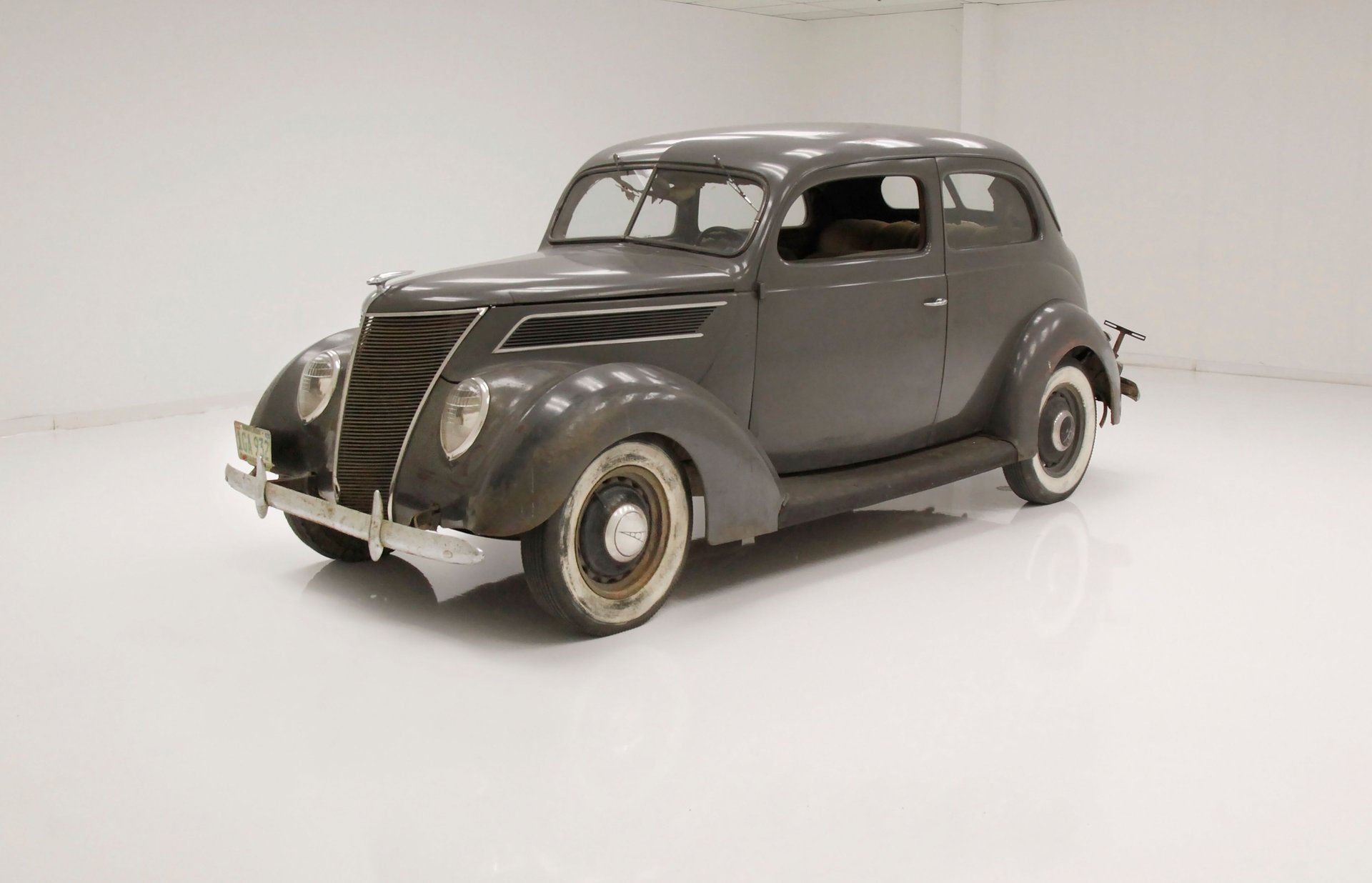
1937–38: the steel-roof cars, flatback and humpback. For 1937 Ford restyled completely: an all-steel "turret top" roof with no fabric insert, a split windscreen in a V, headlamps faired into the fenders, and the spare wheel moved inside on trunk models. Two Tudor sedans were catalogued. The standard Tudor has the sloping flatback — elegant, and with luggage space accessible only from inside, behind the rear seat. The Tudor Touring Sedan is the humpback: a swollen bustle trunk with an outside lid, less pretty in profile and vastly more useful on a tour. The site's 1937 pool car is a humpback, and its photographs below show you both the virtue and the cost — that trunk bustle and the rear fenders around it are where these cars rust and where this one's patina is honestly displayed. Underneath, 1937 brought relocated water pumps (now in the block, driven differently — the engines section explains why you care), a new Stromberg 97 carburettor specification, and the option of the V8-60, the 136-cubic-inch miniature flathead built for economy and for the European market's tax brackets. For 1938 the Standard car kept a version of the 1937 body with a new grille while the DeLuxe got its own smoother styling — a one-year split that confuses sellers constantly, so date a 1938 by its serial, not its face.


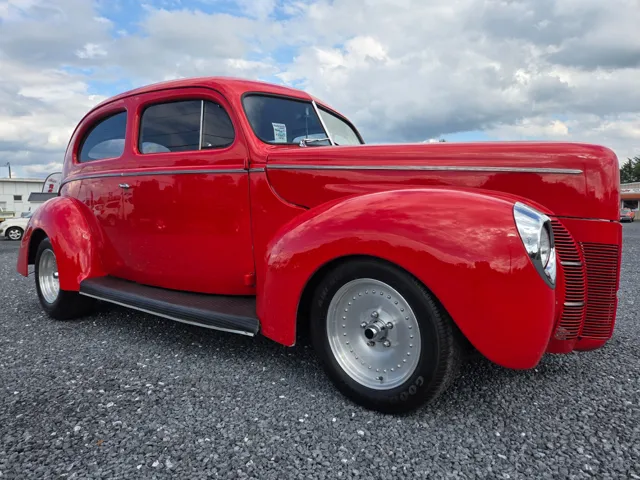
1939–40: the modernised cars. Two changes transform usability. For 1939, Ford finally fitted Lockheed-type hydraulic brakes — single-circuit, drum all round — across the range, and the DeLuxe cars got a handsome new face with headlamps set into the fender tops. For 1940, the gear lever moved to the steering column (Ford's "finger-tip" shift), sealed-beam headlamps became standard, and the Standard line adopted the previous DeLuxe styling while DeLuxe went smoother still. The V8-60 lingered in the 1940 Standard catalogue and then disappeared from American cars. A 1939–40 Tudor is the prewar Ford you can most honestly use: it stops, it shifts from the column, its lights work at night. The pool's red 1940 car, pictured below, shows the other direction these cars travel.
Engines and gearboxes
Three engine families power the Tudors in this guide — the L-head four, the flathead V8 in two sizes, and, in the 1941-on cars, the L-head six — and they have almost nothing in common beyond Ford badges and a preference for being understood rather than feared. Take them in turn, and remember the standing rule for every prewar Ford: the engine in the car is evidence, not identity. Swaps between years were normal service practice, so you identify what is actually fitted, date it by its own features, and price the car on that — never on the seller's year claim alone.
The four-cylinder: Model A and Model B/C (200.5 cu in)
The four is an L-head (side-valve) engine of 200.5 cubic inches — 3.3 litres — with a three-main-bearing crankshaft, splash-and-pump lubrication, thermosyphon cooling on the Model A (no water pump doing real pressure work; the pump assists circulation) and a single updraft Zenith carburettor on the A, replaced by improved downdraft practice on later B installations. Output is 40 hp in Model A tune and 50 hp in the 1932 Model B, which gained a counterweighted crankshaft, better breathing and a higher compression ratio; the further-developed 1933–34 four, with a proper fuel pump and revised details, is often called the Model C by enthusiasts, though Ford never sold it under that name — a useful myth to have corrected before a seller charges you a premium for a "rare Model C engine" that is a service B with updates.
The flathead V8, 221 cu in: the engine this guide is really about
Ford's flathead V8 is a 221-cubic-inch (3.6-litre) L-head V8: the valves sit in the block beside the cylinders, the heads are flat slabs whose only job is to close the bores and carry the plugs and water outlets, and the exhaust ports thread a long, hot path through the water jacket — a layout that defines both the engine's character and its weaknesses. It was rated 65 hp for 1932, 75 hp for 1933, and 85 hp from 1934 through the prewar years, on compression ratios that rose only modestly; the real changes year to year were in cooling, bearings, carburation and detail durability, and those are the changes a buyer should track.
Cooling architecture, and why the year matters. The 1932–36 engines carry their two water pumps high, in the cylinder heads at the front, driven by the fan belt, with thermostats housed in the hose outlets. The 1937-on 221 moved the pumps down into the front of the block, improved the water distribution through the jacket, and is the engine experienced flathead people mean when they say "the good cooling." Both systems run two pumps because the flathead's siamesed layout demands flow to both banks; both are unpressurised or lightly pressurised by modern standards, so the system's health is flow and cleanliness, not pressure. A flathead that overheats almost never needs "a bigger radiator" as its first fix. It needs its actual fault found: pumps with eroded impellers, a radiator silted at the bottom tank, a block full of casting sand and scale (these engines accumulate both, and a proper hot-tank and rodding-out at rebuild is not optional), incorrect ignition timing — a flathead run retarded runs hot, full stop — or a slipping belt. The distinguishing test on a viewing is a proper drive: twenty minutes including a sustained climb or a fast main-road stretch, then watch the gauge and, more tellingly, watch for boil-over in the five minutes after you switch off, when heat soak peaks. An engine that only stays cool while moving has a flow problem at idle, usually pumps or radiator.
Bearings: babbitt, LB, and the rebuild bill. Early 221s run poured babbitt main bearings. During 1936 production Ford introduced the improved block with insert-type (shell) main bearings — the "LB" block of flathead vocabulary — and from 1937 insert bearings are standard practice. This single detail swings a rebuild by thousands: an insert-bearing engine takes shells off a shelf, while a babbitt engine needs a specialist to pour, bore and fit. Learn the external clues (casting and machining details at the front of the block and the oil-pan rail are the usual tells; a knowledgeable marque specialist can confirm from photographs), and always ask a seller of a 1936 car which block it carries — the honest ones know, because it was in their rebuild invoice. Rod bearings on all these engines are full-floating inserts and rarely the issue; the flathead's bottom end, kept in oil and not overheated, is fundamentally strong.
Induction and ignition. One downdraft two-barrel carburettor feeds the whole engine through a log manifold — Detroit Lubricator on early 1932, Stromberg EE-series (the EE-1) on 1933–36, the Stromberg 97 from 1937, and the Ford 94 (built by Holley and Chandler-Groves in period) joining and then succeeding it from 1938. These are simple, rebuildable instruments. Their classic faults are a worn throttle shaft leaking air and spoiling the idle, a sunk or fuel-logged float, and — the one everyone misdiagnoses — a failed accelerator-pump or power-valve diaphragm presenting as a flat spot blamed on "the carb being worn out." The distributor is the flathead's other signature piece: a compact dual-point unit driven from the front of the camshaft, mounted low at the front of the engine under the water pumps on pre-1942 engines, with the coil integral or remote depending on year. It works superbly when its points, condenser and advance mechanism (vacuum brake and centrifugal weights on the various years) are right, and it produces a characteristic fault when they are not: an engine that starts and idles sweetly, then breaks up under load at road speed, is usually telling you about points float, a dying condenser or a stuck advance — a $40–120 parts question, not an engine rebuild. Budget $250–450 for a professional carburettor rebuild and $200–400 for a distributor rebuild with a proper advance curve set, and be suspicious of any flathead whose owner has fitted an electronic conversion to "cure" a misfire nobody diagnosed: the conversion may be fine, but ask what it was curing.
The flathead V8, 239 cu in, and the V8-60
The 239-cubic-inch flathead arrived with Mercury for 1939 — a bored-out 221 architecture, same layout, rated 95 hp in Mercury tune and 100 hp when Ford adopted it for 1946 — and it is the engine you will find under the hood of a great many prewar Tudors, because for forty years it was the standard service replacement and the mild hot-rodder's first step. In a 1930s car it is an entirely pleasant upgrade: more torque everywhere, identical manners, and parts support as good as the 221's. What it is not is the car's original engine, and the value treatment follows from that: a 239 in a 1934 Tudor is a driver-grade plus and an originality-grade minus, and the seller does not get to claim both premiums at once. Identify it by its casting and machining details rather than by eye — externally the two engines are near-identical, which is precisely why the swap was so common — and by the seller's paperwork where it exists.
The V8-60 is the opposite case: the engine sellers apologise for and historians prize. A 136-cubic-inch miniature of the 221, rated 60 hp, built from 1937 for economy cars and European tax brackets, with a lighter block, smaller internals and a following in midget racing that proves its fundamental soundness. In an American Tudor sedan it is, frankly, underpowered — the Tudor is a full-size family body, and 60 hp moves it at a pace that modern traffic tolerates only on quiet roads. Its cooling and bearing specification follows the late 221 pattern in miniature, its carburation is a smaller Stromberg or Ford unit, and its parts are noticeably scarcer than 221 parts, though the specialist trade supports it. The buying rule is sharp: a V8-60 Tudor that still has its V8-60 is a rarity worth preserving and paying a small premium for as a collectible; a V8-60 Tudor whose engine has been replaced by a 221 is a better car to drive and should be priced as an ordinary 221 car, with no apology and no premium either way.
Gearboxes: three speeds, a torque tube, and two eras of shift
Every prewar Tudor in this guide drives through a three-speed manual gearbox — there is no factory automatic in a prewar Ford, and the pool's listings that describe automatic Tudors are describing street rods with modern drivetrains, which is your first and clearest signal of how far a given car has travelled from stock. The Ford three-speed is a sliding-mesh design in its earliest form: on 1932–38 cars, first gear is a crash engagement and second and third are also unsynchronised in the earliest boxes, with Ford adding synchromesh progressively — by the 1939 transmission, second and third are properly synchronised and the box is a genuinely pleasant instrument. Learn to drive the early box before you judge it: an unsynchronised change made at the wrong speed crunches in a healthy gearbox, so a crunch proves nothing until you have matched revs and tried again. The faults that do condemn a box are jumping out of second gear on the overrun (worn dogs and a tired detent, the classic flathead-era Ford wear point, and a gearbox-out rebuild at $800–1,800 in parts and labour through a specialist), a whine in first that is merely character, and a whine in top that is bearing wear and money.
The driveline behind the box is the other era-defining feature: a torque tube. The propeller shaft runs inside a rigid tube bolted to the gearbox at a universal joint and to the rear axle, and the tube — not radius rods alone — locates the axle and takes the drive torque. It is a sound, quiet system whose service points are the single universal joint at the front (grease it; a dry joint announces itself as a shunt and a rumble on the overrun), the centre bearing on longer installations, and the pinion and axle seals whose failure lets oil migrate where it should not be. The rear axle itself is a Ford banjo housing with spiral-bevel gears and semi-floating shafts carried on roller bearings at the hub; its classic Tudor-era fault is a sheared or fretted axle-shaft key and a loose hub taper, felt as a clunk on take-up of drive, cured by correct cleaning, lapping and torquing of the taper — and ruined by owners who keep driving on it until the hub and shaft are scrap. For 1940 the shift linkage moved to the column with rods to the box; worn column linkage gives a vague, graunching change that owners blame on the gearbox and that a $100–250 linkage overhaul usually cures. Postwar shoebox cars (1949-on) changed the architecture — open Hotchkiss driveline, hypoid axle, and from 1951 an optional Fordomatic automatic — and if you are viewing one of those, judge the gearbox by the ordinary rules of its type and ignore the torque-tube material above.
Problem areas
Ninety-year-old cars do not have random problems; they have the problems their design, their materials and their storage history dictate, and on a Tudor those problems fall into a stable map. Work through it system by system. One piece of the site's own evidence before you start, quoted honestly because the sample is small: of the three Tudor Sedans whose photographs were examined in detail for the site's photo notes, rust was recorded on one car and visible damage on one, with no smoke and no leaks recorded on any of the three. Treat that as a reminder that condition spreads from honest patina to hidden trouble even in a tiny pool — not as a statistic about the model. The map below is what ninety years of these cars actually do.
Rust and the body: the map that decides the money
Everything else on a Tudor is mechanical, available and rebuildable. The body is the car, and rust in the body is the expense that decides whether a purchase makes sense. Learn the map in order of structural consequence.
Start underneath, with the frame. The 1932–40 Ford frame is a channel-section ladder with a substantial X-member from 1933 onward, and it is strong — but it traps mud and water at the body mounting points, inside the X-member junctions and along the top flange under the body, and it rusts from those traps outward. Surface scale is cosmetic; perforation at a body mount, a spring hanger or the X-member is structural and is welding, not cosmetics. Take a torch and a screwdriver (with the seller's permission) and probe: the rear crossmember and the frame horns behind the rear axle, the rails under the front doors where road grit blasts them, and the front crossmember that carries the spring and the engine's front mounts. A frame that rings when tapped is sound; a frame that crunches is a negotiation or a walk-away. Budget honestly: localised frame welding by a competent fabricator runs $500–1,500 per area once the body is lifted for access, and a car needing a frame is a project car at a project price, whatever the paint says.
The body's own rust map is just as predictable. Floor pans go first — front footwells under the mats (lift them; a seller who will not let you lift the mats has answered the question), the pan under the rear seat, and the trunk floor on humpback cars, where the bustle that makes the car useful also collects every drop of water that passes the lid seal. Door bottoms rust from the inside out because the drain holes block: open each door, look at the lower skin and the bottom flange, and run a hand along it feeling for filler. The lower rear quarters ahead of the rear wheels, the wheel-arch lips themselves, and the bottoms of the front fenders where they meet the running boards are the grit-blast zones — the 1937 pool car's photographs show the early stage exactly, brown bloom breaking through at the rear arch seam and the trailing edge of the rear fender, which at that stage is a preservation decision (stabilise and monitor) rather than a restoration bill. Cowl sides and the lower windshield frame matter disproportionately on 1932–36 cars, because water entering at the opening windscreen (these cars have opening windscreens; the seal is a consumable) runs down inside the pillars. Roof and drip rails on the 1937-on all-steel tops rust along the rail seam, announced by bubbling above the doors. On Model A Tudors, add the dimension no other Tudor has: the body is a steel skin over a hardwood frame, and the wood — door frames, body pillars, roof rails, the floor structure — rots, splits and loses its screws' grip, so doors sag and gaps wander even where the steel looks sound. Re-wooding is skilled carpentry at $3,000–8,000 for a Tudor body depending on how much is replaced; check by pressing the pillars and door frames for softness and by watching whether the doors close on their latches or have to be lifted into them.
Brakes, steering and suspension: two brake eras, one chassis logic
The single most important mechanical divide in this guide is the brake divide, and it falls between 1938 and 1939. Cars through 1936 stop on mechanical brakes operated by rods; 1936–38 cars use a cable-operated mechanical system (Ford's one unhappy experiment — the cables stretch, the conduits corrode, and adjustment is a compromise); from 1939 the cars have hydraulic brakes, Lockheed-pattern, single-circuit, with drums all round. None of these systems is dangerous when maintained, and all of them are dangerous when neglected, and the neglected state is the default on a car that has sat.
Mechanical brakes work by leverage and adjustment, and their condition is entirely testable at a viewing: the car should pull up straight from 30 mph with firm pedal effort, all four wheels should lock evenly on a loose surface at walking pace, and the cross-shaft and rod ends should show no slop when an assistant works the pedal while you watch underneath. Worn clevis pins, ovalled holes and bent rods are cheap parts and an afternoon's labour; a car that pulls violently has one wheel doing nothing, which is adjustment or a seized expander, not a mystery. Budget $300–700 to go through a mechanical system properly with new linings and hardware. The cable cars deserve their reputation only for adjustment sensitivity — a well-set 1937–38 system stops the car as well as rods do — but check conduit condition, because perished conduits are the difference between a service and a fabrication job.
Hydraulic cars (1939-on) fail in the hydraulic ways: a master cylinder weeping into the booster area (there is no booster; it weeps down the firewall and onto the floor), wheel cylinders seized or leaking onto the linings, steel lines corroded along the frame rail, and — the one that matters most — perished flexible hoses that look fine outside and balloon or block inside, giving a brake that applies and will not release, or a pedal that is fine cold and long after three applications. On a single-circuit system there is no second chance, so the ownership rule is absolute: any hydraulic Tudor you buy gets its hoses, fluid and cylinder seals renewed as a first job unless the seller produces dated receipts, a $400–900 job that is the cheapest insurance in this entire guide. Pedal feel tells you most of it at the viewing: spongy is air or hoses, sinking slowly under sustained pressure is a master cylinder bypassing internally, and rock-hard with poor stopping is glazed or oil-soaked linings.
Steering is a Gemmer worm-and-roller (later cars) or worm-and-sector box, mounted at the frame, driving a drag link to a transverse-spring solid front axle located by radius rods — Ford's famous wishbone. Wear accumulates at the kingpins, the tie-rod and drag-link ends, the spring shackle pins and the steering box itself, and it presents as wander, shimmy at a specific speed, and free play at the wheel rim. Separate the causes on the test drive and on the jack: with the front wheels off the ground, rock each wheel at top and bottom for kingpin and bearing play, at the sides for linkage play, and watch which joint moves when an assistant rocks the steering. Kingpins and bushings are a $350–800 job with the reaming done properly; a worn steering box is an adjustment first (the sector mesh adjusts; most "worn out" boxes are maladjusted and dry) and a $500–1,000 rebuild if adjustment fails. The transverse leaf springs themselves sag and lose leaves to fatigue cracks at the centre bolt; shackles should sit at their working angle, not folded flat, and a car sitting nose-down on a flattened front spring is telling you its ride and geometry are both wrong. Lever-arm Houdaille shock absorbers complete the system: they are rebuildable, they are frequently empty or seized, and a car that crashes over ridges and floats afterwards has dampers that are decoration. Rear suspension repeats the pattern — transverse spring, banjo axle, lever dampers — with the torque-tube centre and axle seals as its specific leaks.
Cooling and electrics: the systems that strand you
More Tudors are stranded by these three systems than by everything else combined, and almost never expensively — they are stranded by small parts nobody renewed.
Cooling faults are covered mechanically in the engines section; the problem-area version is about evidence. Look for the green or rusty tide-mark at water-pump weep holes and hose joints, a radiator whose core shows solder blooms and fin rot between the tanks, hoses that are soft, perished or swollen, and a fan belt polished and cracked. On 1932–36 cars, remember the pumps are in the heads: a pump bearing failing there drips onto the belt and throws water everywhere, and its replacement is a head-off-adjacent job in access terms even though the part is modest. A cooling system pressure test and a combustion-gas test together take ten minutes and settle more than an hour of opinion.
Electrics are six-volt, positive earth, generator-charged, on every stock prewar car here, and the system's reputation for dim lights and lazy cranking is a reputation for neglected cables, not for six volts. A healthy six-volt system with clean, heavy cables and good earths cranks a flathead briskly and lights the road adequately; a system with thin modern replacement cables, corroded earth straps and a sulphated battery does none of those things and gets blamed on its voltage. Test at the viewing: the starter should spin the engine with authority (slow, groaning cranking with a charged battery is cable resistance or a tired starter, both fixable for $150–450), the charge needle or lamp should show the generator working at a fast idle, and every light and the horn should work — not because a bulb matters, but because each dead circuit is a clue to the state of the cloth-braided wiring loom, whose insulation crumbles with age and shorts against the body. A full rewire with a correct reproduction loom is $600–1,200 in parts and a weekend-to-a-week of labour, and many good cars have had it; a car with original 1930s wiring that "has never given trouble" is a car whose fire risk you are underwriting. Twelve-volt conversions on street rods are judged as builds: alternator, modern fuse box and tidy looming are good work; a converted car still running its six-volt starter on twelve volts and its original cloth loom is a shortcut with a date on it. Vacuum windscreen wipers (engine-vacuum driven on most of these cars) slow or stop under acceleration by design — they run off manifold vacuum, which vanishes at full throttle — so test them at idle and do not condemn a motor for behaving as designed; a weak motor at idle, though, is a rebuild or an electric conversion, $100–300 either way.
The street-rod problem: judging a build, not a car
A substantial share of the Tudor population — including, on their photographs, half of the site's small pool — are street rods, and they need their own problem list because the stock list does not apply. The identity questions come first: is the body steel or fibreglass (tap panels, look for mould seams and the absence of spot-weld flanges, check for a magnet's indifference everywhere), and if steel, is it an original Tudor body or a reproduction? None of these answers is disqualifying; all of them change the price by thousands, and a fibreglass body sold as steel is the one outright fraud in this market.
How to inspect one
Inspect in this order and do not let the seller re-order it for you: identity first, because a Tudor is not what its title says until the numbers agree; body second, because the body is the money; mechanicals third, because they are all fixable; and the drive last, because it confirms or refutes everything the static inspection suggested. Bring a torch, a magnet wrapped in cloth, a tyre gauge, a block-test kit if the car is a driver, overalls, and a friend to work pedals and steering while you watch underneath.
- Settle the identity before you admire anything. Find the serial number. On prewar cars it is stamped on the top of the left frame rail near the steering box (you may have to clean ninety years of paint and scale to read it) and, on the V8 cars, repeated on the transmission case. The title should match the frame number — Ford titled these cars by that number, not by a body plate. Note the prefix: it dates the chassis (the 18-series belongs to the first V8 era, and each year's sequence is documented in the marque literature). A car whose frame number is ground off, restamped or simply absent is not automatically stolen, but it is a legal project, not a purchase, until its paperwork is resolved. On a Model A, check the engine number against the frame number under the body — they matched when new and usually no longer do, which is normal and worth noting, not a defect.
- Date the car by its hardware, not its paperwork. Cross-check the year claims against the generation tells from the models section: brake type (rods, cables or hydraulics), pump position on the flathead (heads for 1932–36, block for 1937-on), windscreen (opening or fixed V-screen), gear lever (floor or column, 1940-on). A "1934" with block-mounted pumps and hydraulic brakes is a 1934 body on later running gear or a later car re-bodied — either way you now know more than the advert told you, and you price the car you are looking at.
- Identify the engine that is actually fitted. Flathead or overhead-valve is a two-second check — valve covers mean overhead valves, and no stock prewar Tudor has them, as the pool's 1934 photograph demonstrates. On a flathead, establish 221 versus 239 by the casting and detail features (and the seller's receipts), check for the LB insert-bearing specification on a 1936 car, and on a V8-60 car confirm the little engine is really there — its survival is the car's value. Record casting numbers in your phone photographs; they are your evidence in every later negotiation.
- Do the cold start yourself. Insist the engine is cold when you arrive — a warmed-up flathead hides choke faults, low oil pressure and starting troubles. A healthy car starts on the button with modest choke, settles to an even idle, and shows oil pressure promptly. Blue smoke at start-up that clears is valve guides; smoke that persists under load is rings and bores; either is a compression test and a price conversation, and the test itself (all plugs out, throttle open, readings within a sensible spread) takes twenty minutes and settles arguments. While it warms, listen at the exhaust for the flathead's even, soft beat — a regular miss at idle that vanishes with revs is ignition or a valve, and the distributor section of the engines chapter is your diagnostic map.
- Test the cooling system under load, not at the kerb. Drive at least twenty minutes, including a sustained pull, then switch off and watch for five minutes: boil-over on heat soak is the flow fault the problem areas section describes. Check the coolant for rust and oil, the oil for emulsion, and run the block test for combustion gas if anything smells wrong. A seller who will not allow a proper drive is selling you the car he has, not the car he describes.
- Work the rust map with the magnet and the torch. Floors under the mats, door bottoms, rear quarters, wheel-arch lips, trunk floor on the humpback, cowl and windscreen frame, drip rails — in that order, as set out in the problem areas. Then underneath: frame at the body mounts, X-member junctions, rear crossmember, spring hangers. Probe scale with the screwdriver where the seller permits. Photograph everything you find; the photographs are both your memory and your negotiating instrument.
- Test the brakes by their era's rules. Mechanical car: straight stop from 30 mph, even lock-up at walking pace on gravel, pedal effort consistent, and watch the rods and cross-shaft work while your friend presses the pedal — slop at clevises is visible. Hydraulic car (1939-on): pedal firm and high, no sink under sustained pressure, no pull, and a look at every flexible hose and the master cylinder for weeping. Any hydraulic car without dated brake receipts goes into your budget at the full renewal figure from the problem areas section, without argument.
- Separate the steering and suspension wear. Front wheels off the ground: rock for kingpin play top-and-bottom, linkage play side-to-side, then have your friend rock the steering while you watch each joint in turn. Check spring shackles sit at a working angle, count the leaves against specification, and squeeze the lever dampers' links for slop. On the drive, note wander, shimmy at its specific speed, and whether the car darts over bumps — the rod-builder's bump-steer tell from the problem areas.
- Judge the gearbox and torque tube on the overrun. The classic Ford wear point is jumping out of second gear as you lift off: test it deliberately, twice, on a gentle descent. Crunching on an unsynchronised change at the wrong speed proves nothing — match the revs and retry before condemning the box, exactly as the engines and gearboxes section warns. Listen for a clunk on taking up drive (axle hub taper or a dry universal joint), a rumble on the overrun (the torque-tube joint), and feel for a vague, graunching change on a 1940 column-shift car (linkage first, gearbox second, in that order of cost).
- Run the electrics like a sceptic. Cranking speed from cold with a known-charged battery, charge showing at a fast idle, every lamp, the horn, the wipers at idle (remember vacuum wipers fade under acceleration by design). Look at the loom where it passes the bulkhead and along the frame: crumbling cloth insulation is a rewire in your near future and belongs in the price. On a twelve-volt rod, look for a fuse box, an alternator and tidy looming — and treat their absence as unfinished work.
- Read the interior as a bill. Price what you see in real money — a full correct retrim in materials alone runs into four figures, and pot-metal rechroming is priced by the piece: headliner, seat cloth, door cards, woodgrain, handles and lamp rims, rubber seals. Work every window regulator, the windscreen crank on early cars, every latch. A complete, tired, original interior is worth more than an incomplete shiny one, because the specialists can restore what exists and cannot conjure what is missing.
- Close with the paperwork and the build file. Title against frame number (step 1, now with the documents in hand), registration history, and — decisive on two kinds of car — receipts. On a stock car: engine rebuild invoices naming the specialist, brake renewal dates, the cooling history. On a rod: the build file, component receipts, body material evidence. No file on an expensive car means you are buying the previous owner's word, and you price the word, not the car.
Values
The Values section of a guide like this one deliberately carries no prices — the market block beneath this guide on the site carries the current listings and recorded sales, refreshed as the market moves, and any number printed here would be stale before it was useful. What does not go stale is how to read those numbers, and on Tudors the reading rules matter more than usual, because the name covers several different markets wearing one badge.
First, segment before you compare. A Model A Tudor, a 1934 V8 Tudor, a 1937 humpback and a 1940 street rod are four different markets with four different buyer pools, and an average across them is a fiction. When you use the recorded sales, filter by generation and by the stock-versus-rod divide before you look at a single figure; a price achieved by a documented stock 1939 DeLuxe tells you nothing about a fibreglass-bodied rod, and vice versa. Within a segment, the spread is driven by the same three things in the same order every time: body condition (the rust map, professionally resolved or honestly absent), originality of the major components (frame number, correct-generation engine, correct brakes and transmission for the year), and documentation. Colour, trim jewellery and shiny accessories move a Tudor's price hardly at all; a matching frame number and a named specialist's engine invoice move it a great deal.
Second, understand the asking-versus-achieved gap in this market. Prewar Fords are disproportionately sold by long-term owners and estates, and asking prices are frequently set by memory — of what a neighbour's different car made, or of what the car cost to restore — rather than by the recorded market. Restoration cost is not value, and on Tudors it is usually a multiple of value: a car carrying a five-figure body and paint bill is worth what comparable cars achieve, not what it cost. The recorded-sales block is your corrective: weight achieved prices over asking prices, weight recent over old, and treat any listing that has sat unsold through several price reductions as the market speaking clearly about that specific car. The project-versus-driver gap is correspondingly wide. A Tudor project is worth its body and its numbers, minus the cost of everything the inspection found, minus a further margin for what the inspection could not find — because on a ninety-year-old car there is always something. A driver with needs is worth more than the arithmetic suggests if its needs are the cheap systems (brakes, electrics, fuel) and less if its needs are the dear ones (body, engine, interior), and the sections above exist precisely so you can sort one from the other before you bid.
Parts and ownership
Ownership of a Tudor is supported by one of the deepest parts trades in the old-car world, and the honest summary is: mechanical parts are easy, body panels are good for the popular years, trim is available at a price, and the scarce resource is not parts but skilled labour that knows the cars.
The flathead V8 trade is a small industry. Rebuild parts for the 221 and 239 — pistons, rings, bearings (including, with specialist help, babbitt work for the early blocks), gaskets, water pumps, valves and guides — are in regular production or stock with the established flathead specialists, and a full engine rebuild through a named specialist, with the block properly cleaned, crack-checked and machined, runs in the region of $5,000–9,000 depending on specification and how much of the ancillary work (carburettor, distributor, pumps) is included. Carburettor rebuild kits, distributor parts and even complete reproduction units for the Stromberg 97 and Ford 94 are shelf items. The V8-60 is the exception that proves the rule: supported, but by fewer hands, with some internals requiring patience or good used stock. Four-cylinder Model A/B parts support is, if anything, better than the V8's, courtesy of the Model A hobby's scale. Gearbox, torque-tube and banjo-axle parts — gears, bearings, seals, universal joints, axle shafts and hubs — are available new, reproduction and good-used through the same specialists, and the mechanical-brake hardware for the pre-1939 cars is reproduced down to the clevis pins.
Day to day, ownership is a rhythm rather than a budget crisis: oil changes every few thousand miles and at least annually, a grease gun applied to kingpins, shackles and the torque-tube joint at the short intervals these chassis were designed for, brake and valve checks on a schedule you keep in a notebook, and storage that is dry, with fresh fuel in the tank and the battery tended. Half the faults in the problem areas section are storage faults in disguise. The Tudor that is driven monthly and serviced on its rhythm is the Tudor that does not strand you, and the club scene — the Early Ford V-8 Club and the Model A clubs between them cover every car in this guide — supplies the literature, the classifieds and the accumulated knowledge that make the rhythm easy to keep.
Which one to buy
- The all-rounder: a 1939–40 Tudor, stock or near-stock. Hydraulic brakes, the developed 221 flathead with insert bearings and block-mounted pumps, column shift on the 1940 — the prewar Tudor you can use in modern conditions with the fewest apologies. Buy the best body you can find and let someone else chase the glamour years.
- The glamour buy: a 1933–34 DeLuxe Tudor with its numbers in order. The prettiest Ford of the decade and a permanent market — provided the frame number, the correct-generation engine and the body condition all check out, because at this level you are paying for authenticity as much as for a car.
- The value buy: a 1935–36 Tudor. The same 85 hp flathead and most of the charm for noticeably less than a 1933–34, with the LB-block question on a 1936 car worth asking and worth a premium when the answer is yes. Mechanical brakes are the honest compromise you accept for the price.
- The tourer's buy: a 1937–38 humpback (Touring Sedan). The bustle trunk transforms the car's usefulness on a trip, the steel roof ends the fabric-insert era, and the flatback's prettier profile keeps humpback prices sensible. Check the trunk floor and rear arches twice — the hump collects water as faithfully as it carries luggage.
- The collector's buy: a V8-60 Tudor that still has its V8-60. Slow, rare and irreplaceable once swapped. Buy it to preserve and to show, not to tour in traffic, and pay the premium only with the little engine verified in place.
- The rod buy: a documented steel-bodied street rod, any year. The pool's red 1934 and 1940 cars show the type at its most attractive. Pay for the build file, the steel body and named components; discount hard for fibreglass described vaguely and for any car whose title year and hardware tell different stories.
- The first-Ford buy: a Model A Tudor. The cheapest, friendliest entry into prewar motoring, with the best club and parts support of any car here — bought on body wood and brakes, driven at Model A speeds, and never mistaken for a cheap V8 car.
The overriding rule: buy the body and the numbers, and let the mechanicals be negotiable — a Tudor's engine, brakes and electrics can all be rebuilt with parts off a shelf, but a rusted body and a frame number that does not match the title cannot be fixed at any sensible price, and no shine, story or seller's enthusiasm changes that arithmetic.
See the 3 Tudor Sedan cars currently listed.
For sale now
 $20,984 · 20% below typical
Expand
 $15,000 · 43% below typical
Expand
What they sell for: Tudor Sedan sale prices.